Colorado Supreme Court blocks 2028 redistricting measures in blow to Democrats
Jun 29, 2026 | 2:33 pm ET
Description
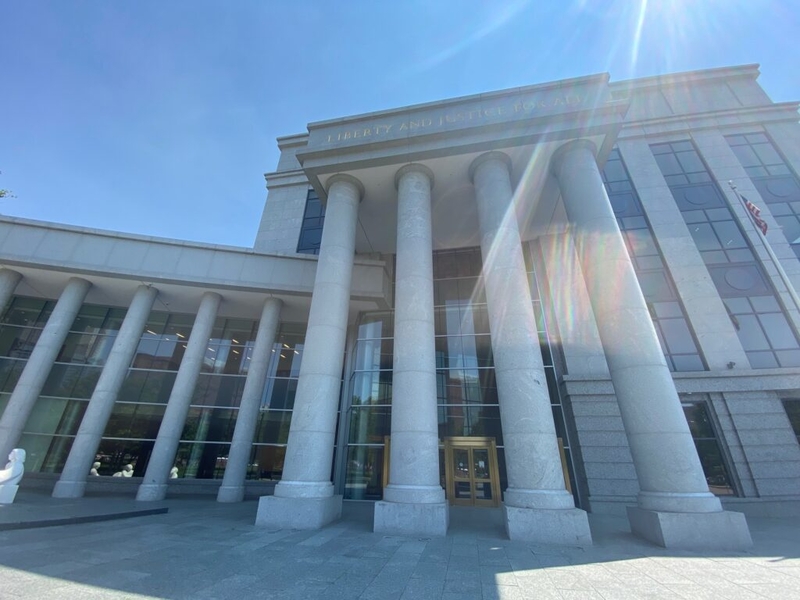
The Colorado Supreme Court building in downtown Denver on July 7, 2021. (Photo by Quentin Young/Colorado Newsline)
The Colorado Supreme Court on Monday ruled that a series of ballot measures aiming to draw new congressional maps for the 2028 and 2030 elections violate the state constitution, a major blow for Democrats aiming to respond to an unprecedented national gerrymandering spree initiated by Republicans last year.
The two unanimous rulings by the state’s seven supreme court justices bring an end to Democratic attempts to draw a new map either through a single constitutional amendment, which would have required a 55% supermajority to pass, or through a pair of statutory measures, which would have both needed a simple majority to take effect.
The new map drawn by the measures’ Democratic backers would have likely given the party a 7-1 advantage in Colorado’s U.S. House seats. The rulings also apply to several Republican counter-proposals that would have asked voters instead to tilt the congressional map in the GOP’s direction.
Coloradans for a Level Playing Field, the group backing the Democratic redistricting measures, said state Supreme Court justices — all of whom were appointed by Democratic governors — had sided with the GOP’s “partisan attempt to sideline Coloradans from responding to Donald Trump’s unprecedented mid-decade redistricting scheme.”
“While Trump and his MAGA allies regularly sidestep the law and ignore voters, efforts to respond have once again been dealt a legal setback over a technicality,” Curtis Hubbard, the group’s spokesperson, said in a press release.
Single-subject violation
Colorado’s current eight-seat congressional map was drawn by its inaugural independent redistricting commission, established by a pair of anti-gerrymandering constitutional amendments passed by voters in 2018. The current congressional delegation is split 4-4 between Democrats and Republicans, with four seats rated as solidly Democratic, three leaning towards Republicans and one toss-up.
Initiative 240, a constitutional amendment backed by Coloradans for a Level Playing Field, would have temporarily sidelined the independent redistricting commission and adopted the Democratic-leaning map for the 2028 and 2030 elections. The court ruled that the measure violates the Colorado constitution’s single-subject requirement, which bars initiatives from appearing on the ballot if they contain multiple subjects.
“The adoption of a specific map for the 2028 and 2030 election cycles is a distinct and separate subject from whether to temporarily allow this manner of mid-decade redistricting generally,” wrote Chief Justice Monica Márquez in her opinion.
But the court separately ruled that Democrats’ effort to split the measure in two — through statutory initiatives 241, to allow mid-decade redistricting, and 242, to adopt a specific map — also violated the single-subject rule, because one measure was contingent on the other.
“When the effective date of one measure is made expressly contingent on the passage of a separate and independent measure, it is neither accurate nor complete to say that the subject of the first measure is the single subject,” wrote Justice Richard Gabriel.
Redistricting wars
Congressional maps are typically drawn once a decade after the decennial census. But Republicans launched a mid-decade gerrymandering war that began last year in Texas, where Trump had pressured the GOP into redistricting to give the party an advantage in the 2026 midterm elections. A month later, California Democrats moved forward with their own redistricting effort in response. Missouri, North Carolina, Ohio and Florida also redrew their maps to favor Republicans.
The 6-3 conservative majority on the U.S. Supreme Court cleared the way for further Republican gerrymandering when it gutted a key provision of the Voting Rights Act of 1965 earlier this year. Several Southern states have since redrawn their maps to eliminate majority Black districts, further increasing Republicans’ advantage.
At the same time, Democratic attempts to respond have faced a series of procedural roadblocks. Democrats’ defeat in Colorado follows a similar ruling in May by the Virginia Supreme Court, which invalidated voters’ approval of a new 2026 map favoring Democrats. An analysis by the New York Times estimates that the GOP’s gerrymandering advantage means the party could lose the national popular vote in House races by up to four percentage points in the 2026 midterms and still retain its current razor-thin majority.
Denver, CO