Virginia education group files ethics complaint against RI Senate president
Jun 24, 2026 | 6:59 pm ET
Description
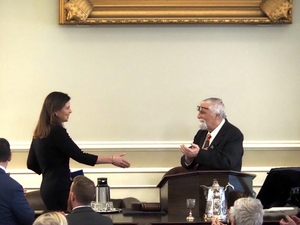
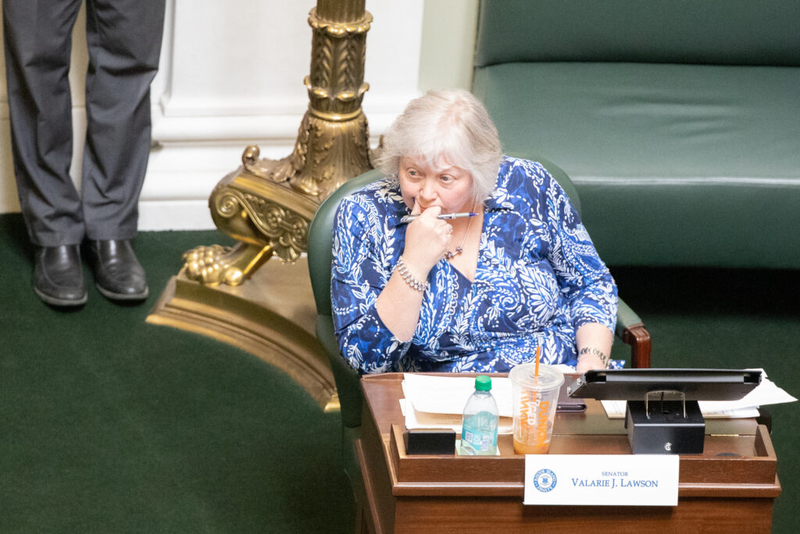
Then Majority Leader Sen. Valarie Lawson, an East Providence Democrat, listens to debate to determine a new Rhode Island Senate President on April 29, 2026. Lawson secured 24 votes against her two competitors that night to become president. (Photo by Alexander Castro/Rhode Island Current)
A Virginia-based organization known for mounting legal challenges to DEI initiatives and LGBTQ-inclusive school policies across the country has filed an ethics complaint against Rhode Island Senate President Valarie Lawson for advancing bills the group claims benefits the education union she leads.
Defending Education submitted a complaint to the Rhode Island Ethics Commission on Monday claiming Lawson, who serves as president of the National Education Association Rhode Island, violated the state’s code of ethics by voting on two pieces of legislation.
One bill, signed into law by Gov. Dan McKee last week, bars approvals of new charter schools in the state for three years. The second, which cleared the Senate but failed to move past a House committee, would have expedited public sector unions by explicitly permitting their formation via a process known as a card check, in which a majority of workers can sign authorization cards to unionize, instead of a traditional election.
Lawson, an East Providence Democrat who has served as the chamber’s president since April 2025, voted for both bills.
“I have a duty to the people of Senate District 14 to cast my vote on their behalf, despite the fact that doing so may draw a politically motivated complaint,” Lawson said in a statement Wednesday.
A spokesperson for NEARI, meanwhile, declined to comment on the matter.
Defending Education’s complaint argues Lawson should never have voted because of her role as the state’s top education union leader.
“The conflict presented here is structural as well as transactional,” the complaint states. “As Senate President, Lawson exercises significant authority over the legislative agenda, including legislation governing public sector labor relations and the charter public school sector. As NEARI president, she leads the organization that directly benefits when public sector labor law is expanded and charter school growth is restricted in the ways these bills contemplate.”
The charter moratorium bill which provoked Defending Education’s complaint also emerged as one of the most contentious debates of the 2026 legislative session. Backed by teachers’ unions, as it had been in years past, the legislation also reduces the statewide cap for public charters from 35 to 28.
Proponents of the bill said it would create more time to study the state’s school funding formula. That effort will be underway at the State House this fall with the convening of a special legislative study commission. Opponents of the moratorium, meanwhile, cited the bill’s derailment of De La Comunidad, a planned dual-language school serving Providence, Pawtucket and Cranston students. It was set to open in 2027, but now cannot because it did not receive final approval before the moratorium bill’s cutoff date.
At the State House on June 10, the House passed the charter moratorium bills, effectively clearing their way to the governor’s desk with only the favorable Senate’s vote needed. Speaking to Rhode Island Current after that night’s vote, Janie Seguí Rodríguez, the founder and CEO of Stop the Wait, a charter advocacy organization, pointed to Lawson’s dual roles.
“The leader of the largest teachers’ union is also the Senate president,” Seguí Rodríguez said. “How is that not a conflict of interest? I understand why it’s not a conflict of interest, per the law. It doesn’t make it right. It doesn’t make it fair to kids.”
Seguí Rodríguez said in an email Wednesday that while she hadn’t had a chance to read through the complaint, or the organization that filed it, she added, “My comment from last week still holds true.”

Balancing two roles
The new complaint relies on an old one, and in its June 22 filing, Defending Education revisits a previously settled matter involving Lawson from 2019. Back then, the Ethics Commission had to determine whether Lawson could ethically have input on bills which would affect collective bargaining agreements for public school teachers.
Commissioners decided Lawson could vote on these bills and ultimately dismissed the complaint, citing two reasons.
First, the legislation “did not result in any appreciable financial impact upon NEARI itself as an entity,” the commission concluded. Second, Lawson — who was at the time vice president of the union — would not benefit any more or less “than any other similarly situated member of the class of Rhode Island public school teachers.”
Lawson was elected president of NEARI in 2023, after more than 30 years teaching in East Providence public schools. The death of former Senate President Dominick Ruggerio in April 2025 led to Lawson’s promotion from majority leader to senate president.
Last June, Lawson sought an advisory opinion requesting guidance about what she could and couldn’t do as Senate president if she also remained president of the National Education Association Rhode Island.
Commissioners ultimately found no conflict, but the opinion from staff attorneys advised Lawson to recuse herself from any policy or funding decisions that could financially benefit her, her family, fellow union members, or school administrators.
“She received an advisory opinion on a very broad question of is the Senate presidency and presidency incompatible,” John Marion, executive director for Common Cause Rhode Island, said in an interview. “But now the question is what does it look like to balance those two roles simultaneously when it comes to very specific legislation.”
Lawson on Wednesday said she has been attentive to the Ethics Commission’s guidance, both past and present.
“As I always do, I consulted with our legal staff and reviewed these bills before determining that it was appropriate to vote on them,” she said.
Defending Education’s complaint revived the possibility of Lawson’s potential ethical problem in light of her new role.
“When NEARI negotiates its legislative agenda with the Rhode Island Senate,” the complaint argues, “Lawson need only negotiate with herself.”
The complaint goes on to say that she and NEARI effectively share the same institutional stance and vested interests, and argues that this makes her votes on the two bills in question problematic.
“She does not merely share interests with her employer — she establishes those interests with one hand, and votes in favor of them with the other,” the complaint argues.
The complaint additionally argues that, unlike the 2019 case, which it says “affected terms and conditions of employment for an existing workforce,” the union check-card bill for which Lawson voted is different in that it is “specifically designed to grow the union membership base itself” — an outcome which could benefit NEARI financially in a different way.
Defending Education is asking for the Ethics Commission to accept the complaint and investigate Lawson’s votes.
‘It is an astroturf’
Headquartered in Arlington, Virginia, Defending Education describes itself in its tax filings as a “national grassroots organization working to reclaim our schools from activists promoting harmful agendas.” Much of its advocacy has been through filing records requests and lawsuits to pressure schools over diversity, equity and inclusion efforts, race-conscious programming and policies benefiting transgender students.
The group’s website lists at least 42 actions it has taken through June 2026, including direct lawsuits, agency complaints, and records requests since it was founded in 2021 under its original name, Parents Defending Education.
The ethics complaint angle, however, is relatively fresh for the group, which has typically filed complaints with the U.S. Office of Civil Rights or jumpstarted litigation against school districts and universities directly over policies relating to race-conscious programs or transgender students. An overview of the group’s actions shows an uptick in activity in 2025, with about two dozen taken that year.
Recent examples include civil rights complaints against Chicago Public Schools’ Black Student Success Plan, an educators of color cohort at Stanford University and Portland Public Schools’ Center for Black Student Excellence.
“They usually get a fairly good hearing with this administration,” Maurice Cunningham, a retired professor at the University of Massachusetts Boston and author of “Dark Money and the Politics of School Privatization,” said in an interview. “I don’t know what they accomplish with this.”
At most, Cunningham guesses the complaint is a way to draw attention to Rhode Island.
“I’ve seen them do things for press attention and then get out,” he said.
Beyond an agency agreeing to open an investigation, one of the larger victories scored by Defending Education was a speech policy case in Ohio. In November 2025, a federal appellate court overturned a lower court’s decision and ruled favorably in the group’s 2023 challenge to the Olentangy School District for its policy that disallowed students from referring to transgender and nonbinary classmates “using the pronouns that match their biological sex.”
The district could not censure “students for the commonplace use of biological pronouns,” wrote Circuit Judge Eric Murphy in the Sixth Circuit’s majority opinion. “Yet nothing we say here forecloses the district from enforcing its anti-harassment policies against the abuse of transgender students just as it enforces those policies against the abuse of all other students.”
Defending Education entered into a consent decree with the district in May.
The group was founded by Nicole Neily, who previously worked at the Cato Institute founded by conservative billionaire and activist Charles Koch. She also served as executive director for the Independent Women’s Forum, a Koch-funded group that mass produced a template letter for activists challenging school mask mandates during the COVID-19 pandemic.
“She’s very much Koch connected,” Cunningham said. “This goes deep — I look at her funders and it’s nothing but right-wing foundations.”
As a 501(c)(3) tax-exempt organization, Defending Education is not required by the IRS to disclose its donors. But a 2021 tax filing from the Donors Trust, a dark money donor associated with the Koch network, shows a $20,250 contribution to Parents Defending Education for general operations. That same tax form noted another $200,000 grant as part of a “project on fair representation” in Texas.
Searle Freedom Trust, another right-leaning donor with ties to Donors Trust, contributed $250,000 that same year.
“It is an astroturf, there’s no question about it,” Cunningham said. “This is a fully-funded, fully staffed outfit.”
The group’s communications director is Erika Sanzi, a former Cumberland School Committee leader and former teacher who has oft criticized teachers unions and education policies both online and in national editorials. Sanzi did not immediately respond to a request for comment.
The full Ethics Commission must now determine whether the complaint against Lawson warrants a formal investigation. Jason Gramitt, executive director for the commission, did not immediately respond to request for comment.
Providence, RI