Scientists identify a soldier who died in the 1780 Battle of Camden, hold out hope of naming others
Jul 02, 2026 | 5:00 pm ET
Description
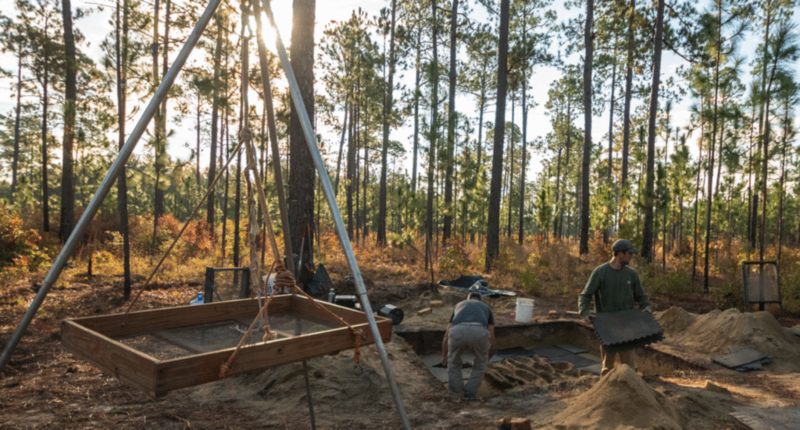
University of South Carolina archaeologists work in the fall of 2022 to recover the remains of 14 unidentified Revolutionary War soldiers who fell at the 1780 Battle of Camden. The identity of one soldier, John Pumphrey of Maryland, was unveiled in June 2026. (Photo courtesy of USC)
CAMDEN — Fourteen unknown soldiers who died in the Battle of Camden are one step closer to being identified 246 years after their deaths.
With one soldier named last month, a team of archaeologists, preservationists, genealogy and DNA experts hold out hope of raising the necessary funds to identify at least one other soldier — even perhaps all of the fallen fighters recovered from the heart of the Revolutionary War battlefield in the Midlands of South Carolina.
They have a lead: One of the other soldiers, known for now as 11A, has a lineage that traces to a man named Robert Fleming, who researchers say helped start a church in colonial York County.
Looking for clues to these soldiers’ heritage and seeking to share their stories amid the 250th anniversary of the country’s founding has filled the team at Texas-based FHD Forensics, one of few in the field, with a great sense of purpose.
“We all felt very honored to be able to do it at this time in our country’s history,” said Allison Peacock, president of the company conducting the genealogy research, who was surprised to learn she’s distantly related to Fleming.
Much work still remains. But for now, the group is celebrating identifying the first soldier: John Pumphrey was between 13 and 15 years old when he joined the 7th Maryland regiment of the Continental Army to fight British troops. He fell at the Battle of Camden on Aug. 16, 1780.
Some 54 people deemed to be Pumphrey’s last remaining “next of kin” gathered June 18 in his home county of Anne Arrundell, Maryland, to celebrate.
“We’re doing this in the 250th anniversary of our country, and I’m telling a story of a boy who was orphaned and then defrauded by his own relatives and left with nothing,” Peacock told the SC Daily Gazette. “As a 13- or 14-year-old, he went to war, marched 1,000 miles, got a $100 reenlistment bonus, and gave his life for the idea of escaping tyranny, even as he was escaping tyranny at home.”
If the group can raise the $50,000 or $60,000 it takes to fund testing and research, they plan to do the same for the unidentified 11A.
How it began
While the effort to honor the soldiers began in earnest nearly four years ago, it’s a project that’s been decades in the making, since preservationists from the Katawba Valley Land Trust in 1996 first tapped a pair of University of South Carolina archaeologists to map out and care for the 300-acre battle site.
Relic hunters had been on the site searching for medals, buttons and other memorabilia since the 1970s, and the land trust wanted the area protected.
By 2000, archaeologists Steven Smith and James Legg realized they had found the core of the battle, which was a decisive defeat for the Continental Army.
About 3,700 Patriot troops faced roughly 2,230 British soldiers and Loyalists — colonists who supported the British.
The dead, buried in a rush, included members of the Maryland and Delaware units, Virginia and North Carolina militias, and a corps known as Armand’s Legion, recruits of French Lt. Col. Charles Armand.
The digs continued on and off over two decades as time and funding allowed, Smith said.
But as time wore on, burials were unearthed and the condition of those unmarked, mass graves became more precarious.
“They were very shallow,” Smith said. “They were in danger.”
Honoring the fallen
The South Carolina Battleground Preservation Trust in 2019 asked the archeologists to recover the remains so the soldiers could be honored properly. Then the COVID-19 pandemic hit, delaying the effort until fall 2022.
The team went in knowing about six burials. Ultimately, they uncovered 14 soldiers.
“We recovered them with the whole goal of honoring them, recognizing them, and reburying them safely and deeply with military honors,” Smith said.
A grant from the Archaeological Research Trust, a nonprofit arm of USC’s SC Institute of Archaeology and Anthropology, where Smith works, paid for the initial DNA gathering.
At least 12 of the men are among the United States’ first veterans. One was Native American, likely fighting on the Loyalist side against the Continentals. The other was a British Highlander of the 71st Regiment of Foot.
Hundreds of people gathered in April 2023 for three days of events honoring the soldiers with a funeral service that included Revolutionary War reenactors, Army musicians, and flyovers by the 79th Fighter Squadron from Shaw Air Force Base.
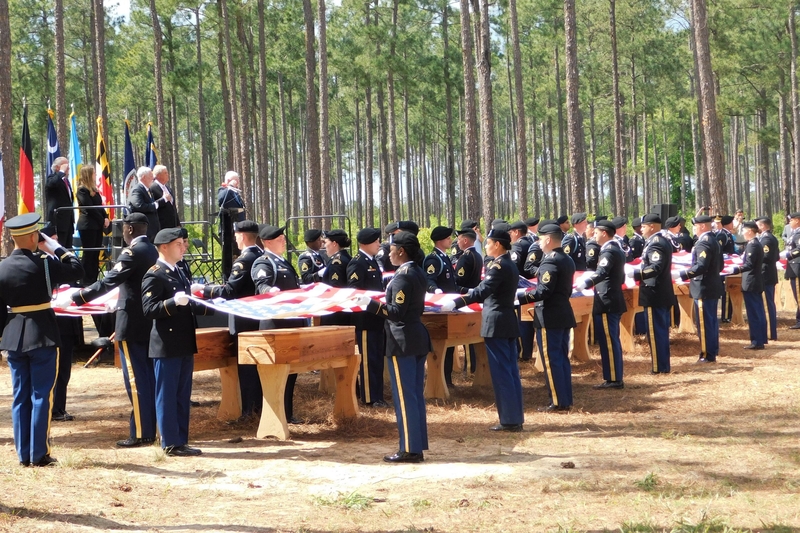
On the first day, a caravan transported the coffins from the Richland County Coroner’s Office, where the DNA lab work was performed, to the Camden Military Academy. Stops were made at the Statehouse and Fort Jackson, and the remains lay in wake at the Kershaw-Cornwallis House until the morning of the funeral.
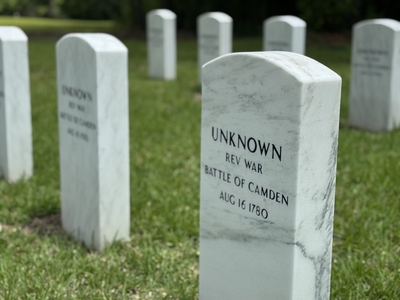
The soldiers were buried at the Old Presbyterian Cemetery, which is next to the Quaker Cemetery in Camden, laid to rest in custom-made pine coffins sealed with hand-forged nails.
It was that care shown by those involved in the ceremony that convinced Peacock and her team to join in.
“Nobody knew whether it could be done,” Peacock said of the identification.
The remains are certainly the oldest her team and expert partners have ever encountered. Before Pumphrey, the oldest they’d tried was from the 1800s.
“They asked us to come out and tour the battlefield,” Peacock said. “Every single person we crossed paths with was doing it with an intense amount of respect, with care and concern for these men … Caring for the dead is just a unique calling and I recognize that in a lot of the people that were in Camden.”
The process: genetic genealogy
The practice of using what’s known as genetic genealogy to identify remains is not even a decade old.
In 2018, it was used in the Golden State Killer case when investigators uploaded the suspect’s crime scene DNA to the open-source genealogy platform GEDmatch to identify the California serial killer. Joseph James DeAngelo pleaded guilty in 2020 to 13 murders dating to the 1970s.
Before that, it was largely used by adoptees looking for biological family, Peacock said.
“So, it exploded on the world stage,” she said. “It’s still catching up in the archeology world.”
The samples undergo whole genome sequencing, producing DNA profiles that can be matched to others who share the same ancestry. After Peacock’s team gets a genetic profile, which can generate some 25,000 genetic matches from two public databases, the real work begins.
Remains of teen soldier who died in Battle of Camden identified 246 years later
“We’re at this unique moment in time, in that millions of us are doing DNA testing because we want to know more about our past, we want to know more about who we are, who our ancestors were, and where they came from,” Peacock said.
For the Revolutionary soldiers, they have to build a paper trail and family trees to make the connections going back 246 plus years, pulling old land grants, tax records and wills for a time period when the U.S. Census did not yet exist.
It’s through this research that Peacock learned she’s actually distantly related to the unidentified soldier 11A. Fleming is her sixth-great-grandfather.
It took five private grants to identify Pumphrey. Peacock said her team has a lead on a grant that could cover a considerable portion of identifying 11A.
“I think everyone hopes that we’ll be able to get through all of them one day,” she said. “It’s just going to be a matter of finding the budget to make that happen.”
Telling the story
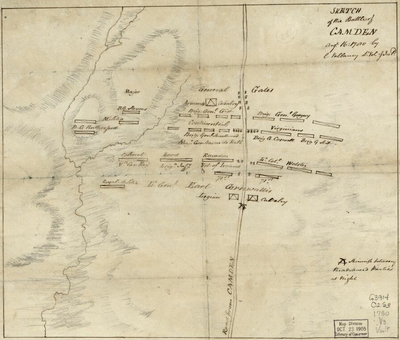
In the meantime, Smith and Legg are working to tell the story of the Battle of Camden, having found more than 3,000 artifacts at the site.
“One individual artifact doesn’t tell you anything about what happened, but that many artifacts plotted on a map can give you valuable information as to how the battle unfolded,” he said. “Where heavy fighting occurred, where the retreat route was, and places it on the battleground makes the battle more real and interpretable to people who go out there.”
Today the property is managed by Historic Camden and boasts the Revolutionary War Visitors Center, which opened in 2021.
And now they have a name: John Pumphrey.
“We always held out the hope that we might be able to identify them somewhere down the line, and after a couple of years, this is an amazing thing that’s happened,” Smith said. “DNA technology gets better all the time, so possibly we’ll get additional profiles.”
Columbia