President Jeremiah Shinn takes helm of University of Montana
Jul 02, 2026 | 5:16 pm ET
Description
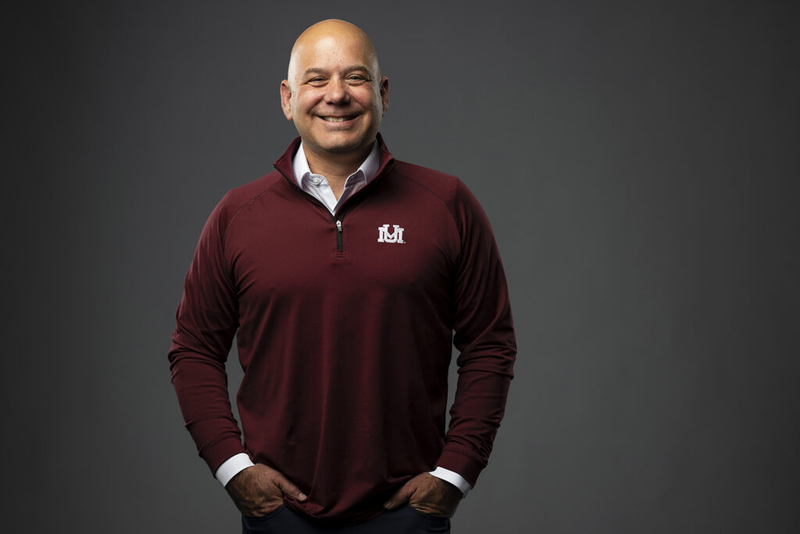
University of Montana President Jeremiah Shinn stands for a portrait on June 29, 2026, in Missoula. (Provided by UM)
Studying at the University of Montana should be easier — that’s one priority Jeremiah Shinn has set for the flagship even before finishing his listening tour.
Easier in the classroom, in the parking lot, in the residence halls.
“We’re never going to stop pursuing that,” Shinn said.
Shinn took the reins at UM on Wednesday after serving as interim president of Boise State University.
His tenure follows former UM President Seth Bodnar’s resignation this year to campaign for a U.S. Senate seat.
In an interview Thursday, Shinn, the 20th president of the Missoula flagship, said he’ll continue UM’s priority to make life on campus easier for students so they can succeed.
He also plans to travel the state, help set benchmarks for enrollment, figure out how to measure quality (in food service, academics and more), and cheer a winning Grizzlies football team.Shinn takes the helm of UM in a politically challenging time for higher education, and he said he is starting his tenure by learning about what it means to be “of Montana and for Montana.”
“I want to learn what Montana needs from us. I want to learn how to support the present and the future of Montana,” Shinn said.
Liberal arts at UM
UM has a deep tradition in the liberal arts and sciences, with Pulitzer winners for writing, Marshall Scholars for leadership potential, and Udall Scholars for public service.
But it has also made budget cuts that have diminished or discontinued some notable programs, such as a decision this year to terminate its master’s in literature.
Shinn said liberal arts are at the core of UM, and they will play a more critical role in the age of artificial intelligence.
For example, he said AI can answer questions, but it doesn’t have discernment, and more people trained in the humanities and liberal arts are needed to discern quality and validity.
“I believe that the liberal arts is in for a renaissance, and I think it can sit right alongside our business offerings and right alongside our life sciences and physical sciences offerings,” Shinn said.“ … I embrace our liberal arts mission and our humanities mission because I believe that now more than ever it’s going to be a really important part of what we do.”
But Shinn said it’s too early for him to talk about how the budget will look for liberal arts — he sat down with UM’s chief financial officer but was still filling out his own onboarding forms one day earlier.
“There are budget questions, there are priorities questions, there are questions about pain points and hopes and dreams, but that’s a conversation we’re going to have to have,” Shinn said.
‘Do right’ by state, taxpayers
In 2010, enrollment hit a high of 13,198 at UM on the main campus, according to data from the Montana University System.
In 2011, it reached a record 15,669, including Missoula College, according to the Montana Kaimin, the campus newspaper.
UM then experienced years of decline, with just 8,651 on the main campus in 2020, but more recently stabilized and saw an uptick, with enrollment at 9,427 in fall of 2025, according to the Montana University System.

Within six months, Shinn said he would like to have an idea of what the right number is for the campus in order to maximize capacity, but not exceed it.
He said a surge in enrollment brings challenges too, such as limited parking, more conduct cases and more trips to the health center.
“We need to know what we’re aiming at,” Shinn said.
He said that conversation is related to UM’s budget, but also to the needs of the state, and the mix of in-state versus out-of-state students.
“I don’t just want to pick a number out of a hat,” Shinn said. “I want to be intentional and thoughtful about how we establish those benchmarks, and then I want to have a plan for getting there.”
He said he wants to be certain UM is making the most of every dollar from the state, the investment from its taxpayers.
“I’m very conscious of being sure that we’re delivering a high-quality product at a reasonable price,” Shinn said.
‘Public means for everybody’
Shinn has a doctorate of philosophy in educational leadership, and he said he studied the way universities operate as organizations.
“Higher education is notoriously slow to change, and I believe the world demands us to change,” Shinn said.
He said that means thinking differently about priorities and funding priorities.
It means universities need to respond differently to the outside world, he said, to “their relevant financial environments, cultural environments, institutional environments.”
“Higher education has, in the past, maybe attempted to wall itself off from external environments,” Shinn said.
But he said UM, especially as a public university, needs to be open to the outside world.
“That’s where we get our legitimacy, that’s where we get our ability to exist, that’s where our students and faculty and staff are coming from,” Shinn said.
External political pressure is high on universities, especially under the administration of U.S. President Donald Trump.
Trump signed an executive order to dismantle the federal Department of Education and return control to state and local governments, and his administration has pushed and touted the elimination of diversity, equity and inclusion measures on campuses.
But Shinn said as a public university, UM will act on its mission, serving people with different experiences, from different places, with different identities.
“Public means for everybody, and we’re going to serve everybody,” Shinn said. “We’re going to serve the people of the state.”
He said the ideology around the DEI conversation became challenging, or the perception some people had that higher education was serving some students more than others.
“Every student that walks onto this campus, I want them to know that this is their home, that we care for them, and that they can be successful here,” Shinn said.
Meeting political leaders, cheering Grizzlies
Montana is a large state, and Shinn is working on a plan to travel, and meet families, legislators, tribal leaders, political leaders and business leaders.
On campus, he’s already meeting people, including running into Grizzlies football Coach Bobby Kennedy, who recently signed a four-year contract with UM.
“He’s a breath of fresh air in college athletics,” Shinn said. “I think he’s phenomenal.”
He said Kennedy, a “world-class football coach,” understands the concept of a student athlete.
“We’re here to win, but we’re here to win with integrity,” Shinn said. “We’re here to prepare young people for life after football or soccer or softball, because the vast majority of them will be professional in something other than sport.”
Shinn himself is a first-generation college graduate, and he said he believes in “the transformational power of higher education.”
He said he wants to lead UM in a way that makes students, faculty, staff, alumni and supporters proud.
“I know that’s a heavy lift, but that’s what I want people to know. I’m here to do that. I’m not here for me, I’m here for the university,” Shinn said.
Helena, MT