Missouri auditor warns deep budget cuts loom as surplus nears end
Jun 10, 2026 | 2:19 pm ET
Description
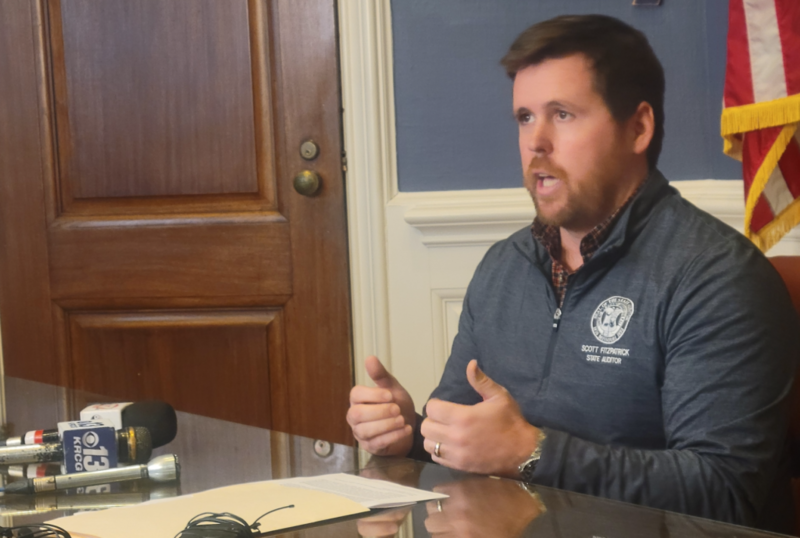
Missouri Auditor Scott Fitzpatrick speaks to reporters about a critical report of the Secretary of State's office on Jan. 23, 2024 (Jason Hancock/Missouri Independent).
Missouri is about to exhaust the surplus lawmakers relied on to balance the state budget, and elected officials are going to have to make deep cuts to align spending with revenue, State Auditor Scott Fitzpatrick said in a report released Wednesday.
The report shows a worsening picture of state finances since Fitzpatrick wrote a similar analysis in December. There will be some surplus remaining at the end of the new fiscal year that starts July 1, but not enough to sustain current spending in the following year.
The budget will, at some point, have to be limited to current tax receipts, the report states, because Missouri cannot borrow money to cover a shortfall. The budget passed this year, the report states, missed a chance for “a responsible, proactive” steps to achieve that balance.
“Instead,” Fitzpatrick writes in the report, “the state is on track to completely run out of money in the (general revenue fund) and be forced to implement emergency budget reductions — limiting options and maximizing pain for every Missourian and entity who relies on state funded services.”
In an interview with The Independent Wednesday morning, Fitzpatrick, a Republican seeking re-election this year, said he issued the report this week because Gov. Mike Kehoe must soon make decisions on spending. Budget bills passed by lawmakers are traditionally signed just a few days before the spending year begins.
Kehoe has access to the numbers he’s reporting, Fitzpatrick said.
“It’s my public encouragement of the governor to start now instead of later,” he said. “It’d be better to start putting the brakes on at (fiscal 2027) so that we don’t keep going 100 miles an hour into the brick wall.”
Dan Haug, director of the state budget office and Kehoe’s top adviser on spending, did not return an email message seeking comment on the new report.
State Rep. Betsy Fogle of Springfield, ranking Democrat on the House Budget Committee , said in an interview with The Independent that she agrees with Fitzpatrick that the state is in financial danger. Fogle is seeking a seat in the state Senate in this year’s election.
“We would disagree on whose fault that is,” Fogle said, “but I have continually, throughout the budget process this year as ranking minority member, cautioned that years to come are going to be exponentially harder, and we’re going to feel the pain in the budget room exponentially more than we have this year.”
The fact that Missouri cannot spend more than it has in revenue and reserves isn’t a comfort, Fogle said. Republicans have controlled both chambers of the General Assembly for more than two decades and the governor’s office since 2017.
The policies set by Republicans created the fiscal issues, she said.
“I disagree that it is good news that one way or the other the budget will work itself out, because those decisions are numbers on a spreadsheet for people in the building, but they are real lives being impacted back home,” Fogle said.
Her biggest issue with Fitzpatrick’s report, Fogle said, is that it portrays the state’s fiscal crunch as a spending issue. The Republican-controlled Legislature has passed a series of major tax cuts, starting with cuts to the top tax rate in 2022 and including an exemption for income from capital gains — profits from the sale of assets — during last year’s session.
The capital gains tax cut, estimated at about $111 million annually when passed, actually cut state tax receipts by more than $500 million.
“You have to have revenue to pay your bills, just like in your household,” Fogle said.
Fitzpatrick’s report from December estimated that the general revenue fund would be $366 million short by June 30, 2028. Lawmakers increased general revenue spending in the budget it passed in May, the report notes, leaving the general revenue fund $627 million short of what would be needed to sustain spending at current levels.
The report assumes that future spending, including amounts set aside for one-time construction projects, will remain at current levels. It bases revenue projections on historic trends for revenue growth.
The $50.7 billion budget awaiting action by Kehoe appropriates $16.65 billion in general revenue for state operations and capital construction needs, with $15.9 billion in new appropriations and $708 million to complete multi-year projects.
It sets aside another $100 million for supplemental appropriations to continue programs at the end of the coming year.
“If we’re off $300 or $400 million here, it doesn’t, in my view, change the story in terms of what the ending balance is,” Fitzpatrick said. “I don’t think it changes the year of reckoning.”
Kehoe is likely to look for cuts in the earmarked spending inserted into the budget. The final budget includes 132 earmarks identified by The Independent, at a cost of $134 million in general revenue and $304 million overall.
Last year, Kehoe vetoed 109 earmarks out of 248 included by lawmakers, reduced the amounts for 23 others and restricted spending on 23 more, money that has not been released.
Lawmakers cut $375 million from general revenue spending requested by Kehoe. At the time the budget was passed, The Independent reported that the cuts helped increase the estimated balance at the end of the coming fiscal year from $265 million to about $600 million.
Fitzpatrick’s report estimates the fund balance at the end of the fiscal year will be $600.2 million.
The difference between the $16.75 billion for appropriations and $13.65 billion in anticipated general revenue in the coming fiscal year will be paid from surpluses accumulated from 2021 to 2023. Those surpluses peaked at nearly $8.1 billion at the end of fiscal 2023, when the treasury held $5.8 billion in the general revenue fund plus $2.3 billion that could be spent like general revenue — money saved mainly from federal COVID aid tied to the Medicaid program.
On May 31, $5.6 billion of that money remained in the treasury. The general revenue fund stood at $2.9 billion, with almost all the remainder sitting in funds dedicated to specific projects including widening Interstate 70, major work on Interstate 44 and renovations to the Missouri Capitol Building.
The depletion of surplus federal funds received as part of federal Medicaid policies during the COVID-19 public health emergency is contributing to the demands on general revenue.
Most Medicaid clients are enrolled in a managed care program. For the coming fiscal year, the $2.9 billion budget line for managed care includes $494 million from general revenue after costing the general revenue fund just $25 million in the current year.
Lawmakers also used general revenue for the first time to pay the state’s share of the cost of Medicaid coverage for working-age adults. Over the four years the program has been set off in its own budget line, the state’s share of the $13.5 billion appropriated by lawmakers came from accumulated federal funds for COVID relief.
In the coming year, out of $5.2 billion appropriated for Medicaid expansion, $395.2 million will come from general revenue.
The demands of programs like Medicaid, which can increase or decrease depending on enrollment, increase budget uncertainty, Fitzpatrick’s report states.
“As difficult as the current budget situation is, it could get even worse as the state faces several other challenges,” the report states.
The $100 million set aside for supplemental needs is likely too low, the report states. The average amount of general revenue in the supplemental budget for the last six years is $371 million, it notes.
And the next budget will have to make room for general revenue to pick up the cost borne in the coming year from one-time sources. The legislature took money set aside in 2022 and 2023 for renovations to the Capitol Building for $147 million and $45 million from the Blind Pension Fund.
Along with publicly lobbying Kehoe to make cuts, the report is intended to help the public understand why reductions are needed, Fitzpatrick said.
“If the governor does decide to take significant action to move us closer to balancing the budget when he takes action on the budget this month,” Fitzpatrick said, “hopefully, this can serve as information for people who aren’t as familiar with the budget to understand why that was necessary.”
Jefferson City, MO