States step into voting rights void left by federal rulings
Jun 10, 2026 | 5:22 pm ET
Description
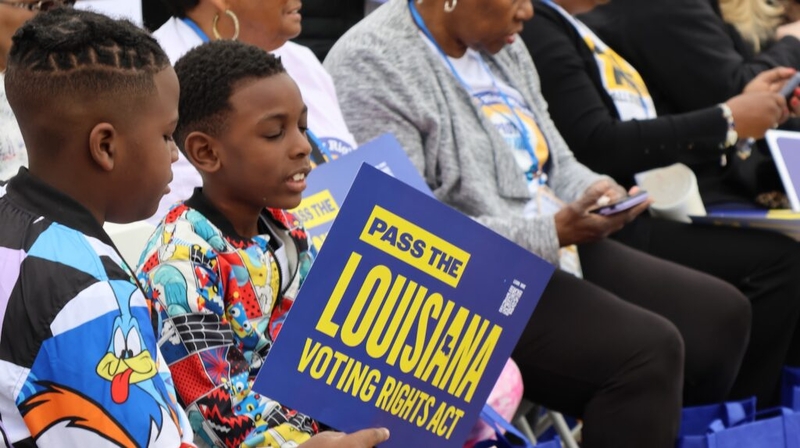
Jericho Morris and Christian Morris Jr. join their mom, Pamela Evans of Shreveport, and hundreds of others in a voting rights rally at the Louisiana State Capitol in Baton Rouge on March 18, 2026. Democratic state lawmakers proposed a Louisiana voting rights law earlier this year aimed at strengthening protections against gerrymandering and voter suppression. It later died in committee. (Photo by Wes Muller/Louisiana Illuminator)
As the U.S. Supreme Court pulls back from the landmark federal law designed to safeguard the voting rights of minorities, more states are stepping in to prohibit discrimination in state and local elections.
State versions of the 1965 Voting Rights Act include some of the federal law’s approaches to fighting discrimination, including prohibitions against voter intimidation and vote dilution — that is, drawing electoral maps that distribute racial minorities across districts in a way that denies them the opportunity to elect their candidates of choice.
The state laws also typically require local jurisdictions to get state approval before changing their election maps and policies. Those so-called preclearance provisions matter because its federal counterpart within the Voting Rights Act was rendered unenforceable by the U.S. Supreme Court in 2013.
Many of the state laws direct courts to consider a variety of ways to solve discriminatory voting policies, and aim to push voters and government officials to work together to head off lawsuits.
Unlike the federal Voting Rights Act, the state laws do not apply to congressional elections.
Ten states currently have their own versions of the federal Voting Rights Act: California, Colorado, Connecticut, Illinois, Maryland, Minnesota, New York, Oregon, Virginia and Washington. California’s is the oldest, enacted in 2002, while Maryland’s is the newest and passed in April.
Already this year, lawmakers in at least nine other states (Alabama, Arizona, Florida, Louisiana, Michigan, New Jersey, Oklahoma, Rhode Island and Vermont) have introduced their own Voting Rights Acts.
“As Washington continues chipping away at fundamental voting protections, it’s up to the states to stand up and ensure our elections remain free, fair and accessible to all eligible voters,” Michigan state Sen. Darrin Camilleri, a Democrat, told reporters at a May press conference announcing the reintroduction of legislation dubbed the Michigan Voting Rights Act.
All of the state voting rights bills introduced this year were sponsored by Democrats, with the exception of Vermont, where two Republicans joined with their Democratic colleagues.
The efforts have taken on added urgency since the U.S. Supreme Court’s May ruling in Louisiana v. Callais all but nullified a provision in the federal Voting Rights Act that required states to draw electoral maps to give racial minority voters the opportunity to elect their chosen candidates.
The court was considering whether Louisiana’s intentional creation of the state’s second majority-minority congressional district was unconstitutional. In his majority opinion, Justice Samuel Alito wrote that by considering race in drawing the district, Louisiana had engaged in the “very race-based discrimination that the Constitution forbids.”
“Because the Voting Rights Act did not require Louisiana to create an additional majority-minority district, no compelling interest justified the State’s use of race in creating (the district) and that map is an unconstitutional racial gerrymander,” Alito wrote.
Supreme Court voting rights ruling set to reshape local power from statehouses to school boards
In the wake of the Callais decision, conservative lawmakers in Alabama, Florida, Louisiana and Tennessee rushed to redraw or alter their congressional election maps to benefit Republicans. Critics say those changes will weaken the electoral power of Black and other minority citizens. The redistricting push came as other states, led by both Democrats and Republicans, have also updated their congressional maps in an effort to shift partisan balances.
The federal Voting Rights Act followed decades of marching, lobbying and protesting by Black Americans to guarantee their right to the ballot box and end state-sponsored voter suppression. In a nod to that legacy, several of this year’s voting rights bills, including those in Florida, Georgia, Mississippi and New Jersey, were named for Civil Rights champions and Black lawmakers.
“Named after one of the first Black state legislators in Georgia, the Henry McNeal Turner Voting Rights Act will provide absolutely crucial protections and expand the rights of Georgia voters so that they have an equal chance to participate without fear of discrimination in free and representative elections,” said Georgia state Sen. Nikki Merritt, who chairs the Georgia Legislative Black Caucus, in a February 2026 statement announcing Georgia’s Voting Rights Act bill. It later died in committee.
The state efforts come as American voters’ confidence in the fairness of state and local elections has dropped to its lowest point in years, according to a poll from PBS News, NPR and Marist, a nonpartisan polling center.
Meanwhile, some lawmakers are concerned that the Callais ruling could weaken their state laws. Maryland’s brand-new voting rights law took effect in April, just one day before the Supreme Court’s Callais decision.
The Maryland law’s lead sponsor, Democratic state Sen. Charles Sydnor III, called the ruling “a gut punch,” Maryland Matters reported in April. But he said he expects the new state law will hold, even if the federal decision limits its enforcement around race-based protections.
“I believe we have a tool that can be used in other ways if people are being discriminated against or harmed,” he said.
Stateline reporter Anna Claire Vollers can be reached at [email protected].