Oklahoma universities failing to support international students after recruiting them here
Jun 08, 2026 | 9:38 am ET
Description
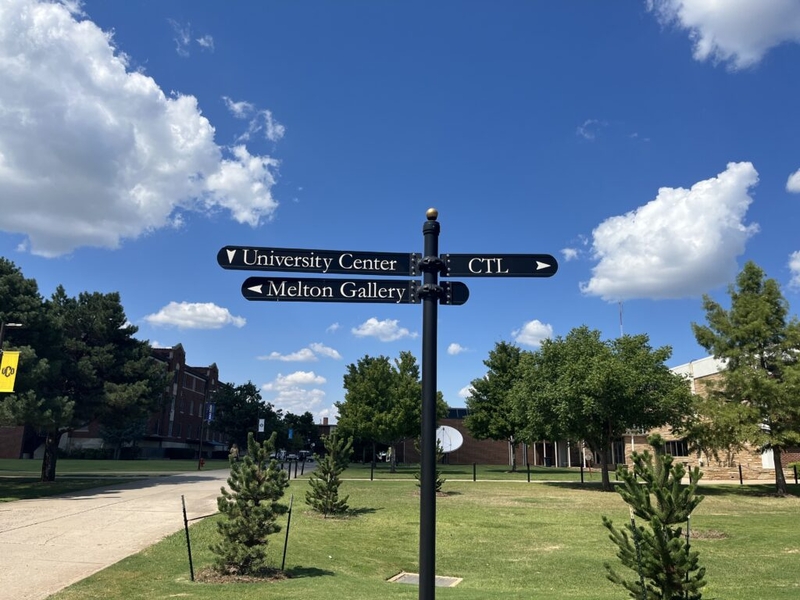
University of Central Oklahoma signs point students toward campus landmarks on Aug. 27, 2024. (Photo by Janelle Stecklein/Oklahoma Voice)
OKLAHOMA CITY — International students attending some of Oklahoma’s largest universities are struggling to thrive as employment laws coupled with a scarcity of on-campus job opportunities have hamstrung their earning potential.
In exchange for attending an Oklahoma university, the students said they expected their schools to provide them access to on-campus employment and 20 hours of work each week to help them foot the bill.
Multiple international students, working a variety of on-campus jobs, told Oklahoma Voice that their universities have not been able to provide them reliable employment opportunities since arriving to attend college in the state.
They’re among the students that Oklahoma colleges and universities have made a concentrated effort to recruit in recent years in an effort to tackle workforce shortages and bolster revenue by charging out-of-state tuition rates.
“For the previous two semesters, I went into a deep crisis that affected me and my grades,” said Eunice Gyamfi, a sophomore nursing student from Africa. “If you don’t pay for your fees, you do not get to be a student at the school anymore, and everything comes to an end. The fears give me a tough time, and it’s hard for me to excel in my classes and focus on my studies with these thoughts in my mind.”
Gyamfi is among an estimated 9,665 international students attending college in Oklahoma on a student visa. In all, these students contribute about $224.7 million to the state’s economy and support about 1,450 jobs, according to an analysis by the Higher Ed Immigration Portal.
Most international students attend Oklahoma college on a F-1 visa, which has stringent work limitations. First-year students are prohibited from being employed off campus, but can work up to 20 hours a week during the school year in an on-campus job.
After the first year, students can work off-campus, but only if they’re receiving practical training related to their degree, according to U.S. Citizenship and Immigration Services.
Federal law also requires that international students’ employment “not displace a U.S. citizen.”
Gyamfi said international students are told that their families need to be able to provide for their fees, but that is completely different from being able to pay for basic expenses such as rent and groceries.
She said it was very hard to find employment at the University of Central Oklahoma. She applied to “countless jobs” that told her she was not qualified before obtaining her current position, which pays slightly over minimum wage. She ensures clubs receive their disbursements, gives out scantrons for students to take exams and runs errands for her supervisors.
“I don’t work the full 20 hours a week because other people need the hours too, and with being paid $7.75 an hour, it is not enough to support myself,” she said. “Even with the job I have now, I had to wait an entire semester to work there because it was full. In a nutshell, it was not easy.”
Nalini Nerusu, a graduate computer science major from India, works with International Students and Scholars at Oklahoma State University. She helps handle international student queries, manage social media accounts and generate reports.
“Financial stress affects me because managing the expenses and bills has been stressful, and it affects my academics,” she said.
Nerusu said, “It would be better if international students were paid more because we are not allowed to work off-campus jobs.”
OSU and UCO officials did not return multiple requests for comment.
The labor laws restricting international students’ employment opportunities makes it hard for them to be able to argue for a raise or advocate for more hours.
“If a group of international students decided the terms and conditions of their employment on campus is wrong, such as the way they’re treated, the pay, or the discipline, they could get together to advocate it, that is protected under the National Labor Relations Act regardless of whether they are international students or U.S. citizens,” said Chris Vaught, director and attorney in the Tulsa office of the firm Crowe and Dunlevy. He mainly focuses on labor and employment issues.
He said the visa restrictions are “designed to ensure that the student prioritizes their studies.”
“It doesn’t apply to U.S. citizens, but it applies to international students, which could raise an argument that it discriminates against international students,” Vaught said.
He said even if universities are telling international students that their families must be able to provide for them while they are studying abroad and should be able to afford it, that is not always the case.
Shivani Patel, a senior computer science major from India, started working as front desk receptionist at University of Central Oklahoma’s Global Affairs office. After a year, Patel was promoted to handle commissions and establish contracts with companies and universities abroad that can bring international students to the university and send American students overseas.
“Sometimes my financial stress affects my academic performance,” Patel said, “When my scholarships from UCO are delayed, it makes me overthink whether it will be enough based on my credits, and that is a major way of how I pay for school because my on-campus job can’t fully pay for school.”
Gyamfi, the international nursing student, said even though her family does support her, it is not easy for them to pay her fees, tuition and rent. Those costs are not always reliable due to fluctuations in exchange rates.
“The dollar is very high,” she said, “One dollar in my country is about $10 here, so just imagine bringing money for college from my country to the United States; it’s a lot, and it’s not easy. Scholarships can help, but they can be hard to get and, at times, unreliable.”

Oklahoma City, OK