How environmental advocates stopped a late-session push to let RI Energy own power plants
Jun 08, 2026 | 4:28 pm ET
Description
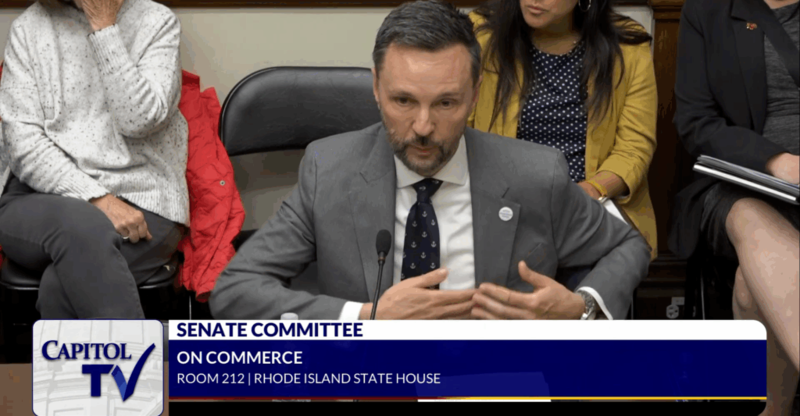
Greg Cornett, president of Rhode Island Energy, testifies in support of a bill to let energy distribution companies own generation facilities during a Senate Committee on Commerce hearing on April 28, 2026. (Screenshot/Capitol TV)
No one testified in opposition when a proposal that would let Rhode Island Energy own power plants went before lawmakers during concurrent chamber vettings on April 28.
It seemed unlikely that the sweeping reversal of a three-decade-old law separating utility ownership from power generation would advance, said Emily Koo, Rhode Island program director and senior policy advocate for the Acadia Center.
Which is why she and other environmental advocates with Green Energy Consumers Alliance and Conservation Law Foundation scrambled to react after the Senate bill was resuscitated and narrowly advanced out of committee on June 2, with a floor vote first scheduled for June 4, then postponed till June 9.
After a weekend blitz of letters and emails to lawmakers, Koo was still nervous. Was it enough to persuade legislators to reject the measure until questions about the impact on market competition and ratepayer protections were answered?
“It’s hard not to interpret this as another way for Rhode Island Energy to build more capital and return more money to shareholders at the expense of ratepayers,” she said. “They’re taking advantage of the moment.”
Hours later, the contested legislation met its end. Senate Majority Whip and bill sponsor David Tikoian confirmed to Rhode Island Current in a midday interview that he intended to pull the bill from Tuesday’s Senate floor calendar due to advocates’ concerns.
Instead, Tikoian, a Smithfield Democrat, said he will ask the bill to be recommitted to the Senate Committee on Corporations where he expects it will remain when the legislative session concludes.
“I don’t see it happening this session,” Tikoian said in an interview Monday. “We’ll try again in January.”
Michael Jude Dalo, a spokesperson for Rhode Island Energy, did not directly respond to questions regarding Tikoian’s decision to pull the bill on Monday.
“We will continue to monitor the situation,” Jude said in an email.
News of Tikoian’s decision was met with celebratory laughter from Darrèll Brown, Rhode Island vice president for Conservation Law Foundation.
“That’s excellent,” Brown said when informed by Rhode Island Current about Tikoian’s decision.
Turning back the clock
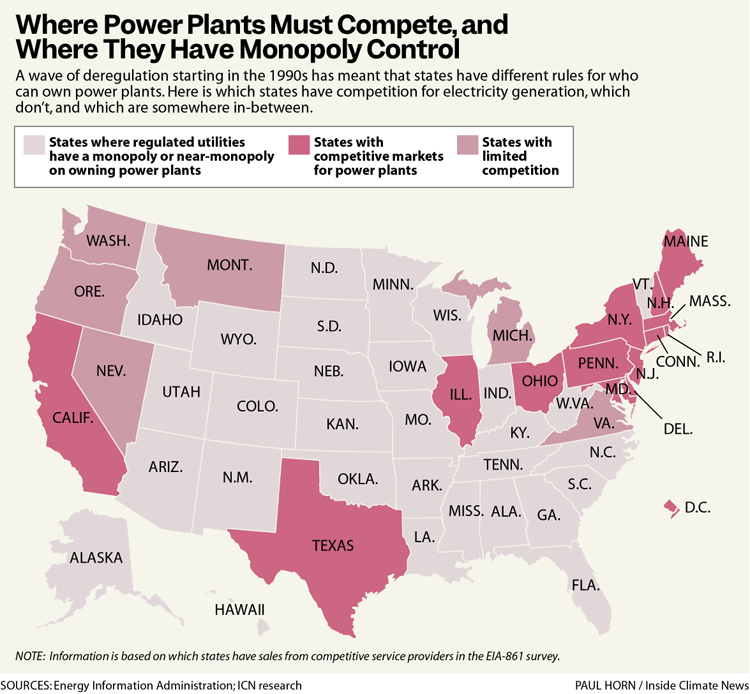
Since 1996, Rhode Island has prevented the companies that distribute power to ratepayers from also owning the facilities that produce the power. The Utility Restructuring Act, which mirrored policies adopted by a dozen states as part of a nationwide deregulation sentiment, aimed to prevent utility monopolies in favor of free market competition that also controls costs to ratepayers.
In February, companion bills introduced by Tikoian and Rep. Patricia Serpa, a West Warwick Democrat, sought to reverse the separation provision by letting electric distribution companies also own electric generation facilities like power plants, battery storage facilities and renewable energy projects.
The only testimony the Senate Committee on Corporations heard at the April 28 hearing came from Greg Cornett, president of Rhode Island Energy, who was in favor of the bill.
“I’m often asked where we can work together to begin moving the ball on delivering reliability, affordability and sustainability,” Cornett told lawmakers. “This is one of those opportunities.”
Letting the utility provider also build and operate power-generating facilities, mirroring policies adopted in 36 other states, would help address the growing demand for electricity generation while shielding consumers from the volatile and expensive cost for power, Cornett said.
There would be no monopoly, he assured lawmakers, instead framing the legislation as the gateway to a hybrid model in which third-party suppliers could still sell power to Rhode Island, with their offerings supplemented by Rhode Island Energy’s own production. All of it would be under strict regulation by the Public Utilities Commission (PUC), Cornett said.
Neither the three-member appointed utility panel, nor its administrative arm, the Division of Public Utilities and Carriers (DPUC), weighed in on the legislation during the April 28 hearings.
Process in question
Opposition from environmental groups centers as much on the speed by which the legislation advanced as well as the policy itself.
“It’s unfortunate that this process occurred at the eleventh hour,” Brown said. “This is bad public policymaking and members of the General Assembly shouldn’t be put in that position.”
Koo also worried that key questions remained unanswered, including the input from state utility regulators who would be charged with reviewing utility-owned project construction and putting limits on how the cost of those projects could be billed back to ratepayers.
“They’re being asked to have tremendous new oversight responsibilities without any additional funding or staff capacity to do so,” Koo said.
The PUC declined to comment on the legislation Monday. The DPUC acknowledged but did not immediately return inquiries for comment Monday.
It’s unfortunate that this process occurred at the eleventh hour. This is bad public policymaking and members of the General Assembly shouldn't be put in that position.
Tikoian rebuffed suggestions that the process lacked transparency, noting the legislation went through standard vetting, with opportunity for public input, six weeks earlier.
“There was no opposition,” he said of the April 28 hearing.
Letting the company that owns the electric poles and wires also generate the power that flows through them would save people money, Tikoian reasoned — much like how local mulch and masonry shops he frequents in his Smithfield boast better prices than big-box competitors that outsource their products.
Cornett also noted in his testimony that the seven states with the highest retail electricity prices as of 2024 — excepting Hawaii — all prevent or severely limit utility ownership of energy generation facilities. Rhode Island had the fifth highest retail electricity rate, behind Hawaii, California, Massachusetts and Connecticut.
But letting Rhode Island Energy produce its own power to flow into the electric grid might not lower costs for ratepayers, environmental advocates warned. Much like the capital expenses on infrastructure maintenance and improvement, the company would use the rates charged to customers to help recoup costs on building and operating energy generation facilities.
Cornett said the opportunity could support state decarbonization goals by building battery storage facilities to store the growing array of wind and solar projects across the state. He declined to commit not to build fossil fuel facilities when put on the spot by Sen. Sam Bell, a Providence Democrat, during the committee hearing.
“Can you ensure you wouldn’t do this to build more fossil fuel capacity,” Bell asked.
“It might involve renewables, it might involve natural gas production,” Cornett replied. “Do I have a project in mind? No. If we were to get this authority, we would start immediately evaluating battery storage options.”
Bell, along with Democratic Sens. Meghan Kallman of Pawtucket, Ryan Pearson of Cumberland, and Tiara Mack of Providence, and Republican Elaine Morgan of Hopkinton, voted against advancing the bill out of committee on June 2.
“There are, to my mind, very valid concerns raised about creating even more of a monopoly in an era where Rhode Island Energy’s accountability to the public has been somewhat challenging to keep our arms around,” Kallman said in an interview Monday,
Rewriting the state’s laws on energy supply and distribution could create a chilling effect for the private sector if it thinks it has no chance at selling power to Rhode Island, Koo warned.
“There’s a big risk of self-referential treatment,” she explained. “If Rhode Island Energy, which purchases the supply, also owns the supply, they have the ability to benefit themselves over any other kind of electricity generator.”
She continued, “it’s hard not to interpret this as another way for them to make money to return to shareholders.”
A half dozen other states have grappled with similar proposals in recent years, including New Hampshire, where this year a bill letting utility distributors also invest in natural gas and nuclear energy production advanced to Gov. Kelly Ayotte’s desk after passing both chambers. Ayotte, a Republican, has not commented on whether she intends to sign the bill, which caps the amount of natural gas or nuclear energy a distribution company can own at no more than 10% of its peak load. It also restricts ownership to smaller projects — no more than 5 megawatts — which in practice excludes any nuclear plants.
Vermont is the only other state in New England that lets utility distributors also participate in energy production.
Larry Berman, a spokesperson for House Speaker Christopher Blazejewski, confirmed in an email Monday that the chamber does not intend to pass the legislation this year. The companion bill by Serpa remains in the House Committee on Corporations following its April 28 hearing.
New Hampshire Bulletin reporter Molly Rains contributed to this story.
Providence, RI