A Q&A with Jon Echols, a Republican candidate for Oklahoma AG
Jun 08, 2026 | 6:30 am ET
Description
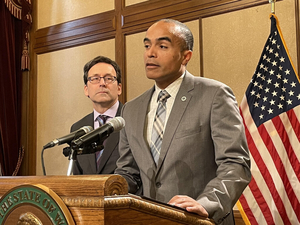
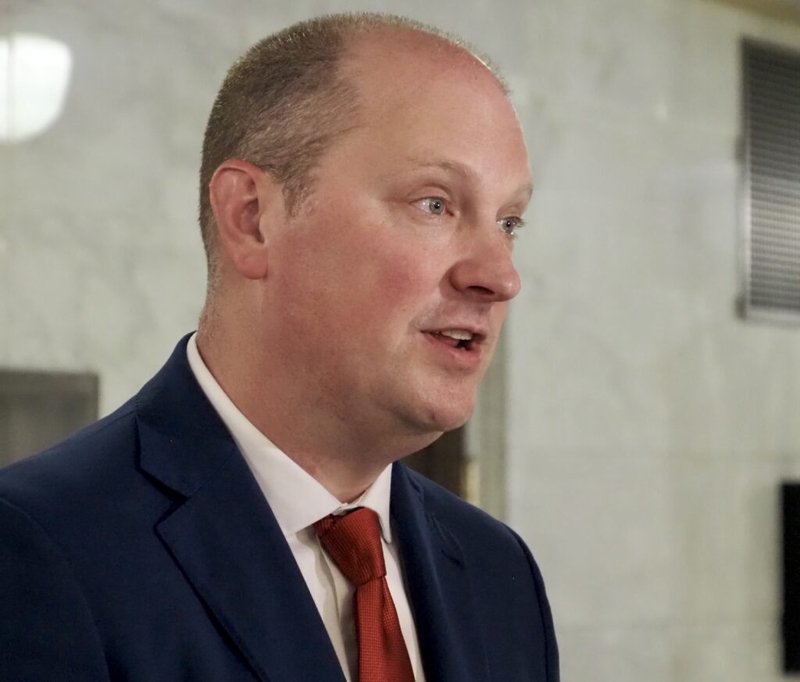
Jon Echols speaks to news reporters after filing to run as a Republican candidate for attorney general on April 1, 2026, at the state Capitol in Oklahoma City. (Photo by Nuria Martinez-Keel/Oklahoma Voice)
Editor’s note: This is one of two stories on Republican primary candidates for Oklahoma Attorney General being published by Oklahoma Voice in partnership with KOSU.
OKLAHOMA CITY — Jon Echols is running for attorney general because he wants to continue his public service career that includes 12 years in the state Legislature.
Echols, 46, said he’s a fifth generation Oklahoman who lives and practices law in Oklahoma City. He said his time practicing law includes civil litigation, regulatory compliance and consumer protection. Echols said he’s owned healthcare and construction companies in addition to serving in the Legislature.
“Their (the attorney general’s) job is to make sure state agencies are following the law, that their allegiance is to the law, is to the taxpayers of the state of Oklahoma,” Echols said. “And it’s to hold their client, in those cases, the State of Oklahoma, accountable and to educate them. … The AG also plays a role in defending the State of Oklahoma whenever it’s sued, and that’s where it’s important we have somebody that understands Oklahoma courtrooms and understands what it’s like to try cases and actually put juries in the box and appear before judges in the state of Oklahoma.”
Echols faces Jeff Starling during the June 16 primary to secure the Republican nomination for attorney general. The winner will face Democrat Nick Coffey on the Nov. 3 general election ballot.
Oklahoma Voice and KOSU sat down with Echols to ask him about his positions on several key legal issues that are expected to face the next Oklahoma attorney general. Answers from the candidate have been paraphrased and shortened for space and clarity.
Q & A with Echols
Q: What kind of relationship would you like to see the Attorney General’s Office have with the next governor?
A: Whoever the next governor is, I think I can have a strong working relationship with them if they come from the perspective of, “How are we going to do what’s best for all Oklahomans?” And if there is a disagreement, the promise I can make is they’re going to hear from me first. They’re not going to hear it on social media. And we’re going to try to work that out. But it is a separate office, and I would hold the governor accountable if they were breaking the law just like I would hold anyone else accountable.
Q: What do you think the attorney general’s role in regulating and enforcing the marijuana industry and illegal grows should be?
A: The reality is, we don’t need new laws. We need enforcement. … What we’re going to be doing is we’re going to be dividing up the state into five different quadrants. We are going to have inter-operational agreements between our local law enforcement. Do we want the Feds help? Absolutely, come on in, it’s an open door. But we’re not waiting because we don’t need to wait. We have the right laws right now.
Q: Where do you stand on the issue of religious charter schools, like St. Isidore, receiving public dollars?
A: I actually entered in an amicus brief with the American Center for Law and Justice on behalf of St. Isidore, and I would have supported St. Isidore as attorney general. In theory, yes I’d support other religious charter schools. Now I have to look to ensure the requirements were non-proselytizing and complying with all other state law.
Q: What do you think of how the poultry pollution lawsuit settlements were handled and what would you do differently?
A: I’ve met the producers, and it’s not about Tyson’s and Simmons, that’s not my concern. My concern is the Oklahoma farmers. … It is such a short step between what is going on to those poultry producers and then someone suing cattle operators, and then someone suing our pork producers. That lawsuit has to be settled, and has to be settled in a way where we continue to have poultry operations inside the state of Oklahoma.
Q: Where do you stand on issues of tribal sovereignty stemming from the U.S. Supreme Court McGirt decision, such as income taxation, criminal jurisdiction, cart tags, etc.?
A: We need more tribal compacts, less lawsuits. … The outgrowth of McGirt has been an absolute disaster. … Our tribes and our state government could not be more at odds. I mean, they could not be fighting harder. We have to find a way to work with our tribal governments and to bring people back together. … Citizens are tired of it. When we continue to just handle our tribal relations by lawsuit after lawsuit after lawsuit, we are federalizing Oklahoma law. And we are giving Oklahoma law to nine Supreme Court justices that probably can’t find Oklahoma on a map and surely haven’t been here and have any interest in how we and how we do things here. Oklahomans can take care of Oklahomans.
Q: Oklahoma has been criticized for its use of the death penalty, lengthy stays on death row and botched executions. Do you support the use of the death penalty?
A: I’m a strong supporter of the death penalty, hard stop. I think it needs to be only used in most heinous cases, of course, and it has to be proven beyond all reasonable doubt, as it would with any other criminal case. I think we do need to do something about these ridiculously long waits that cost taxpayer dollars.
Q: If elected as attorney general, would education and enforcement of the state’s open records and meetings laws be a priority?
A: I am a stalwart for open and transparent government, and I’m very excited as the next attorney general that we’re going to be the person that can enforce that. I’m going to start indicting people who don’t comply. … Oftentimes with Open Meetings Act violations that I saw, there needed to be more education, there needed to be a better understanding that, ‘Don’t do it again.’ I’ve looked at Open Records Act violations that are absolutely egregious. We are going to start holding people accountable.
Oklahoma City, OK