Candidate Q&A: Colorado secretary of state
Jun 08, 2026 | 6:02 am ET
Description
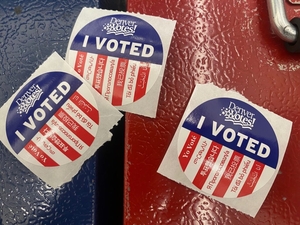
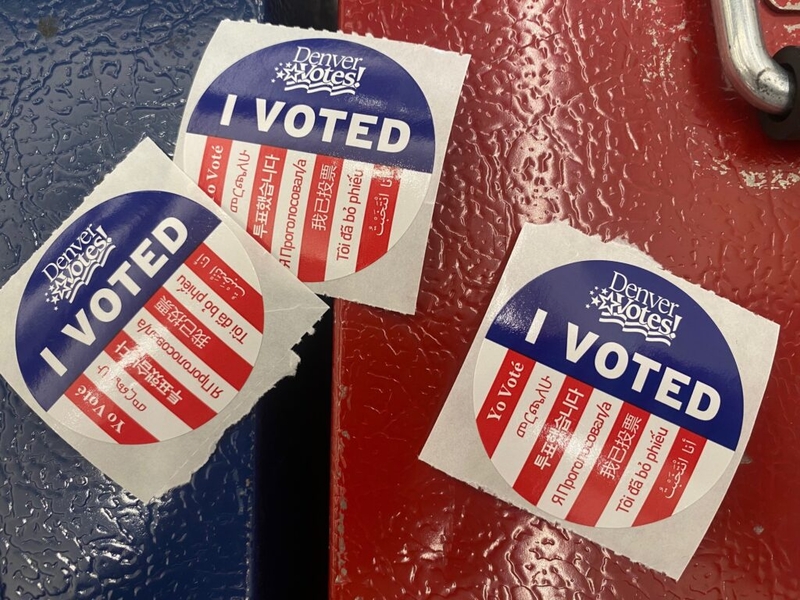
Se ven etiquetas de “I voted” (“yo voté”) en el centro electoral de la biblioteca Blair-Caldwell
African American Research Library en Denver el 25 de enero, 2024. (Quentin Young/Colorado
Newsline)
Coloradans will vote in primary elections June 30 to determine which candidates will represent their party in the general election in November.
The elections cover Colorado’s four statewide constitutional offices, one U.S. Senate seat, all eight of the state’s congressional districts, state legislative districts and other races. Colorado Newsline sent questionnaires to candidates in contested primary races and is publishing responses as part of its voter guide to help Coloradans make informed choices.
Colorado’s secretary of state position is open. Jena Griswold, the current secretary of state, is term-limited and running to be the Democratic nominee for attorney general. Democrats and Libertarians have secretary of state primary elections. Republican James Wiley is running unopposed.
The office of secretary of state, which oversees elections, has become an increasing object of attention as the Trump administration and “election integrity” activists have brought intense scrutiny to it, including through legal challenges.
Ballots were scheduled to be mailed to all registered voters in Colorado starting June 8.
Voters can contact their county clerk if they have not received their ballot or check the online BallotTrax system. They can also visit the secretary of state’s website to make a plan to vote in person ahead of or on Election Day. Ballots need to be received by the county clerk by 7 p.m. on that day, so voters should mail their ballot at least eight days ahead of time or drop it off in person.
Colorado secretary of state, Democrats


Why are you running to be secretary of state, and why are you the best candidate?
GONZALEZ: I’m running for Colorado secretary of state because our democracy is under attack, and Colorado needs a proven leader ready to defend it. I’ve spent my career doing this work: writing and strengthening Colorado’s election laws, expanding access to the ballot, running secure elections, and fighting attempts to restrict the freedom to vote. As Jefferson County clerk and recorder, I oversee elections for nearly half a million voters — more than the entire state of Wyoming. I lead a $20 million organization with about 115 staff and up to 1,000 election workers each year. We have delivered some of the highest turnout in our county’s history while keeping elections secure, transparent, and accessible. Before becoming clerk, I served as executive director of Colorado Common Cause and CLLARO, where I helped write and pass many of the election laws that made Colorado a national leader, including automatic voter registration and multilingual ballot access. I’m also an election attorney who knows how to protect voters and defend our systems from political interference. Colorado cannot afford on-the-job training for this role. The secretary of state is Colorado’s Democracy Defender in Chief, and I’m ready to fight for every Coloradan’s freedom to vote.
DANIELSON: I’m running for secretary of state because I helped build the election system Coloradans trust, and I’m the most prepared to protect it. Coloradans deserve someone with a proven record of standing up to power to defend our democracy. I’m the only candidate in this race with a track record on the issues voters care about. In 2013, I helped develop the Voter Modernization Act, which created universal mail-in ballots, same-day registration, and vote centers. In the state Senate, I passed Automatic Voter Registration and expanded ballot access for voters with disabilities. My opponent administers elections in one county, I helped build the systems that govern them in all 64. The secretary of state’s office is our first line of defense against Donald Trump’s ongoing attacks on our elections. Protecting it requires experience, integrity, and strong relationships across Colorado. I’ve spent my career doing this work, and I’ll be able to hit the ground running on day one.
How will you be a strong defender of election security without appearing to politicize the role of secretary of state?
GONZALEZ: The integrity of our elections is not a partisan issue. I know because I run them. Every year, I hire hundreds of Democrats, Republicans, and unaffiliated Coloradans who work side by side to make sure every eligible voter can cast a ballot and have it counted accurately. They take that responsibility seriously — and they take real pride in keeping our elections secure. A strong secretary of state does what is right for voters, regardless of party politics. I have taken criticism from both sides for decisions I’ve made to strengthen our election system and expand access, but I will never regret taking political risks that helped thousands more Coloradans participate in our democracy. Trust starts with transparency. That is why I have opened our election center to thousands of Coloradans so they can see firsthand how we test equipment, verify voters, secure ballots, conduct audits, and protect against interference. As secretary of state, I will build trust by focusing on transparency, accountability, and accessibility: working collaboratively with county clerks, communicating clearly with voters, and protecting Colorado’s elections from anyone who tries to undermine them.
DANIELSON: I believe the secretary of state must be a steady, trusted voice for voters. Colorado’s system works because it’s built on bipartisan collaboration across the state. I will continue that approach by working closely with the clerks in all 64 counties and clearly communicating with voters about their rights. When national figures try to sow doubt and create chaos, the response must be calm, factual, and grounded in trust. Reassuring voters of their rights and reinforcing that our elections are safe, secure, and accessible will be a top priority. I grew up on my family’s farm in rural Colorado, and I understand the needs of voters, whether rural, urban, or suburban. That’s why I’ve earned support from more than 165 current and former elected officials, community leaders, and county clerks across Colorado. As secretary of state, I will be a voice for all Coloradans and keep the focus where it belongs, on security, access, and integrity.
As the Trump administration has targeted the secretary of state’s office and Colorado election systems, how will you respond to federal actions that could put citizen privacy and election security at risk?
GONZALEZ: The secretary of state’s first responsibility is to protect Colorado voters, defend our election systems, and uphold the law — not to comply blindly with political pressure from any administration. If federal actions threaten voter privacy, compromise election security, or undermine the rights of Coloradans, I will fight back using every legal, administrative, and operational tool available. As an attorney and current election official, I understand these threats from both sides: the legal and the operational. This is not theoretical for me. I run elections now, and I know exactly what is at stake when outside actors try to interfere with secure systems or access sensitive voter data. Protecting democracy requires preparation before a crisis. I have already planned for a wide range of legal, security, and operational scenarios because Colorado needs a secretary of state who is ready on day one. Colorado has one of the strongest election systems in the country, and I have spent my career helping build and defend it. As secretary of state, I will protect our voters, defend our laws, and stand up to any administration that puts our democracy, our data, or our election security at risk.
DANIELSON: Colorado has one of the safest and most secure election systems in the country, and I know how to defend it because I helped build it. We have a system that is secure, accessible, and trusted by voters across the state, and we have continuously made improvements to “Trump-proof” our elections along the way. When federal overreach threatens voter privacy or attempts to interfere in how Colorado runs its elections, I will continue to stand firm in the face of pressure and respond quickly, just as I have for years in the Legislature. Protecting our system requires working in lockstep with the clerks across all 64 counties and responding to their needs in a real, meaningful way. It also requires preparation. I will make sure we have strong contingency plans in place to protect voter data and guarantee elections run smoothly, no matter the challenge.
What election reforms — such as involving the assembly nominating process, ranked-choice voting, citizen initiatives, campaign finance, etc. — do you advocate?
GONZALEZ: I support reforms that make our democracy more accessible, transparent, and secure. The central question that guides my approach is: how do we ensure more voters’ voices are accurately heard? That starts with protecting Colorado’s existing election model: mail ballots, in-person voting options, drop boxes, automatic voter registration, risk-limiting audits, and strong local election administration. These reforms have made Colorado a national leader, and we should keep improving them rather than taking them for granted. I also support strengthening campaign finance transparency so voters know who is trying to influence their elections. Coloradans deserve clear, timely, and usable information about money in politics, especially as outside spending and dark money efforts become more sophisticated. I support expanding ranked-choice voting in presidential primaries because voters should have more meaningful ways to express their preferences and participate in competitive elections. But successful reform requires robust voter education, thoughtful implementation, clear timelines, and real support for county clerks. Local election officials should not be left to absorb major system changes alone. Finally, we must preserve the citizen initiative process so voters can act when politicians fail to. But we also need safeguards so it is not weaponized by wealthy special interests.
DANIELSON: I believe the role of the secretary of state is to make sure our systems are accessible for all voters, and that means listening when they say something isn’t working. This year, I heard clearly from Coloradans that parts of the assembly process felt burdensome, time-consuming, and inaccessible. When voters feel shut out, we have a responsibility to take that seriously. I’m committed to working with the Legislature, county clerks, and leaders across the state to evaluate where reforms are needed and to implement changes that make participation more accessible, transparent, and fair. More broadly, I approach election reforms with a simple principle: expand access, protect security, and reflect the will of voters.
Who is your role model for secretary of state, whether a previous officeholder in Colorado or in another state?
GONZALEZ: My role models are Michigan Secretary of State Jocelyn Benson and labor leader and civil rights activist Dolores Huerta. Secretary Benson has shown what it means to lead with courage, competence, and clarity in a moment when democracy is under real threat. She has defended election workers, stood up to misinformation, expanded access to the ballot, and communicated clearly with voters about how elections work. She understands that the secretary of state’s job is not just administrative — it is also about protecting public trust. Dolores Huerta reminds me why this work matters. Her organizing has always been rooted in the belief that power belongs with the people, especially those who have been left out or ignored. That is the heart of democracy. Together, they represent the kind of leadership this office requires: legally grounded, operationally competent, transparent, and unafraid to fight for voters. As someone who runs elections now, I know it is not enough to believe in democracy. You have to know how to administer it, defend it, and earn voters’ trust every day.
DANIELSON: Former Colorado Secretary of State Bernie Buescher is someone I deeply admire. Secretary Buescher understood that this office is about trust and public service above politics. He focused on making government work well for people, treated election administration seriously, and built strong relationships across Colorado. All values I will bring to this role as well. What I respect most in a secretary of state is someone who can balance new ideas with trust, expanding access to democracy while maintaining confidence in the security and fairness of our elections. That’s the model I hope to follow as secretary of state.
Colorado secretary of state, Libertarians


Age: 34
City of residence: Holyoke
Occupation: Engineering manager at a nonprofit electric cooperative
Why are you running to be secretary of state, and why are you the best candidate?
VADNEY: I am running to be Colorado secretary of state because I believe we can do much better in terms of election security/accessibility and our business registration process. As someone who has been heavily involved in politics for nearly a decade, including volunteering at a polling place as a teenager, I have seen first-hand how elections operate in Colorado. As an owner of an LLC myself, I also understand the processes involved in registering and maintaining a business. Despite being relatively young, I have had a lot of hands-on experience with the realms that the secretary of state’s office oversees, making me a strong candidate with bold new ideas to improve it.
ASTLEY: I am running for secretary of state for three reasons: One, I’ve seen and heard a lot about distrust in public elections. As an engineer, I am experienced in working with complex systems and ensuring they are safe and reliable. I felt called to bring that expertise to office in order to help the public. Two, I have a friend who co-owns a small business. They were issued unreasonable fines by the SoS office, which wanted to punish them for not having worker’s compensation insurance, despite having a clear exemption from that requirement. I dislike bullying of any sort, and I want to fight any culture that stands against small business owners who are trying to help their community. Three, at the Libertarian state convention, folks were asked to run for office “so we could put our party name on the ballot.” I felt called against this idea, as I’m more interested in furthering values of freedom with responsibility, than I am with getting any attention. As for whether I’m the best candidate, I must leave that to the voters to decide.
How will you be a strong defender of election security without appearing to politicize the role of secretary of state?
VADNEY: The secretary of state’s job when it comes to elections is to be completely impartial, ensuring that every Coloradan’s voice is heard regardless of party or background. There have been instances of election security issues that have caught my attention, specifically when it comes to our current mail-in ballot system. I have spoken with many voters who received two mail-in ballots after moving states; one in each state. This is a major issue as it gives the potential for some voters to have a greater voice than others. I would work to rollback this current mail-in ballot system, returning to the in-person only voting method that our nation has used since its founding, to ensure that our elections are fairer and more secure. This is not a political issue, but one of the integrity of our elections.
ASTLEY: Trust in an election to be secure against the influence of anything but a legitimate ballot should be a nonpartisan issue. Individuals have a right to privacy, but governments do not — it is my intention that the processes, procedures, and equipment used in every stage of an election are to be well documented, easily understood, openly observed, and independently audited. I would be wary of anyone who thinks “security by obscurity” has any place in public elections after seeing the political distrust that has grown in the last few years.
As the Trump administration has targeted the secretary of state’s office and Colorado election systems, how will you respond to federal actions that could put citizen privacy and election security at risk?
VADNEY: As a Libertarian, I am a champion of minimal federal involvement in the affairs of the states and their localities. Under Article I, Section 4, the U.S. Constitution grants the states primary authority to manage and regulate elections. I would be more than happy to take the Trump administration, or any presidential administration or federal entity for that matter, to court should they decide to breach this Constitutional clause in order to maintain Colorado’s rightful autonomy over its elections and ensure that its election security remains intact.
ASTLEY: Bullying in any form by any person is something that falls contrary to my values as a follower of Christ. If any level of government attempts to exert force from its position of power, I’ll stand as firmly against them as I did against the CO SoS office when they attempted to fine my friend’s small business as I detailed previously. A lot of conflicts can be resolved by simple conversations, but if that is not adequate then I am not afraid to face Goliath.
What election reforms — such as involving the assembly nominating process, ranked-choice voting, citizen initiatives, campaign finance, etc. — do you advocate?
VADNEY: I am an outspoken advocate of both approval and ranked-choice voting as I believe these systems give Coloradans a greater voice and ultimately incentivizes more options than just the status-quo two-party system.
ASTLEY: Transparency in campaign finance is as important as transparency in any government operation. While assembly nominations are valuable, they should not be the exclusive manner of ballot qualification — there are over 40,000 Libertarians in Colorado, but there were less than 150 assembly delegates at the assembly. Having multiple ways for candidates to qualify for primary elections is key to ensuring that all voters have a say in who will represent them.
Who is your role model for secretary of state, whether a previous officeholder in Colorado or in another state?
VADNEY: I have recently been reading up on Georgia’s Secretary of State Brad Raffensperger. I really like how he stood up to President Trump multiple times throughout his career and did not let the pressure impact Georgia’s election integrity. Despite pressure from both Republicans and Democrats since becoming secretary of state in 2018, Raffensperger has seemed to never back down in this recently notorious swing state. He has also supported various measures to enhance election security in Georgia, including security updates to voting machines, voter ID laws, a ban on ballot harvesting, and skepticism towards the use of mail-in ballots. Overall it appears that Raffensperger is a great example of what a secretary of state should be, in having a strong moral code that is unwavering against the forces of politics.
ASTLEY: As I am a professional engineer by trade and training instead of a politician, I cannot speak confidently in support of any previous officeholders. My sole role model for how I would approach my office is my Lord Jesus. As is said in Galatians 5:1, it is for freedom that Christ set us free; it is my intention to follow His example and use my office to advocate for the rights and responsibilities of all Colorado citizens.
Denver, CO