Why AG Nick Brown wants the Supreme Court involved in WA’s redistricting fight
Jun 08, 2026 | 7:01 am ET
Description
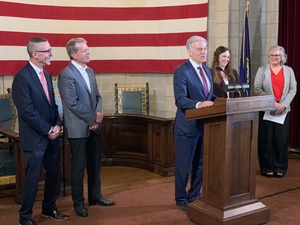
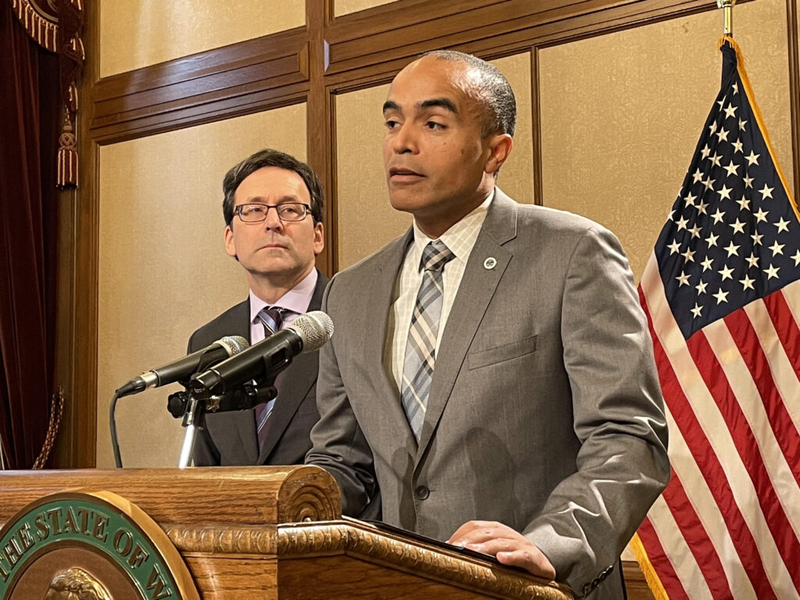
Washington state Attorney General Nick Brown, right, is asking the U.S. Supreme Court to accept a challenge of the political maps for the state Legislature so a lower court can determine if the way the lines were drawn complies with a recent ruling in a Louisiana case. Gov. Bob Ferguson, left, served as attorney general when the redistricting legal fight began. (Photo by Jerry Cornfield)
State Attorney General Nick Brown wants the conservative U.S. Supreme Court to wade into Washington’s partisan-fueled tiff on the boundaries of legislative districts.
Last Tuesday, he told the high court that it should accept a case contesting the political maps for the state Legislature, then send it back to a lower court to decide if the manner in which the lines were drawn complies with the justices recent ruling in a Louisiana case.
Brown, a Democrat, says his reason isn’t all that complicated.
The decision in Louisiana v. Callais significantly rewrote how the federal Voting Rights Act is applied in redistricting by significantly curtailing the use of race in drawing boundaries.
This transformed the legal landscape compared to early 2024 when U.S. District Court Judge Robert Lasnik approved redrawn maps for Washington legislative districts to enhance the political voice of Latino voters in the Yakima Valley. Later that year, the 9th U.S. Circuit Court of Appeals upheld his decision, concluding race was not the predominant factor in shaping the redrawn map.
“When we have a substantial change in the underlying case law that the original decisions were based on we think it’s important that the court follow the current standard and the current precedent,” Brown said in an interview late last week.
“We’re asking them to take the case but we’re not asking the Supreme Court to decide the case,” he said. “We have to make sure that the court here gets it right.”
Jose Trevino and state Rep. Alex Ybarra, R-Quincy, who opposed the redrawn legislative maps, petitioned the U.S. Supreme Court in January to take up the case. They argued that Lasnik’s action was a “racial gerrymander” disallowed under the federal Voting Rights Act.
In March, in separate filings, the state and the Latino voters whose lawsuit in 2022 led to Lasnik’s action, told the court they did not plan to respond to the petition. But the court requested they do so by June 2. Attorneys for the Latino voters asked for the petition to be denied.
Callais came out April 29.
Brown said it is “a horrible decision. It undermines the voting power of black and brown communities all across this country, including in Washington state. It really flies in the face of 40 years of precedent.”
But to be “honest brokers” representing the state means asking the court to grant the petition, vacate the 9th Circuit Court judgment and allow that panel to decide whether its prior decision still applies under existing case law.
That would be similar to how the Supreme Court has dealt with redistricting cases in Alabama, North Dakota and Mississippi, Brown noted in the 19-page court filing.
“To ignore or try to pretend that Callais was not issued would not really be a good faith argument on behalf of the people of the state of Washington,” he said. “That’s the law of the land, and we will follow the law of the land.”
Brown declined to say if, before Callais, the state wanted the petition denied, or if he now thinks the 9th Circuit Court of Appeals will reach a different conclusion if it gets the case. Any state position will emerge in future filings — if the litigation continues.
This year’s elections are unlikely to be affected if the court keeps the case alive, he said. It certainly would open the door to the possible reconfiguring of legislative districts before 2031 when they’re scheduled to be redrawn, he acknowledged.
For example, if the appellate panel upholds Lasnik’s decision again, the Supreme Court could still intervene and require adjustments.
That’s what happened in Alabama. After Callais came out, the Supreme Court granted the state of Alabama’s request to vacate a lower court’s ruling that prevented it from using a congressional map and remand the case to that court for further review. That lower court upheld its previous decision and issued another injunction saying the state-backed map was “tainted by intentional race-based discrimination.”
In response, the Supreme Court stepped in to reverse the lower court’s ruling so the state could use the map it wanted.
Olympia, WA