Legislative study commission formed to study hospital staffing levels in Rhode Island
Jun 08, 2026 | 5:45 am ET
Description
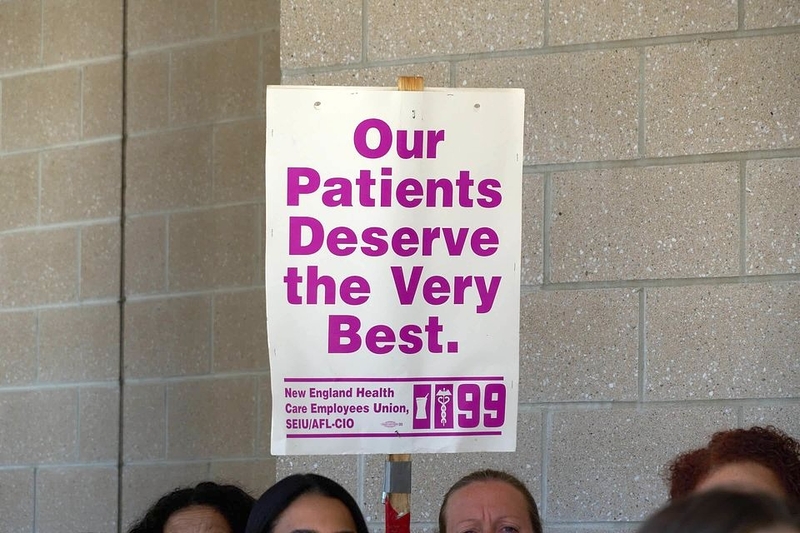
SEIU 1199 NE union members hold a rally outside outside their workplace Women & Infants Hospital on Wednesday, June 3, 2026, in support of legislation to create a hospital safe staffing study commission. appears. (Photo courtesy of SEIU 1199 NE)
Are Rhode Island’s hospitals adequately and safely staffed?
That’s one of the primary questions to be investigated by another special study commission coming to the Rhode Island legislature, thanks to a pair of companion resolutions passed unanimously by both chambers of the General Assembly.
The commission will look at how staffing levels affect patient outcomes and safety, recruitment and retention practices, and financial implications for hospitals. The commission will also look at other states’ staffing models, plus how the Ocean State is implementing a recent slate of national standards created by an independent, nonprofit accrediting organization.
Per the resolution text, the commission has an initial deadline of Sept. 1, 2027 to submit its recommendations to the General Assembly. The commission is set to expire on Jan. 30, 2028. 
Unlike bills which seek to tangibly change state law, the joint resolution, sponsored by Democratic lawmakers Sen. Melissa Murray of Woonsocket and Rep. Deborah Fellela of Johnston and passed June 4, does not require the governor’s signature.
The resolutions’ passage was praised by union members at Women & Infants Hospital, part of SEIU 1199 NE, who rallied outside the hospital last week in support of the bills’ passage. Frontline healthcare workers at the hospital have argued that staffing shortages make it difficult for nurses to deliver the high level of care they want to provide.
Melissa Blais, a registered nurse who has worked at the hospital for 26 years and worked in labor and delivery for 18 years, said in a phone interview Friday that the resolutions’ passage felt “very rewarding” and that the commission’s creation is something hospital workers like her have wanted for a long time.
“I cannot give my patients the adequate amount of care that they need,” Blais said. “To go home and feel confident that I gave that patient my 100%, it is sometimes impossible because our staffing levels are so low.”
“We want to give the patients in this community the best possible care,” she added. “I wouldn’t be spending countless days off advocating at the state house.”
In her time at the hospital, Blais said, the staffing situation has been worsened by a number of factors, including the retirement of older employees. But full-time employees with specialist knowledge are needed in the maternity ward and delivery room, she argued. Blais said she’s seen the general age of her patients rise over the years, “women are choosing to have babies later on in life.”
“That brings on more comorbidities,” she said. “People aren’t coming in so healthy; they’re coming in with underlying cardiac diseases and diabetes, and so it’s a fine line. We’re delivering a baby. I’m taking care of two lives, not just one, two.”
A morale boost
At a June 3 press conference, union members also alleged that the hospital’s spending and staffing practices have only been further exacerbated by a general milieu of financial constraint. Thirty positions, according to a union press release were cut by the hospital because of “current financial conditions [which] have made additional cost-saving measures unavoidable.”
Doreen Scanlon Gavigan, a spokesperson for Care New England, wrote in an email ahead of the union press conference that the 30 roles which were cut were purely nonclinical, leadership roles.
These reductions did not “reflect staffing on patient care floors,” Gavigan wrote, adding that they rather “reflect the ongoing financial pressures facing hospitals and healthcare providers across Rhode Island, driven in large part by longstanding structural underfunding and inadequate government reimbursement rates that do not cover the actual cost of care.”
The hospital is still working to fill open positions, Gavigan added. She reiterated that notion on Friday when asked about SEIU’s claim that on May 26, hospital administrators informed union delegates that no more full-time positions would be created until the next fiscal year.
“The hospital’s staffing approach is driven by patient volume and the complexity of care needs at any given time,” Gavigan wrote. “Our staffing levels are subject to ongoing review by the RI Department of Health and consistently meet regulatory and patient care standards.”
When asked about Care New England’s position on the study commission bills, Gavigan deferred to the Hospital Association of Rhode Island. That organization’s Senior Vice President Lisa Tomasso wrote in opposition to the Senate Committee on Health and Human Services in an April 28 testimony.
“Staffing ratios do not create additional nursing supply and, particularly in constrained labor markets like Rhode Island, have been associated with unintended consequences such as unit or bed closures, increased reliance on agency or overtime staffing, and reduced operational flexibility during surges,” Tomasso wrote. “The evidence supports better staffing, but not the conclusion that fixed ratios are the only, or best mechanism to achieve it.”
Gavigan added that hospital leadership “is committed to maintaining open and professional dialogue with SEIU 1199 NE representatives in a setting that does not disrupt the patient experience.”
Blais said Friday that the union is “not trying to cause discord between hospitals and leaders. We’re trying to have oversight.”
The study commission will help in that regard, she thought.
“I can tell you we cannot take care of [patients] adequately with the staffing and safety we have going on right now,” she said, noting it as a situation of less-than-ideal morale. “But this was a morale boost yesterday.”

Providence, RI