Fifty for 150: Colorado Supreme Court in 2023 finds Trump engaged in insurrection
May 26, 2026 | 6:00 am ET
Description
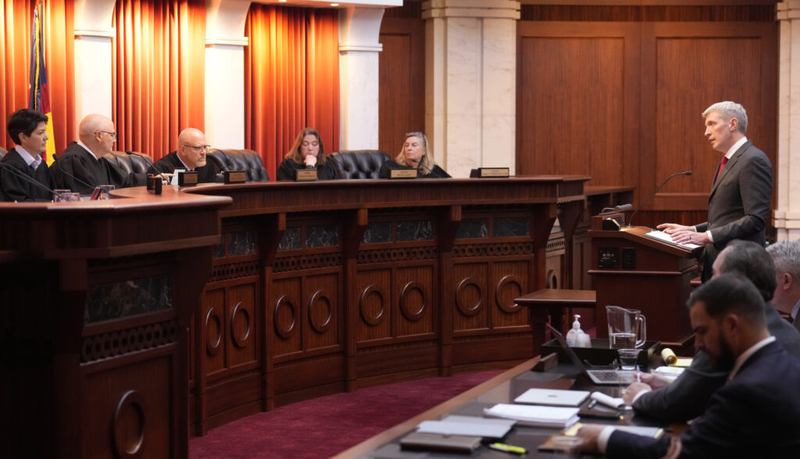
Attorney Eric Olson, far right, argues before the Colorado Supreme Court on Dec. 6, 2023, during oral arguments over Donald Trump's eligibility to be president. (AP, pool/David Zalubowski)
The ruling handed down by the Colorado Supreme Court on Dec. 19, 2023, was a lengthy one, but two sentences on the first of its 213 pages were enough to send political shockwaves across the country.

This story is part of Colorado at 150. Each Fifty for 150 story focuses on an event that helped define Colorado over 150 years of statehood. Newsline is publishing one Fifty for 150 story every weekday in reverse chronological order until the sesquicentennial, Aug. 1, when the final of 50 stories, about the declaration of statehood, will appear.
“A majority of the court holds that President (Donald) Trump is disqualified from holding the office of President under Section 3 of the 14th Amendment to the United States Constitution,” the court wrote. “Because he is disqualified, it would be a wrongful act under the Election Code for the Colorado Secretary of State to list him as a candidate on the presidential primary ballot.”
The state Supreme Court’s 4-3 order came just ahead of the three-year anniversary of the Jan. 6 attack on the U.S. Capitol by a mob of Trump supporters, after a speech near the White House in which the then-outgoing president had repeated the “big lie” alleging widespread fraud in the 2020 election, and urging supporters to march to the Capitol and “fight” to overturn his defeat during a routine congressional vote to certify the results.
Ratified in 1868 and enforced only a handful of times after the 1870s, Section 3 of the 14th prohibits anyone who took an oath to uphold the Constitution and then “engaged in insurrection” from holding office in the United States.
In September 2023, six Colorado voters, backed by the nonprofit Citizens for Responsibility and Ethics in Washington, had sued Trump and Colorado Secretary of State Jena Griswold in state court, arguing that the clause rendered Trump — then under federal indictment for his role in the Jan. 6 insurrection, but well on the way to a resounding victory in the 2024 Republican presidential primary — ineligible for office.
Their lawsuit, Anderson v. Griswold, challenged Trump’s ballot eligibility under a procedure in Colorado election law typically used to adjudicate disputes over candidate residency requirements or irregularities in party nominating assemblies. At times, the two-week trial in Denver District Court closely resembled the proceedings of the U.S. House of Representatives’ select Jan. 6 committee, complete with dramatic video exhibits of Trump’s election-denying rhetoric and the mob’s attacks on Capitol police officers.
“We conclude that the foregoing evidence, the great bulk of which was undisputed at trial, established that President Trump engaged in insurrection,” the Colorado Supreme Court ruled. “President Trump’s direct and express efforts, over several months, exhorting his supporters to march to the Capitol to prevent what he falsely characterized as an alleged fraud on the people of this country were indisputably overt and voluntary.”
“Moreover, the evidence amply showed that President Trump undertook all these actions to aid and further a common unlawful purpose that he himself conceived and set in motion: prevent Congress from certifying the 2020 presidential election and stop the peaceful transfer of power,” the majority’s opinion continued.
Three dissenting justices on the court did not directly dispute that finding, arguing instead that the case’s accelerated timeline violated due process or that Section 3 requires an act of Congress to be enforced.
The court’s seismic majority opinion was the first of its kind in the nation’s history. It was followed just 10 days later by Maine Secretary of State Shenna Bellows’ order declaring Trump ineligible on the same grounds. The rulings became subject of intense criticism — not only from Trump allies, but also from centrist and liberal commentators who worried about the consequences of barring a presidential frontrunner from the ballot.
The ruling would not last. Indeed, it never technically went into effect, since the court stayed its order pending Trump’s inevitable appeal of the case to the U.S. Supreme Court.
In February 2024, the nation’s highest court heard the case, renamed Trump v. Anderson, amid a growing cloud of distrust of the court felt by many Americans in the wake of its 2022 decision to overturn Roe v. Wade. Three of the court’s six conservative justices had been appointed by Trump himself, and in a Fox News appearance prior to oral arguments in the case, Alina Habba, an attorney representing Trump, said it was a “slam dunk” that the court would rule in Trump’s favor.
“People like (Justice Brett) Kavanaugh, who the president fought for, who the president went through hell to get into place, he’ll step up,” Habba said.
In a unanimous ruling, Supreme Court justices sided with Trump on March 4, 2024, citing the “disruption” and “chaos” that would ensue if states were allowed to enforce the Section 3 against federal candidates.
“Because the Constitution makes Congress, rather than the States, responsible for enforcing Section 3 (of the 14th Amendment) against federal officeholders and candidates, we reverse,” justices wrote in an unsigned, “per curiam” opinion.
One day later, Trump won Colorado’s GOP presidential primary with 63.5% of the vote, en route to his victory in the 2024 presidential election.
Hours after being sworn in for his second term, Trump issued pardons to more than 1,500 people who had been charged with crimes related to the Jan. 6 insurrection, including 608 defendants who faced charges of assaulting, resisting or impeding law enforcement. Nearly a third of those used a dangerous or deadly weapon.
Earlier this month, Trump’s Department of Justice announced the creation of a $1.8 billion fund that will pay out compensation to so-called victims of “weaponization and lawfare,” a group that is widely expected to include Jan. 6 insurrectionists.
Denver, CO