Colorado in 1876 wasn’t immune from the Wild West’s plague of deadly gun violence
Jun 05, 2026 | 6:30 am ET
Description
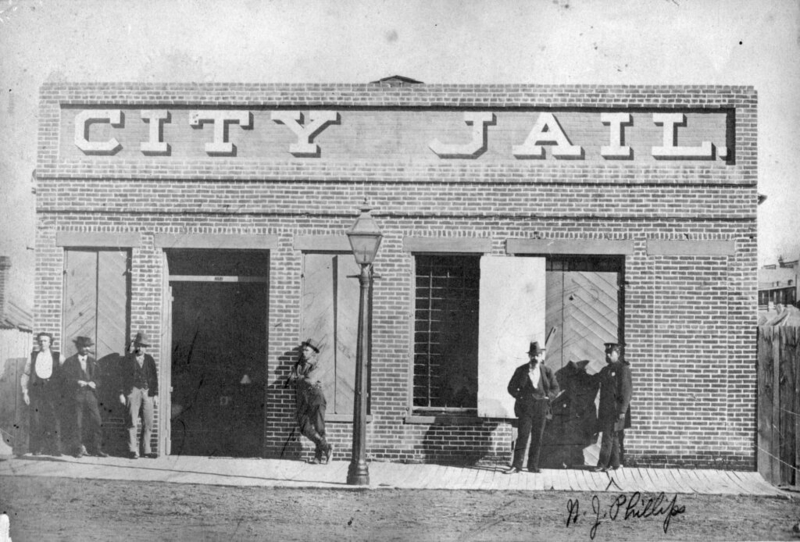
A group of men, including a police officer at far right, stand outside the Denver City Jail on 13th Street in this 1874 photograph. (Courtesy of Denver Public Library Special Collections, X-29677)
Though the political intrigue of the Colorado’s 1876 constitutional convention and its looming admission to the union were ably covered by territorial newspapers, few stories received more attention in the press in the centennial year than the murder trials of four men branded by the Rocky Mountain News as “the Italian cut-throats.”

Seven alleged perpetrators, led by a former tinsmith named Filomeno Gallotti, had been charged in connection with the murder of a Denver man, Giuseppe Pecorra, along with his two sons and a nephew, at a house on Lawrence Street in October 1875.
All but one of the suspects were convicted by juries in Denver in a lengthy series of trials the following spring, which were covered in detail by the News and other Denver papers. Two were convicted as accessories and sentenced to 10 years in the penitentiary at Cañon City, while Gallotti and three others pled guilty to murder and were sentenced to life in prison — having “escape(d) the hangman’s halter,” the News reported bitterly, thanks to a territorial statute that barred capital punishment in the case of a guilty plea.
Like the Hispanos of southern Colorado, who found themselves the targets of deadly land grabs and vigilantism throughout the late 19th century, Italian-Americans at the time were considered to belong to a racial category separate from “whites” of northern European descent. Denver papers filled up with graphic stories describing Gallotti’s gang as “butchers” and “brutes” who literally drank the blood of the men they’d slain.
In early June, following their convictions, the six men were transported by Denver Sheriff David Cook to the Cañon City prison, which had served as the territory’s sole penitentiary since 1871. The News covered the journey in the same sensational tone with which it had chronicled the suspects’ apprehension, indictment and trial over the previous nine months.
“To the other inmates of the institution they were evidently objects of considerable curiosity,” the News reported on June 6. “The most hardened and unrepentant criminals confined therein shuddered and slunk back into their cell at sight of the fiends.”
Within days, the Denver papers were filling up with new tales of grisly violence. A report in the News on June 9 of a “DUEL TO THE DEATH,” at the short-lived Eastern Plains town of River Bend, was immediately followed by another, reporting the “BRUTAL MURDER” of a miner in Park County.
Though the nature and extent of violent crime in the Wild West would often be distorted by later fictionalized accounts of the period in film, television and literature, violent personal conflicts were indeed a fact of life on the frontier.
Between 1862 and 1872, research has estimated, the homicide rate in Colorado’s Central City averaged 68 per 100,000 residents per year — a higher rate of deadly violence than plagues even the most dangerous U.S. cities today. Plenty of frontier settlements were even less safe than that: In the 1870s, homicide rates in the storied Kansas cattle towns of Abilene, Dodge City and Wichita regularly exceeded 100 per 100,000 residents per year, vastly higher than the rates in large eastern cities during the same period, the historian Clare McKanna found in his book-length study of violence in the American West.
Murders were still far from a daily occurrence in most Western towns — but when they occurred, they did often resemble the stereotypical gunfights of Wild West lore. Shootings by law enforcement officers were common, as were acts of quasi- or extrajudicial violence by sheriff’s posses or other vigilante groups. Much of the deadly violence took place as a result of a confrontation between two men in a saloon.
“Homicide in the American West tended to be a crime committed by a male under the influence of alcohol in a saloon or outside on the street, typically late at night,” McKanna wrote. “The homicide usually resulted from some minor disputes with an acquaintance, and more often than not was committed with a handgun.”
“The list of grievances included too much foam on the beer, unpaid fifty-cent bets, pool games, bar tabs, and a myriad of other minor issues,” he added.
Easy access to cheap guns — some models could be had for two or three dollars, about the price of a sack of flour or a decent straw hat — helped fuel this distinctly Western brand of violence, as did the tensions that arose in rowdy mining camps and cow towns inhabited by men of many different backgrounds and nationalities. Saloons and alcohol were another important factor, and perhaps unsurprisingly, many frontier communities, including Colorado Springs, became hotbeds of the nation’s growing temperance movement.
Both of the homicides reported in the Rocky Mountain News on June 9 were linked to alcohol. Ike McClain, the accused murderer from the Park County town of Grant, was reported to be “a drunken desperado who has been feared as a dangerous character for years past.” After fatally shooting John Kane, a fellow miner, he was pursued by “four citizens, armed with guns,” and eventually surrendered.
A fuller account of the deadly duel at River Bend arrived the following day. The man killed, Albert Jessup, was the son of a wealthy Philadelphia industrialist, and his death at the hands of ranchman Otis Davis warranted coverage in the New York Times.
“Jessup and Davis were drunk, that being, unfortunately, the too common condition of the former, who had been sent out here to reform, some years since,” the News reported, citing a witness. “Davis and a herder got into a row, and Jessup took the herder’s part, when Davis suggested a resort to arms, and chose a Winchester rifle as his weapon. Jessup said he only wanted the Colt’s revolver which hung at his side. The two walked away and in three minutes from the time they left the station were shooting at each other.”
Davis’ killing of Jessup with the more accurate long gun, the News declared, was “little else than an assassination,” and he was reported to be “still at large,” with a reward for his capture.
“(Davis) appears to have had but few friends among the stockmen,” said the News, “while Jessup, though addicted to drink, was very generally well liked.”
Selected sources
- The Rocky Mountain News, June 6–10, 1876
- McKanna, Clare. “Homicide, Race, and Justice in the American West, 1880-1920”
Denver, CO