Louisiana Legislature takes aim at New Orleans’ criminal justice system
May 05, 2026 | 7:27 pm ET
Description
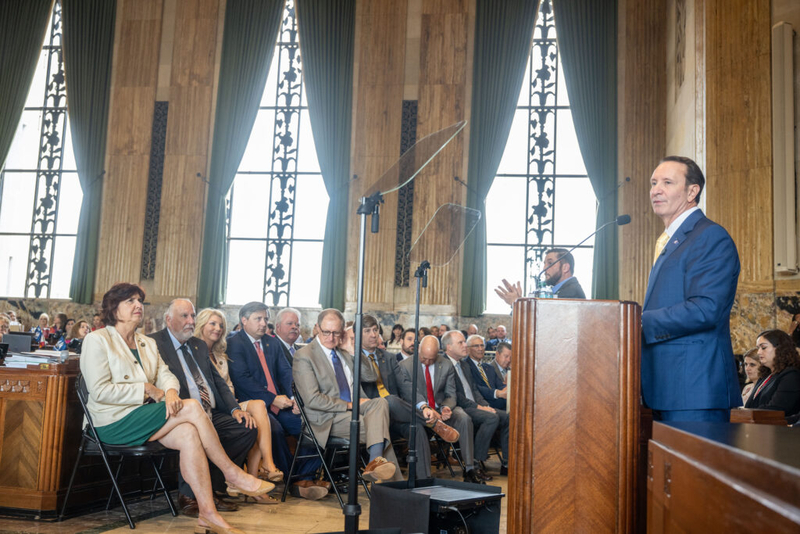
Gov. Jeff Landry addresses a joint session of the Louisiana Legislature on the opening day of their lawmaking session at the State Capitol on Monday, March 9, 2026. (Photo by John Ballance/The Advocate-Pool)
One of the less noted, but significant collateral costs of the contested 2000 election was that it cemented the “Red State vs. Blue State” metaphor in our national consciousness. This has ossified an almost Civil War-esque way of thinking about politics as battles between states. But in many — if not most—cases the consequential fights are within states, especially between GOP-dominated state governments and their much-more Democratic cities.
A flood of state laws across the country have sought to hamstring or reverse local autonomy, often not to advance sound policy, but to undo local Democratic-leaning policies that are disliked by more-conservative suburban and rural voters.
This is playing out again in Louisiana where Republican Gov. Jeff Landry is pushing a slate of bills through the state legislature framed as “rightsizing” the state’s judicial system. But they are hard to see as anything more than an effort to punish the majority-Black, majority-Democratic New Orleans voters for making decisions state officials dislike, and to make it easier to punish them for such choices in the future.
The first set of bills proposes a constitutional amendment and supporting legislation to make it easier for the legislature and the governor to remove judges and other locally elected officials. One of the bills would allow the state legislature to unseat an elected official for “malfeasance or gross misconduct.” Critics point out that these terms are ill-defined and a Republican dominated legislature could pursue politically motivated removals of electeds.
But we can guess what — or rather, who — a primary target is: New Orleans’ reform-minded district attorney, Jason Williams. Landry, a former police officer and sheriff’s deputy, has made his dislike of criminal legal reform central to his politics.
Barely a month after assuming office in 2024, he called a special session of the legislature to roll back a set of criminal legal reforms his Democratic predecessor, John Bel Edwards, pushed through a state legislature with Republican supermajorities in both chambers.
More recently, after a shooting in a Baton Rouge mall left one person dead and five others wounded, Landry criticized Edwards’ reform policies again and said “we got 18,000 acres at Angola” as a policy response to violence. A video of Landry’s speech was tweeted by Elon Musk.
Louisiana is not the only state to go down this path. Republican state officials regularly target local reform prosecutors. Florida Gov. Ron DeSantis has removed two reform prosecutors from office over their policy choices, after his predecessor removed murder cases from one district attorney who refused to seek the death penalty.
In 2023, Texas passed a law making it easier for anyone to bring cases in court seeking to remove prosecutors over their charging decisions.
In 2024, Georgia established a prosecutorial oversight committee which seems designed not to target overly aggressive misconduct but reform policies.
The same year, articles of impeachment introduced by Republicans in Pennsylvania against Larry Krasner, Philadelphia’s reform prosecutor, were declared null by the state Supreme Court.
And the Tennessee house just passed a bill giving the state attorney general the power to seek removal of the reform district attorney of Shelby County (Memphis) if an audit finds “clear evidence” the DA declined to prosecute criminal offenses “based on an unjustifiable and unconstitutional standard, without regard to facts or circumstances, or taken other official action that constitutes a failure or refusal to prosecute.”
It’s hard to see the push in Louisiana as different from these efforts. The second set of bills in the state target judicial and prosecutorial staffing in New Orleans and beyond. Two bills aim to cut the number of criminal court judges in New Orleans by reducing the parish’s appellate court from 12 judges to 10, and by cutting the criminal trial court judges from 12 to nine.
Proponents of the bills claim that the judicial cuts are based on a recent analysis of caseload studies, but opponents have countered that the analysis relied on flawed metrics. The nonpartisan Bureau of Governmental Research argued that the analysis failed to account for the greater complexity of cases in the state’s biggest city.
Another bill takes aim at prosecutorial staffing, albeit in a less direct way.
In Louisiana, parishes are free to hire as many assistant district attorneys as they like, but the state subsidizes the salaries by $50,000 per position for a fixed number. Currently, the law subsidizes 83 assistant DA positions for Orleans Parish. The new bill shifts from a fixed number to subsidizing one assistant DA per 7,500 people in the parish.
For New Orleans, this would mean the state funding about 48 assistant district attorneys, a cut of 42% to the subsidy. Like with the judicial cuts, the proponents of this law justify it as a need to adjust to population changes in New Orleans, whose population is still nearly 100,000 people (or 20%) less than it was before Hurricane Katrina.
At first blush, gutting the DAs office and hampering the criminal courts seems inconsistent with the tough on crime rhetoric of Landry and his fellow Republicans. But it is likely consistent once you realize that tough on crime is far less about public safety and far more about social control of disliked groups.
Cutting judges will likely lead to cases taking longer to resolve, which will likely lead to more people spending time in New Orleans’ already-overcrowded jail. While this is a bug from a public safety perspective given the growing evidence that pre-trial detention likely does more harm than good, it is a feature for those who wish to act punitively toward those they see as wrongdoers, regardless of the long-run costs.
Similarly, cutting assistant district attorneys will also likely push the system in a more punitive direction, along multiple fronts. To start, shortly after Landry was sworn in as governor and Liz Murrill took over as his replacement as state attorney general, the reform-minded Williams entered into an agreement under which the attorney general’s office would handle criminal cases resulting from arrests made by state police in the city.
An increasingly understaffed DA’s office may turn more cases over to the attorney general’s prosecutors, who are surely more punitive than the Orleans Parish assistant district attorneys, given that the person in charge of the attorney general’s criminal division is Leon Cannizzaro, Williams’ notoriously tough-on-crime predecessor as Orleans district attorney who achieved national notoriety for locking up rape victims to force them to testify. Williams aggressively campaigned against his record and policies.
In effect, transferring cases from the parish district attorney’s office to the state attorney general effectively (partially) overturns a local election. Local capacity constraints, driven by state budgeting power, force the reform-minded Williams to hand over cases to Cannizzaro, whose policies he was elected to reverse.
Even if there is not a significant shift in cases to the attorney general’s prosecutors, weakening staffing will weaken reform efforts. A smaller pool of prosecutors, in an effort to plead out more cases more quickly to manage their suddenly-enlarged dockets, will likely find themselves forced to either threaten and sometimes impose more severe sanctions to induce unwilling defendants to plead out.
Louisiana has a brutal habitual offender law, which Williams pledged to stop using in his 2020 campaign; he already reneged on that promise in 2023, and caseload pressure will likely push his prosecutors to threaten it all the more.
Conversely, his prosecutors might just dismiss more cases to clear them off their dockets. But that’s risky too.
In late 2024, Emily Maw, head of the highly productive team of prosecutors Williams assembled to review wrongful conviction cases, resigned after reports about her decision to dismiss several gun cases when she was briefly assigned case intakes went politically viral. Every dismissal forced on Williams by an understaffed office is an opportunity for his opponents to accuse him of being soft on crime and push to replace him with someone tougher.
The final bill, perhaps the most controversial and so far the only one the legislature has passed, eliminates Orleans Parish clerk of criminal court by merging it into the clerk of the civil court. The bill’s defenders claim it is meant to bring Orleans, the only parish that divides up the two clerk positions, in line with the rest of the state. But it is hard to see this bill as anything more than making sure that Calvin Duncan, the man elected criminal court clerk last year, never serves in that position.
Duncan’s resume is unusual for a court clerk. He spent 26 years in prison, from 1985 to 2011, for a murder he did not commit. As evidence of his innocence mounted, the state offered him a deal in 2011 to plead guilty to a lesser charge and be quickly released for “time served,” which he took. In 2021, a judge found him factually innocent altogether and vacated his conviction.
But conservatives refuse to admit he was exonerated. Murrill threatened to charge Duncan with perjury for describing himself as exonerated because he had pleaded guilty to a lesser charge. And New Orleans attorney Blake Arcuri — a partner in a law office with Cannizzaro’s daughter Laura Rodrigue — has similarly insisted that Duncan was not exonerated. Even Duncan’s Democratic opponent in the race for the clerk position made similar claims, unsuccessfully seeking a petition to keep Duncan from saying he was exonerated.
Of course, Duncan’s finding of factual innocence came after the plea deal he struck to gain his freedom. But forcing factually innocent people to drop their claims of innocence and take plea deals that let them go home is a very common move prosecutors around the country make to undo wrongful convictions while refusing to admit fault on their part — and a means to deny access to state funds for the wrongfully convicted.
That desire to avoid admission of error is likely all the greater here, given that Cannizzaro had been an assistant prosecutor in the case that wrongfully convicted Duncan in 1985 and was the district attorney in 2011 when Duncan accepted the lesser plea to secure his freedom as that case fell apart.
The election of Duncan can thus be seen as a repudiation of the tough on crime policies that wrongfully locked him up in the first place, which makes the elimination of his office look like little more than a backlash against voters who dared to highlight the costs of blindly punitive approaches to crime control.
Landry signed the bill eliminating Duncan’s position late last week, but Duncan sued the state in federal court. His attorneys claim Landry and Murrill “aim to illegally obstruct Mr. Duncan’s assumption of office by retroactively redefining the meaning of ‘clerk of court’ that existed on November 15, 2025 — the date of Mr. Duncan’s election. So too are they working in coordination to retaliate against Mr. Duncan — an exoneree who was wrongfully imprisoned for 28 years — for his outspoken claims that the criminal legal system in Orleans is unjust and frequently discriminatory against Black people.”
On Sunday, a federal judge in Baton Rouge granted Duncan’s request for a temporary restraining order, declaring the bill abolishing the criminal court clerk position to be unconstitutional. Landry said Monday morning that he was appealing the judge’s decision to the U.S. 5th Circuit Court of Appeals, which granted the state’s request for a stay of the federal judge’s order soon afterward.
The wave of bills before the Louisiana Legislature is best seen as part of a broader national story in which conservative state governments work to thwart the will of local voters in their more liberal, more diverse cities. It is a trend not limited to criminal legal policy, and local governments often have little power to defend themselves.
But here, it reflects a clear desire by legislators elected by suburban and rural voters to impose crime control policies city dwellers keep rejecting. And in doing so, such acts make it clear that tough on crime is never really about public safety.
This commentary first appeared on Verite News New Orleans and is republished here under a Creative Commons Attribution-NoDerivatives 4.0 International License.

Baton Rouge, LA