In Colorado and nationally, extreme polarization diminishes voter voices
Dec 10, 2025 | 5:30 am ET
Description
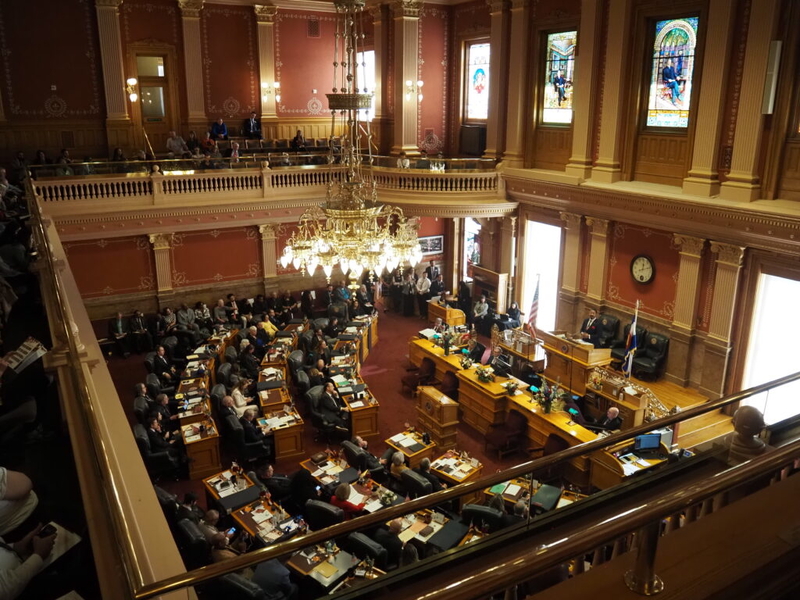
Colorado state senators listen as Colorado Senate President James Coleman, a Denver Democrat, delivers opening remarks on the first day of the 2025 session of the Colorado Legislature on Jan. 8, 2025, at the Colorado Capitol. (Lindsey Toomer/Colorado Newsline)
Polarization has warped democracy in America.
For decades, growing polarization in Congress has made it harder to pass legislation through both chambers. This has led to a shift in governance: When Congress cannot or will not act, presidents increasingly turn to executive orders to move policy on their own.
Presidents aren’t issuing more executive orders than before — actually, they’re signing fewer. The difference now is that executive orders are carrying the weight of major policy decisions that Congress would ordinarily debate and enact. It’s not the number of executive orders that has grown, but rather the power behind them.
In his first 100 days, Trump issued 147 executive orders, a record for any president in that period, while Congress passed only five bills into law, a record low. It seems rational that when Congress becomes paralyzed, the president takes action to implement the administration’s policy agenda.
But consider the flip side: Allowing the executive to both make and enforce policy leads to a collapse in the separation of powers. Unilateral action may work around polarization, but it concentrates decision-making authority in one office.
The Trump administration has repeatedly seen executive orders end up in court. This shines a light on the strain that polarization has placed on the system of checks and balances: in a functioning system, Congress would negotiate and shape these policies; in actuality, the courts increasingly step in to review their legality.
Polarization at the federal level has grown so extreme that Congress now struggles to perform its basic governing functions. But the federal experience isn’t unique; states are grappling with their own versions of polarization.
Colorado is no exception. Our legislature is among the most polarized in the country.
Take the state Legislature’s 2024 election results.
In the Colorado Senate, Democrats hold about 65% of the seats while winning 56% of the total votes. Republicans hold about 35% of the seats after winning 41% of the votes.
The Colorado House is more lopsided: Democrats hold about 71% of the seats even though they received 54% of the statewide vote. Republicans hold about 29% of the seats after receiving 45% of the vote.
This is a symptom of geographic sorting and winner-takes-all elections. Colorado’s urban districts are overwhelmingly Democratic, and its rural districts are overwhelmingly Republican. Even with fair maps, there simply aren’t enough competitive seats to make the overall legislature mirror the statewide electorate.
Colorado often leads the nation in democratic reforms, but if we want a legislature that reflects our electorate, we have to confront how winner-takes-all elections distort representation. With gridlock now the norm at the federal level, states need to take an honest look at their own governance.
States have long been laboratories of democracy, places where reforms can be tested before they scale nationally. If polarization weakens Congress’s ability to govern and leaves states like Colorado with legislatures that don’t accurately reflect the electorate, then the long-term fix starts with how we elect lawmakers — and with electoral rules that let a wider range of voter voices be represented.
One reform is proportional representation, in which parties win seats in proportion to the share of votes they receive, aligning seats with the actual statewide vote and giving all voters a meaningful share of representation.
Under our current winner-takes-all elections, political competition is squeezed into a rigid two-party system, failing to capture the full range of voters’ views. These systems worked reasonably well when polarization was lower, and the Democratic and Republican parties overlapped. But those conditions no longer exist.
In winner-takes-all systems, parties focus on firing up their base rather than appealing to the middle, because that’s how they win. That dynamic encourages polarization, weakens the political center, and makes compromise feel like party betrayal.
Proportional representation changes those incentives. Because every vote can contribute to a seat, parties must appeal to a wider set of voters, not just swing districts or partisan bases. That change could bring historically overlooked communities into the political process and produce policies that more closely match the diversity of public opinion.
Proportional representation strengthens accountability by giving voters real alternatives, so they’re not forced to stick with an underperforming incumbent simply because the other major party feels worse. And in a highly polarized society, proportional representation also reduces the impact of gerrymandering and encourages coalition-building and consensus.
In an era where extreme polarization has weakened Congress and strengthened the presidency, proportional representation offers a way to rebuild representative government — and reduce the pressures pushing us toward executive dominance.
Denver, CO