An endorsement parade U-turn, an electric bill break — sort of — in political notes
Jun 06, 2026 | 10:18 am ET
Description
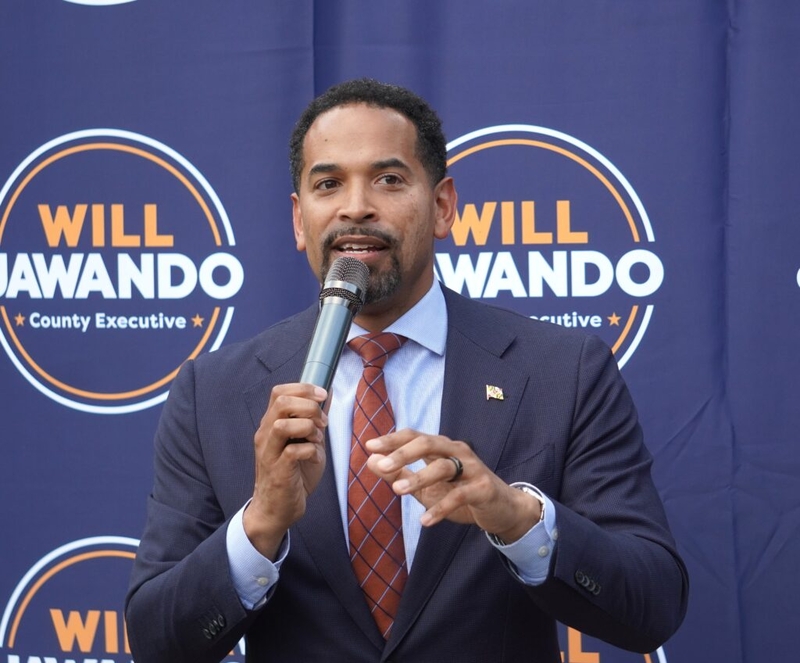
Montgomery County Councilmember Will Jawando at an event June 1 at Zinnia Restaurant in Silver Spring. (Photo by William J. Ford/Maryland Matters)9
Gov. Wes Moore (D) issued another round of endorsements late Friday, weighing in on some highly contested county and school board races and reconsidering an incumbent state lawmaker who was passed over last time — but still leaving others out in the cold.
The highest profile endorsement was probably for Montgomery County Councilmember Will Jawando, one of several candidates seeking the Democratic nomination for county executive.
“We have delivered enormous progress for the people of Maryland since taking office, but there is still more work to do, and Will Jawando is a leader who will help us finish the job in Montgomery County,” Moore said in a statement released by the endorsements.
Jawando, who backed Moore’s first bid for governor in 2021, was the only county executive candidate on Friday’s list of endorsements. But in Montgomery County, the governor also endorsed Scott Goldberg and Drew Morrison for at-large and District 1 council seats, respectively.
One other notable endorsement was for the reelection of Del. Aletheia McCaskill (D-Baltimore County) — one of a handful of incumbent legislative Democrats left out of Moore’s first round of endorsements last month.
That list also left off Senate President Bill Ferguson (D-Baltimore City) and Democratic Dels. Gary Simmons of Anne Arundel County, Veronica Turner of Prince George’s County and Caylin Young of Baltimore City. Only McCaskill made the list on this second go-round.
Ferguson and Moore had a high-profile fight during this year’s legislative session over congressional redistricting, which Ferguson successfully blocked but may be reconsidering. McCaskill and Moore were at odds over his veto — subsequently overridden — of a reparations commission bill she sponsored. McCaskill was apparently forgiven, Ferguson not yet. No reasons were given.
Moore did endorse one other state delegate candidate in Ryan Turner, seeking one of three seats to represent District 41 in Baltimore City, where Del. Malcolm Ruff is running for the Senate seat in that district held by fellow Democrat, Sen. Dayla Attar in the June 23 primary.
The governor also endorsed the reelection bids of Baltimore City Sheriff Sam Cogen and Anne Arundel County Council Chair Julie Hummer. In all, the governor weighed with endorsements for 12 for school board seats in Baltimore City and Charles, Frederick, Montgomery and Prince George’s counties and nine county council races in Anne Arundel, Baltimore, Howard, Montgomery and Prince George’s counties.
He also endorsed Antwan Brown, a candidate running for Prince George’s register of wills in a primary that has almost a dozen Democrats. The current register of wills, Cereta Lee, isn’t seeking reelection after her first election victory in November 2006. She was the first Black official to hold the position.
Voters have started to receive mail-in ballots, and early voting is scheduled from June 11-18. The primary election is June 23.
Energy prices are high … but not that high
Staffers at the Maryland Public Service Commission were alarmed this week to discover that erroneous data posted by the U.S. Energy Administration showed Maryland’s residential energy prices had increased a whopping 89% between March 2025 and 2026.
The data set, published online in March, indicated that Maryland had the second most expensive energy prices in the nation, at 35 cents per kilowatt-hour. But the administration updated the chart to show that the average price for Maryland consumers is 22.2 cents, a 17% increase compared to 2025.
“I want to commend our staff for noticing that this data did not align with information we have on utility rates and for asking EIA to revise their charts,” said Public Service Commission Chair Kumar Barve in a news release Wednesday. “We appreciate the efforts of EIA to correct the record.”
In a statement, EIA spokesperson Curley Andrews confirmed the agency’s charts had been updated, but did not respond to questions about the reason for the error.
The updated data still places Maryland in the upper echelon of states when it comes to residential energy prices. Only about a dozen states had higher prices, including many in New England, along with New York, New Jersey, California, Alaska and Hawaii.
Neighboring Washington, D.C., also had higher prices, averaging 25 cents per kilowatt-hour, according to the EIA data from March.
Annapolis, MD