South Dakota has a conservation priorities problem
Jun 06, 2026 | 4:00 pm ET
Description
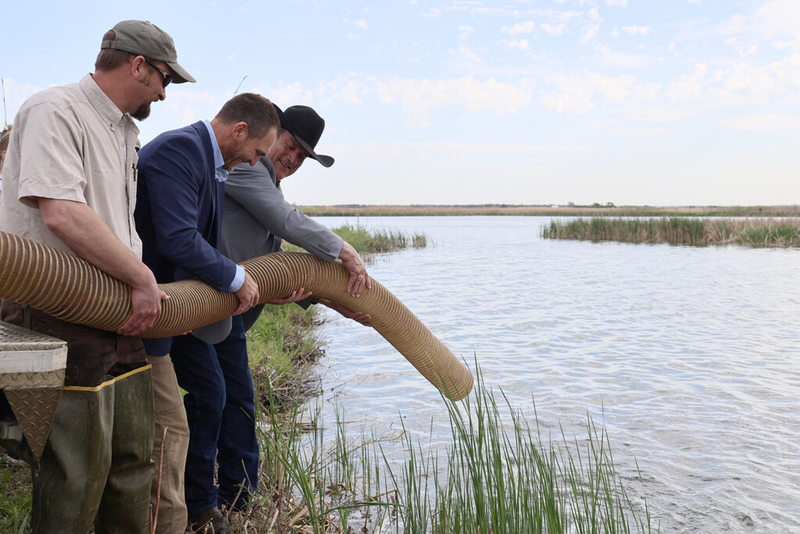
From left, Nathan Poole of Blue Dog State Fish Hatchery, South Dakota Game, Fish and Parks Secretary Kevin Robling and Gov. Larry Rhoden stock fish into Forsberg city pond in Watertown on May 26, 2026. (Courtesy of Gov. Larry Rhoden's office)
Gov. Larry Rhoden stood in Watertown recently asking South Dakotans to help raise $3 million for upgrades to the Blue Dog State Fish Hatchery.
The request itself is reasonable. Blue Dog is aging infrastructure, and fish production remains foundational to South Dakota’s outdoor economy. Hatcheries are among the few state programs that simultaneously support tourism, local recreation and rural communities.
But the fundraising campaign exposes a contradiction state leaders would prefer not to confront: Would South Dakota even need private donations if the Noem–Rhoden administration had not spent years directing hunting and fishing license dollars into a $500,000-per-year predator bounty program that wildlife biologists warned was unlikely to deliver meaningful results?
This is not a question about one hatchery. It is a question about how South Dakota governs.
The Nest Predator Bounty Program, launched in 2019 by then-Gov. Kristi Noem, was marketed as aggressive wildlife management — paying bounties for raccoons, skunks, foxes and other nest predators in an effort to boost pheasant and waterfowl production. Supporters called it bold. Critics called it political theater.
By the 2025 and 2026 legislative sessions, skepticism had turned into open doubt. Lawmakers questioned whether the program produced measurable biological results. Opponents noted the state had stopped conducting the brood-count monitoring needed to demonstrate improved pheasant production in the first place — a striking omission for a program claiming biological success.
Wildlife experts were even more direct. Broad bounty systems rarely suppress predator populations enough to improve nesting success across large landscapes.
George Vandel, retired senior wildlife biologist with the state Department of Game, Fish and Parks and vice president of the South Dakota Wildlife Federation, summarized the issue during legislative testimony:
“Bounty programs can’t work, never will work.”
Research largely supports that conclusion. Predator removal can help in small, intensively managed areas, but statewide bounty systems have shown limited long-term results.
And by 2026, even the state appeared to recognize the program’s political vulnerability. Rather than defend the original structure, the GF&P Commission split the initiative into separate trapping and coyote programs while preserving essentially the same overall spending level.
The structure changed. The spending — and the lack of evidence — did not.
And that spending choice carries a second, less discussed cost: Predator bounties are not eligible for federal Dingell-Johnson matching funds. If the same $500,000 in license dollars were directed toward eligible fisheries work — including hatchery upgrades — South Dakota could draw down an additional $1.5 million in federal matching dollars. That is a 3-to-1 return the state is currently walking away from. Blue Dog is exactly the kind of project that qualifies. The bounty program is not.
Which brings us back to Blue Dog. It’s core fisheries infrastructure — precisely the kind of investment that directly supports South Dakota’s outdoor economy. Healthy hatcheries do not just produce fish; they sustain the tourism, guiding, bait shop, campground and small-town business ecosystems that help keep rural communities alive.
Yet the state now finds itself struggling to modernize essential hatchery infrastructure while continuing to spend $500,000 annually on predator bounty programs whose biological effectiveness remains disputed.
The opportunity cost is not abstract — it is measured in potentially lost federal dollars, delayed infrastructure and a hatchery now forced to rely on private fundraising to cover basic modernization.
That is not a funding problem. It is a priorities problem — and a costly one.
Predator bounties fit neatly into modern political messaging. They generate headlines. They create the appearance of immediate action. They allow conservation to be framed as a simple battle between “good” wildlife and “bad” predators.
Real wildlife management is not that simple.
Habitat quality, wetland conditions, grassland preservation, drought cycles and landscape fragmentation play far larger roles in pheasant and waterfowl production than statewide bounty systems. Wildlife professionals understand this. But habitat work is slower, less dramatic and politically less rewarding than announcing another predator-control initiative.
South Dakota’s outdoor economy deserves better than conservation by press release.
State commission replaces controversial wildlife predator bounty with new programs
If the state truly believes that hatcheries like Blue Dog are essential infrastructure — and they are — then lawmakers should fund them directly and transparently instead of continuing to defend programs with uncertain biological returns.
Because conservation credibility matters.
Hunters and anglers will support serious investment when they believe license dollars are being spent strategically. Public trust weakens when those dollars appear increasingly tied to political branding exercises instead of measurable outcomes.
And that may be the larger lesson behind the Blue Dog fundraising campaign: South Dakota does not lack the money to do conservation right. What it lacks is the political discipline to stop chasing symbolic victories and start funding the work that produces measurable results.
Every year the state pours $500,000 into a program with no federal match, no measurable biological return and little credible scientific support while projects like Blue Dog — which do qualify for a 3-to-1 federal match — are left to pass the hat.
That is not stewardship. It is a political choice.
South Dakotans deserve an explanation for why state leaders continue prioritizing political symbolism over measurable conservation results.

Pierre, SD