WV House Energy approves watered down version of bill loosening regulations for storage tanks
Mar 10, 2026 | 8:01 pm ET
Description
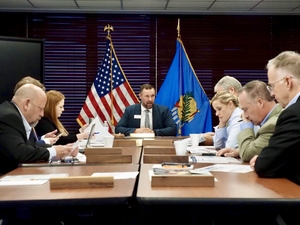
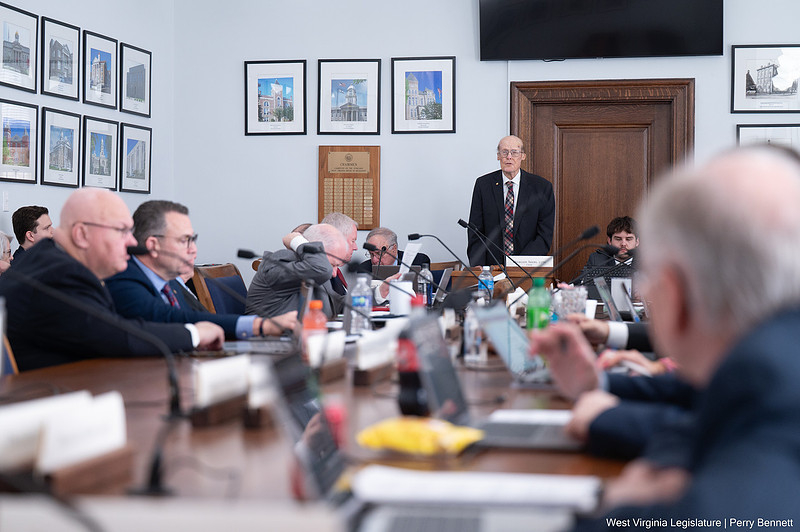
Sen. Bill Anderson, R-Wood, presides over the House Energy Committee meeting on Monday, March 9, 2026. On Tuesday, the committee passed an amended version of Senate Bill 641 that narrows down what aboveground storage tanks would qualify for fewer regulations. (Photo by Perry Bennett/West Virginia Legislative Photography)
Lawmakers on the House Energy Committee passed an amended — and narrower — version of a bill on Tuesday that, if enacted, will loosen regulations for certain aboveground storage tanks in the state.
As amended in committee Tuesday, Senate Bill 641 would only apply to tanks holding 10,000 gallons or less of brine water. Those tanks would be downgraded from being “level 1” tanks to “level 2” tanks under the state’s Aboveground Storage Tank Act.
The bill and the amendments that altered it were passed by the committee via voice vote. SB 641 will now head to the full House for consideration.
Per state code, level 1 tanks are subject to higher fees, more stringent regulations, more frequent inspections and stricter building standards due to the risks they could pose to nearby drinking water sources or the environment if the liquids within them — anything from crude oil and diesel to benzenes and methanol — leaked.
Last week, the state Senate fast-tracked SB 641, passing it just two days after it was considered in committee for the first time. The version of the bill that passed the Senate and was sent to the House would have applied to hundreds of more tanks, including those containing potentially dangerous liquids.
The Senate voted down a floor amendment last week that would have made the bill only apply to brine water.
On Tuesday, nearly that exact language was adopted by the House Energy Committee. The House’s committee amendment also shrunk the size of the tanks that the weaker regulations would apply to — down to 10,000 gallons as opposed to the 50,000 gallons initially proposed in the bill — and removed the word “transmission” from what kind of hydrocarbon activities the liquids held could be produced through.
Proponents for the original bill — including Sen. Chris Rose, R-Monongalia, who is the bill’s lead sponsor — say it’s necessary to help “mom and pop” gas companies that are struggling to meet standards set under current regulations.
On Tuesday, Del. Joe Parsons, R-Jackson, said he would not support the House Energy Committee’s bill because it didn’t do enough to relieve regulatory burdens for those companies.
“I don’t think we’re doing enough to help our small producers, so I’m going to probably be a no on the amendment,” Parsons said.
During the hearing phase for the bill in House Energy on Monday, lawmakers heard from two operators who say they run small gas operations in the state. Jeff Isner, the president and cofounder of Pillar Energy, said the bill would have a “big impact” for his production company.
Pillar Energy, per the company’s website, is the second largest conventional well operator in West Virginia and the 15th largest overall operator by volume. The company operates across four states and owns about 2,400 oil and gas wells. About 200-300 of those wells have aboveground storage tanks, Isner said. Of those, 45 tanks are regulated as level 1 tanks.
Isner said the biggest effect from SB 641 would be cost savings. Tank owners must pay annual fees for each tank they own — about $200 for level 1 tanks and $40 for level 2. They also are on the hook to pay for third party professional inspections of the tanks every three years for level 1 and every five for level 2.
“Paying someone else to come and inspect your tanks, it’s a financial hardship,” Isner said. “When you have 45, 50 (level 1) tanks like we do, it adds up. That’s real money.”
Lawmakers in the Senate — as well as oil and gas industry groups that would benefit from SB 641 — previously argued that there is little risk posed to the public from the tanks that the original version of the bill would have weakened regulations for. Most would only have “trace amounts” of potentially toxic substances, like benzene, methanol, diesel and more, they said.
But Isner, testifying on Monday, told the committee that several of his tanks — and others in operations like his — hold enough oil that trucking companies purchase the contents.
“When they get to a sellable quantity of around 60 barrels, we try to sell it,” Isner said. “I mean, that’s how we get paid.”
Residents, water advocates share concerns on originally proposed bill
Several residents also spoke in committee on Monday to share their fears on what could happen if the state’s Aboveground Storage Tank Act was weakened to appease the state’s oil and gas industry.
The state first adopted the Aboveground Storage Tank Act with unanimous support in 2014.
Just two months before, a tank containing the coal-cleaning chemical MCHM leaked from Freedom Industries into the Elk River, contaminating the water supply for residents of nine West Virginia counties, mostly in the Kanawha Valley. As many as 300,000 residents were ordered not to drink or bathe in the tap water for days.
The initial Aboveground Storage Tank Act added language requiring that all tanks be registered and an inventory list be kept detailing what they contained. Operators and owners were directed to craft spill response plans and give guidance on how local water supplies could be impacted if a spill were to occur. The act also codified the requirement that all tanks receive certified inspections to ensure they are working as intended.
In the last 12 years, there have been at least 12 attempts in the Legislature to loosen requirements made under the original Aboveground Storage Tank Act in 2014, according to the state Legislature’s bill tracker. Some have been adopted while others have died in committees without being taken up for consideration.
When it was first approved, the legislation applied to nearly 42,000 tanks in the state. Through amendments in the years since, it now applies to about 4,500 — an 89% decrease from its original inception.

Honey May currently works as the director for the West Virginia chapter of the Sierra Club. Previously, she served as a board member for the Lincoln County Public Service District. May has testified numerous times against attempts to rollback aboveground storage tank regulations. On Monday, she warned lawmakers that attempts to make regulations easier for oil and gas companies would actually put an undue burden on local water providers.
“(Water utilities) definitely don’t need the added burden of worrying what is in tanks upstream from drinking water sources,” May said.
Numerous water groups — including the West Virginia Rural Water Association, the West Virginia Rivers Coalition and the West Virginia Municipal Water Quality Association — stand against the attempts to loosen regulations that could make the state’s drinking water more vulnerable to leaks.
Todd Grinstead, executive director of the Rural Water Association, told lawmakers Monday that current regulations are working just fine. According to testimony from the state Department of Environmental Protection, there have been about 45 leaks reported from tanks in recent years. None of those leaks were able to reach drinking water sources
“They’re not leaking, per se. It’s working. So if we back off of that, are we going to miss a few? We might,” Grinstead said. “From a drinking water standpoint … We’re looking at people’s health. We’re looking at people’s families consuming water and losing a source (if a leak did occur). So we’re not in favor of this.”

Charleston, WV