U.S. Rep. Tony Wied, challenger Rick Crosson debate in 8th CD race
Oct 22, 2026 | 6:46 pm ET
Description
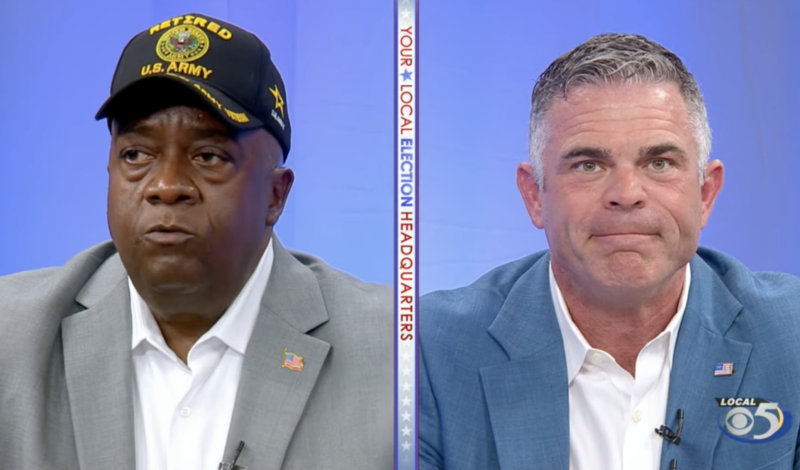
Democratic challenger Rick Crosson and U.S. Rep. Tony Wied met Thursday for a debate in the race for Wisconsin's 8th Congressional District. (Screenshot from WFRV)
Republican U.S. Rep. Tony Wied and his Democratic challenger, former Green Bay school board member and U.S. Army veteran Rick Crosson, met Thursday afternoon for a debate as the two compete for the Green Bay area’s 8th Congressional District seat.
The 8th CD has been under Republican control since 2011 and this year the district is getting less attention and investment than the races for the 1st and 3rd Districts, which are seen as more competitive. Two years ago, the seat was open after Rep. Mike Gallagher’s departure from Congress and Democrats put significant resources into the campaign of Dr. Kristin Lyerly — who lost her race to Wied by 15 points.
With Democrats gaining momentum in Republican-dominated districts across the country, surprises could be coming on Nov. 3, but Crosson’s challenge is still seen as a longshot.
In the debate on Thursday Crosson sought to cast himself as a problem solver and Wied as someone who isn’t up for the job and who has “acquiesced” to the “erratic whims of the current occupant of the White House” while avoiding accountability to his constituents and using the position to personally enrich himself.
Wied, the former owner of gas stations in the Green Bay area, worked to present himself as a good-tempered representative who has worked to improve the lives of people in northeast Wisconsin through his constituent services, while defending many of President Donald Trump’s actions that he has supported.
Hosted by WFRV’s Tom Zalaski and Stacy Engebretson, the debate focused on the economy, the political environment, agricultural consolidation, data centers, healthcare, election integrity and the war in Iran.
Economy
On the economy, Wied acknowledged that gas and diesel prices have risen because Trump started the war in Iran, but said that “decisive action” in Iran is what was needed.
“Gas and diesel prices are too high, and we know that that comes from the president’s actions, and he took decisive action with a threat that we have in Iran,” Wied said. The threat posed by Iran is “something that every president has dealt with my entire lifetime, and through his intelligence briefings, he felt that there was an immediate threat with a nuclear weapon, and he took decisive action,” Weid said of Trump.
“I think as soon as this conflict is over, and it has moved from kinetic warfare over to economic warfare, we’ll see those prices come down,” he added. “During the Biden administration, prices were extremely high as well. Gas and diesel prices were very high during the administration.”
When pressed about his votes to continue the war in Iran, Wied said he wouldn’t support a vote by Congress to end the war, calling it a “symbolic gesture.”
Crosson responded that the people who create a mess don’t then get credit for cleaning it up.
“You caused the instability. Congress acquiesced to the president, to the whims of the president, in kicking off this illegal and unwarranted war,” Crosson said. “This is one where you can’t blame sleepy Joe Biden for this situation and circumstance. We’ve got to end this war.”
Polarization
The two men were also asked about the level of political polarization and tension in the country as voters are inundated with negative campaign advertising.
Crosson said that if elected, he’d focus on “affordability, accountability and quantifiable results.” He argued that Wied, who hasn’t held any in-person town halls during his nearly two years in office, has ducked his responsibility to face his constituents. Wied argued that the telephone town halls he’s held help him reach more people across the district.
“To me, a tele-town hall already communicates the message that there is a reluctance and there’s a fear of standing in front of people,” Crosson said. “Look, I’ve stood before heads of state, four-star military commanders, ambassadors, 3,000 irate, agitated truck drivers. I know what it means to be held accountable in person. There is nothing that substitutes an in-person exchange of information of concern. And yes, they can get spirited, but we should be leaning into that. That’s the nature of this role. If we don’t have the intestinal fortitude to go into that sort of thing, then we shouldn’t be in this role.”
Wied said he’s met with more than 300 groups from the district, done news interviews and sends out a weekly email newsletter. He also said that holding town halls in person brings out a “left-wing mob.”
“I’ve met with over 300 groups here just this year alone. The thing with an in-person town hall is you have this left-wing mob. You have people that work at the Brown County Democrat Party that threatened to kill me,” Wied said, referencing an incident last year in which an unpaid volunteer from the county Democratic party was investigated for making threatening phone calls to Wied’s D.C. office. “They come into these and they scream and they holler and they agitate, and you can’t even get a question. I have no problem meeting with people, and I do. I’ve met with, again, over 300 different groups in this area. I am in the community every single day. I’m the last one to leave to get to D.C. I’m the first one to come home, and we get in the car and we go to all 11 counties every single week. And I will answer any question from anyone.”
Agriculture
Northeast Wisconsin is home to some of the state’s largest factory farms. As consolidation has pushed farmers to expand their operations while squeezing out smaller family farms, neither candidate offered many specifics on how Congress can help reverse that trend.
Wied, who sits on the House Agriculture committee, pointed to his work to get schools serving whole milk again and the passage of a 2026 farm bill by the House of Representatives as actions that he’s taken to help area farmers. A full farm bill has not been enacted since the 2018 version of the law expired in 2023.
“I’ll continue to meet with all of our farmers of all sizes and continue to do everything I can to help them succeed,” Wied said. “What I’m seeing, though, is a very big interest in the next generation to get into farming. There’s issues for sure, but I’m right there to help them, and I will continue to be an advocate and fight for them in Washington.”
Crosson pointed to the tariffs that the Trump administration has imposed on imports from Canada and other major trade partners. He said he’d spoken with an area dairy farmer who can no longer afford to buy Canadian dairy cattle.
“Congress has the responsibility for the imposition of tariffs, and if there is an imbalance of trade, then we look at it rationally,” Crosson said. “We don’t do it irrationally at the whims of the occupant of the White House. Here again is one of the things that Congress again has acquiesced in its mission and responsibility to be that watchdog, that check and balance on the excesses of the presidency, that’s one of the things that we have to do to get ourselves back in place.”
Data centers
As local opposition to data centers has roiled campaigns across the country, the candidates both advocated for local control over the massive developments.
Wied qualified his statement, adding that the U.S. has to keep up in the race to develop artificial intelligence and data center deals can be beneficial to communities.
“Well, I think this is an emerging technology that we need to be the leader in the world in, and there are other countries like China that are really growing in the artificial intelligence, or super intelligence as it’s now being called,” he said, referencing the term that Trump decreed should be used to describe the technology at a White House event late last month. “Some areas around the country are negotiating very good deals. You’re seeing data centers go in and teachers being rewarded with higher pay. There can be a deal, but it cannot be without the approval of the people here locally.”
Wied went on to blame Gov. Tony Evers for forcing communities to construct “big solar farms.”
Crosson said he doesn’t trust the big tech companies building the data centers to have the interests of communities at heart.
“There has to be some level of state and federal laws, policies, procedures that protect our local communities,” he said. “We definitely have to have local control. We need to have the people involved in the decision-making process along the way.”
Healthcare
Republicans across the country are running for reelection after voting to pass the One Big Beautiful Bill Act, which cut billions in federal healthcare spending. Wied argued that the Affordable Care Act is responsible for pushing up medical costs and that he and other Republicans fought to bring federal money to rural hospitals.
Some money did get sent to fund Wisconsin’s rural hospitals, but it’s far less than the shortfall they will face because of the broader cuts to Medicare and Medicaid.
“Ultimately, we need to have a system where people can go directly to the doctor and not have to deal with these insurance companies,” Wied said. “As it relates to Medicaid, we had some of the most transformational reform, but here’s what it did: It basically says that you have to work if you are able-bodied and you do not have a dependent. The Affordable Care Act put people on the sidelines. If you’re a 29-year-old gamer sitting in mom’s basement, you’re going to have to work 20 hours a week, volunteer, or be going to school. That was significant savings, but what it’s going to do is put people onto payrolls and get them off the couch and actually to work.”
Crosson noted that the OBBBA is set to kick millions of Americans off their health insurance and argued that healthcare should be a human right.
“They keep saying that what was called Obamacare was not something that they wanted,” Crosson said. “They tried multiple times to nullify it, but there still hasn’t been anything that replaces this. I start with the premise that healthcare should be a fundamental human right, unequivocally. Once we do that, that’s the vision. We backward plan to where we are, and we move towards that objective. There’s enough dollars to do this. Everybody stops the conversation by saying how we’re going to afford it. There’s money there. We just have to have the national will to do that.”
Election Integrity
Green Bay has been a hotbed of election conspiracy theories since the 2020 presidential election. When asked about trust in elections, Wied said that people have sincere concerns about the validity of the country’s elections — pointing to grant money Green Bay received from a Mark Zuckerberg-aligned non-profit to help fund the added cost of administering an election during the COVID-19 pandemic.
He said that Congress should have passed the Save America Act, which would have instituted a strict national voter ID requirement, because states such as Illinois and Minnesota don’t require a photo ID to vote and therefore they allow undocumented immigrants to cast ballots.
It is illegal for non-citizens to vote in federal elections, and there’s no evidence that it happens in significant numbers.
“One of the biggest issues that I hear as I continue to travel around all of our great 11 counties here in northeastern Wisconsin is that people are concerned with election integrity,” Wied said. “That’s why I proposed and we passed in the House the Save America Act. What that says is, look, you have to be a citizen and show ID in order to vote in federal elections. We have elections all across our country with states like Minnesota and Illinois that don’t do that. They don’t require you to show an ID or be a citizen, and that’s not OK. We need to ensure the integrity in our elections.”
Crosson said the federal government should have no say in how Wisconsin’s elections are run and that fearmongering about these issues only discourages people from voting.
“This is a state requirement, a state responsibility, and we don’t need federal intervention that has the effect of disenfranchising voters,” Crosson said. “This is about making people afraid to come to vote because they know that we outnumber the crazy.”
‘Communism’ and stock trading
Toward the end of the debate, the two candidates were allowed to ask each other one question.
Crosson asked Wied about the large number of trades he’s made while in office. Wied’s net worth has increased by more than $3 million since he was elected and the Milwaukee Journal-Sentinel previously reported that Wied has bought and sold stock in a number of companies that have business before the committees on which he serves. Wied has said all of these trades were made by his independent financial adviser.
Wied said that the stock purchases happened because he and his wife had some savings to invest after selling their business. Then he pivoted to attacking prominent Democrats.
“We sold our business in 2022, and we had some savings. We hired a financial advisor. My wife nor I have ever asked them to buy or sell anything, nor would we,” he said. “But let’s be real. I think the real issue is people don’t trust Congress. You have people like Ilhan Omar that all of a sudden made $30 million out of nowhere. You have career politicians like Nancy Pelosi and Joe Biden that are worth millions, and they’ve never had a real job. That’s why we need to have term limits. We cannot allow people to enrich themselves in Congress.”
Wied highlighted Crosson’s campaign appearances with “known Communist” Francesca Hong, the state representative and former Democratic candidate for governor, and asked if Crosson wants to abolish the police.
Crosson said he “comes at everything from a law and order perspective” and noted his military career included postings in Europe during the Cold War and working with the Mexican government to prevent drug trafficking over the country’s southern border.
“Whether or not Francesca Hong is a ‘communist’ is something that you and her would have to talk about,” Crosson said. “I fought communism in my 20 years of service. I fought against totalitarianism.”
“Of course, I’m for law and order,” he continued. “This is more exploitative conversation to inflame the folks who are inclined to not dig deeper into the facts. So of course I’m for law and order. Who isn’t? But what I don’t want to see happen are people taking advantage of their power and authority and imposing that on our population. That’s not law and order. That’s terrorism, and I’m going to fight that hard.”
Madison, WI