Why the new progressive Democrats in Congress might unite with the old Dems, for now
Oct 22, 2026 | 6:56 pm ET
Description
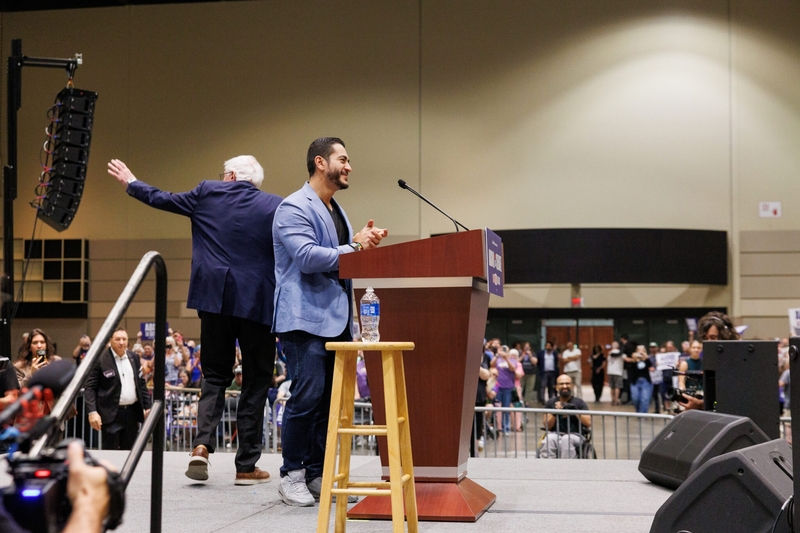
Michigan U.S. Senate candidate Abdul El-Sayed, right, speaks at a rally with U.S. Sen. Bernie Sanders, left, U.S. Rep. Alexandria Ocasio-Cortez and U.S. House candidate William Lawrence in Lansing, Michigan, on July 19, 2026. (Photo by Andrew Roth/Michigan Advance)
PORTLAND, Ore. — The latest cosponsor of a U.S. House bill to provide single-payer health insurance defeated a Republican incumbent in a suburban and rural Oregon district by fewer than 10,000 votes two years ago.
U.S. Rep. Janelle Bynum, a Democrat now seeking her second term, doesn’t have the far-left profile of past Medicare-for-All champions whose mission failed in Congress.
But the policy is popular in her purple district that stretches from central Oregon to the edges of Portland, and aligns with her values as a lawmaker, she said at an October event with the bill’s lead sponsor, Washington Democratic Rep. Pramila Jayapal.
“If you ask me anything about my politics, I'll tell you it's about agency and freedom,” Bynum told a crowd at Portland Community College.
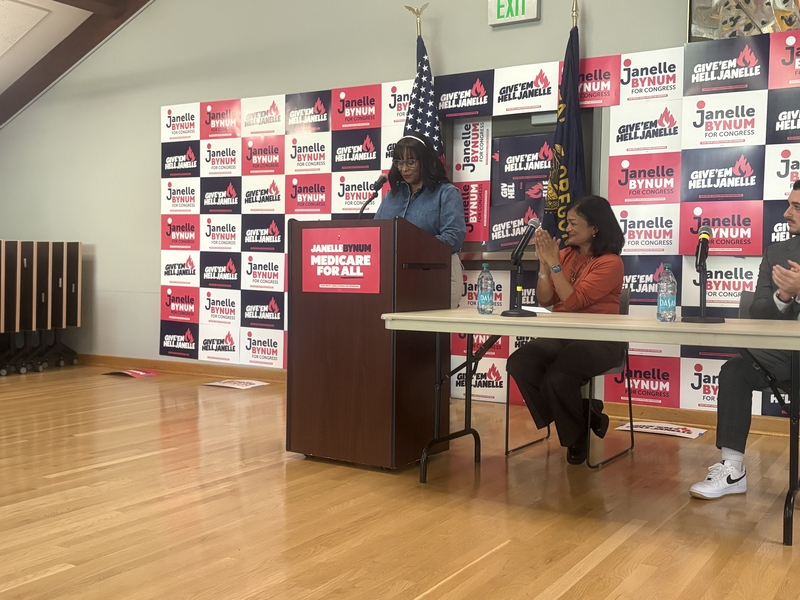
“There’s a lot of Americans that have paid into a system, meaning going to work every day, trying to live the American dream, trying to just be good people, and yet this country can't promise that you can go to the hospital or go to your doctor and not be bankrupted.”
Bynum and Jayapal argued support for single-payer healthcare, long sought by the party’s most progressive members, is growing. And it is one demonstration that voters are in an anti-establishment mood, spurring a possible Democratic takeover of Congress after next month’s elections.
Dissatisfaction with high prices, made worse by President Donald Trump’s unpopular war in Iran, along with aggressive tactics on immigration, have Democrats in a favorable position less than two weeks from Election Day, polling shows.
After a sometimes-bitter primary season, shared policy goals on affordability for Americans and accountability for the Trump administration have bonded the party’s left wing and its establishment factions, analysts say.
But as Democrats eye a likely House majority, and possible U.S. Senate control, they will soon face decision points about the rest of their legislative agenda — and which wing of the party it favors.
Class of 2026
On successive Tuesdays in June, four House Democrats running for reelection, three in New York and Colorado’s Diana Degette, lost primaries to challengers backed by the far-left Democratic Socialists of America.
Observers and campaigners, including Republican leaders, were quick to describe the ascendancy of far-left views in the Democratic Party.
But that narrative is somewhat out of step with a qualitative analysis, according to an August study from the nonpartisan Brookings Institution.
Of 64 DSA-backed members running in Democratic congressional primaries this year, 19 won, according to Brookings. Only one, Will Lawrence in Michigan, is seeking to represent a competitive district.
The ideological makeup of the caucus next year will be “about the same,” the study’s author, Elaine Kamarck, said in an interview.
Kamarck, the director of Brookings’ Center for Effective Public Management, has worked for the Democratic National Committee and presidential campaigns.
While the rhetoric of the House Democratic Caucus might be more progressive in tone next year, many members of the incoming class from blue districts are replacing progressive lawmakers, Rodell Mollineau, a Democratic campaign operative, said.
Practically, progressive House newcomers are likely to accept incremental wins rather than hold out for a future product, he said.
“Is that DSA member, if there's a piece of legislation on the floor that is going to strengthen healthcare, and might not be everything that that member wants, are they gonna vote it down?” he said.
To Trump they are ‘lunatics’
Republicans have used the media attention on the often young, progressive primary winners to criticize the entire party.
House Speaker Mike Johnson, a Louisiana Republican, sought to make the primary winners, all of whom are almost certain to join Congress next year, the face of the entire party.
“The barbarians are inside the gate,” he said at a July 14 press conference. “We’re fighting right now in Congress over whether we're going to maintain our status as a constitutional republic or we're going to trade that in, dismantle the foundations and go down this dark road of death to communism. That is the question on the ballot this fall.”
Republicans continue to campaign nationwide against progressives in general, especially Abdul El-Sayed, the Michigan Democrat who defeated establishment candidates to become the nominee for the state’s open U.S. seat.
“From Chuck Schumer to AOC, moderate Democrats no longer exist,” RNC press secretary Natalie Baldassarre wrote in a Thursday email, referring to the Senate Democratic leader and Rep. Alexandria Ocasio-Cortez, both of New York.
Trump has also falsely painted El-Sayed, who would be the first Muslim elected to the Senate, as a terrorist sympathizer. The attack appears based only on El-Sayed’s race and religion. He was born in the United States to parents from Egypt.
Republicans, including Trump, have sought to tie even centrist candidates to El-Sayed and far-left ideology.
In a speech in Kansas in late October, Trump criticized Adam Hamilton, a preacher who is the Democratic nominee challenging Republican U.S. Sen. Roger Marshall, as “pretending to be a moderate.”
“In 15 days, we're going to reelect Roger Marshall,” he said in a late October speech in Kansas, referring to the state’s incumbent U.S. senator. “We're going to defeat the communists, the jihadists, and the corrupt anti-American lunatics once and for all.”
Size of majority
But Democrats and experts say the establishment Democrats, especially on the House side, will retain control in the caucus, even if their numbers are bolstered by new left-wing members.
Election analysts predict Democrats will pick up between 10 and 20 seats in the House next month, which would give them a majority of 13 to 29. The party is projected to pick up two to six Senate seats, leaving party control a toss-up.
A larger cushion in the House would give Democratic leaders more room to maneuver in the majority, Mollineau, a former Senate staffer, said. Internal division is more likely with a smaller majority, where any single member could be a deciding vote, he added.
But even with a smaller majority, the disparate wings of the party agree on enough of an agenda to keep the chamber busy, he said.
“There's a lot of shared interests that you will see in this caucus they can pursue and move the ball forward, without getting into fights every single day on ideology,” Mollineau said.
That will likely continue as long as Trump is in the White House, Kamarck said. Divisions would emerge, she said, if Democrats take both chambers and the presidency in 2028.
“As long as defeating Trump and his folks are on the agenda, Democrats are going to be pretty united,” she said. “You will only see the depth of these issues when we get the trifecta.”
The overall mood of the electorate minimizes any problems Democrats may have, Lee Hannah, a political science professor at Wright State University in Ohio, said.
“I think it was an ideal year to have some of these challenges” in primaries, he said.
Lawrence, the former DSA member running in a swing Michigan House district, is an example of someone who may not have succeeded under different circumstances, David Dulio, a political science professor at Oakland University in Michigan, said.
That is a sign the party is changing, with an expanding progressive wing, he said.
“I think the messages that those candidates are taking to the Democratic base are being noticed,” he said. “And people are thinking, ‘Yeah, that sounds pretty good.’”
Mood for change
The primary-season distinction was less between progressive and centrist Democrats and more between establishment and anti-establishment candidates, Mollineau said.
El-Sayed’s campaign has targeted Trump voters in northern Michigan with “a similar anti-establishment” message, Dulio said.
Jay Ward, a Medicare recipient at the Bynum-Jayapal event, said growing frustration with the healthcare system has increased the attractiveness of a single-payer model.
“I think different members had different solutions,” he said of past Democrats. “And I think times have changed.”
Jayapal made a similar point in an interview before the event, predicting that more swing district Democrats would support the measure.
“I'm really thrilled that we have people like Rep. Bynum, like Rep. Shomani Figures in Alabama, these are folks that represent really tough districts,” Jayapal said.
“It's unfortunate that this cruelty that American families are dealing with right now has gotten us here, but I do think there's an opportunity here,” she said. “I think that we're going to see more and more folks in the Democratic Caucus signing on that are not just in blue districts, that are in tough districts, that are even in red districts.”
She said the bill would receive a committee markup in a Democratic House next year.
Hannah Winchester, a political and community organizer with the Oregon Federation of Nurses and Health Practitioners, said following the event that her organization does not have an official position on Jayapal’s bill, but does seek to endorse candidates whose goal is universal high-quality healthcare.
“I think we all know something needs to change,” she said.
All States Newsroom content is free to republish. Read our republishing policy for more information.