Domestic fertilizer production to see $1.3B investment with USDA program
Oct 22, 2026 | 6:29 pm ET
Description
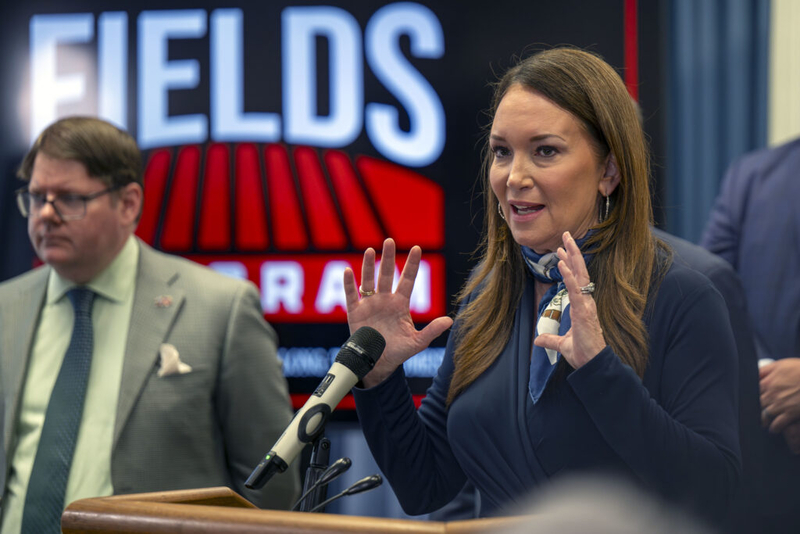
Secretary of Agriculture Brooke Rollins, with Deputy Secretary Stephen Vaden, at a briefing in July about a USDA program to boost domestic fertilizer production. (Photo by Brien Aho/USDA)
U.S. Department of Agriculture head Brooke Rollins and Vice President JD Vance announced Thursday that eight domestic fertilizer manufacturers were selected to receive more than $573 million in USDA funds to boost domestic fertilizer production. With private sector funds, the total overall investment is more than $1.34 billion.
In a virtual press conference Thursday, USDA staff said the projects, which are funded through the Fertilizer Investment & Expansion for Long-Term Domestic Supply, or FIELDS, program, are expected to break ground in weeks, be completed in 2027 or 2028 and cause a “drastic price drop” for fertilizer products once brought online.
Rollins said the program is also a key part of the nation’s efforts to reshore inputs that are currently susceptible to global trade conflicts and contributing to a difficult farm economy.
“For the long term, we expect all of these prices to come down as we’re reshoring fertilizer back to America,” Rollins said. “At the end of the day, this is about building greater input independence, so that America’s ability to farm and feed ourselves is no longer beholden to foreign nations and unstable global markets.”
The FIELDS program was announced in July, as a program to help fund upgrades to existing fertilizer facilities, improve supply chain efficiency and construct new domestic fertilizer production facilities that are domestically owned and are outside of the “dominant” fertilizer suppliers.
Rollins said the program is part of the administration’s goal to change “decades of policy and consolidation” that have led top agriculture companies to continue to post profits while farmers have had to rely on government bailouts – like the $8 billion program announced Monday – to “barely” survive to the next year.
In a news release from USDA about the selected projects, the department said 77% of nitrogen fertilizer production in North America is controlled by four companies, two companies produce 90% of potassium fertilizer and two companies account for 90% of potash production capacity.
USDA has been outspoken about consolidation in the fertilizer industry, and is collaborating with the U.S. Department of Justice on investigations into consolidation and anticompetitive practices in the fertilizer and seed industries.
“We are very, very focused on what is happening, why prices keep going up,” Rollins said.
She said investigations into the industries must “continue unabated” even as manufacturing of the inputs is onshored and prices come down for farmers.
Rollins also said there are “big announcements” coming soon related to improving competition in beef processing by “shifting of some of the closed Tyson plants and others” to “trend back toward less consolidation.”
While in Iowa for the Farm Progress Show in September, Rollins said she had a verbal agreement with leadership at Tyson to keep the company’s recently closed plants from being sold to any foreign companies.
FIELD funding
According to the Thursday announcement, the proposed funding will support fertilizer manufacturing in Iowa, Kentucky, Minnesota, Tennessee, Nebraska, Illinois, South Dakota, Florida, Texas, Oregon, New Mexico, Virginia, California, Arizona, Kansas and Indiana.
The total project investment is around $1.34 billion dollars. USDA is pledging more than $573 million in proposed funding through USDA Rural Development’s Rural Business-Cooperative Service to eight projects, several of which will serve multiple states.
Cody Cornell, a USDA policy advisor, said in the press conference that part of the funding came from Fertilizer Product Expansion Program funds that were not utilized by the Biden administration.
The selected projects will boost the production of a spread of nutrients needed by farmers. One project, TalusAg, will deploy 20 modular ammonia manufacturing units in seven states. PCI Nitrogen in Texas will boost ammonium sulfate and urea production, Intrepid Potash in New Mexico will produce approximately 220,000 tons of sulfate of potash annually and Agriculture Project Holdco will develop plants in Kansas and Indiana to convert dairy manure into liquid ammonium nitrate fertilizer.
USDA economists estimate the additional production from the eight funded projects will support approximately 1.08 million tons of annual domestic fertilizers. It is expected to lower nitrogen fertilizer prices by 4.4% and lower potash prices by 5.3%.
Answering questions from reporters, Rollins said these investments will lead to a long-term reduction in fertilizer prices as manufacturing increases domestically. In the short term, Rollins said she anticipates “a significant drop in fertilizer prices once the Iranian conflict is wrapped.”
The war with Iran has led to global trade disruptions, partially caused by closures along the Strait of Hormuz where key fertilizer and fuel inputs have been held up.
Rollins also addressed the recent resignation of Calley Means, a senior adviser to Health and Human Services Secretary Robert F. Kennedy Jr. and proponent of the Make America Healthy Again movement.
She said that there are some “tensions” across the administration because they are “trying and working to move so fast to change decades-old policy.”
“We just have to work together to continue to support our farmers, stop the trend of losing tens of thousands of family farms every year, work to reshore all of this back to our country for national security reasons, and while doing Make America Healthy Again,” Rollins said.
Des Moines, IA