Secretary of state launches complaint challenging Georgia residency of House candidate
Oct 22, 2026 | 7:00 pm ET
Description
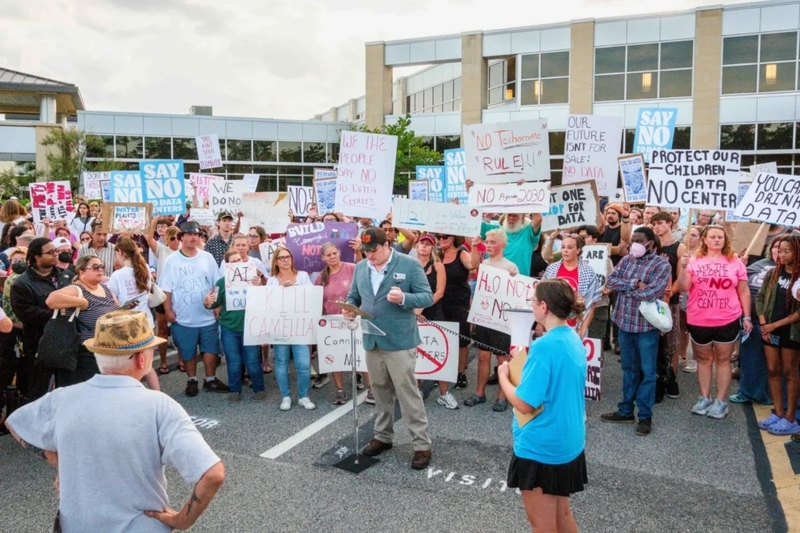
David Dillie addresses 300 people gathered outside the Effingham College & Career Academy to protest the proposed OpenAI data center in Rincon on July 23, 2026. Credit: Justin Taylor/The Current GA/CatchLight/Report for America
Secretary of State Brad Raffensperger has filed a formal complaint against a Georgia House candidate accused of voting in two states, arguing that he does not meet the residency requirements to serve in the state House of Representatives.
David Dillie, a 24-year-old mechanic for Gulfstream, qualified to run as a Democrat for Georgia House District 161 in March and ran unopposed during the May state primary. But last month, Raffensperger’s office launched an investigation into Dillie after discovering evidence that he cast primary ballots this year in both Georgia and Nevada, where he lived until September 2024.
Dillie has denied the allegations. When the secretary of state’s investigation was announced last month, Dillie said he did not know who submitted his Nevada ballot, and cited a 2021 Nevada law requiring the state to send mail-in ballots to every registered voter as the reason why a ballot bearing his name would have been sent to his old address in the Las Vegas area.
But in a complaint filed with the Office of State Administrative Hearings on Wednesday, the secretary of state’s office said it uncovered evidence that Dillie traveled to Nevada from June 6 to 9, which overlapped with the state’s primary election, and voted while he was there. Under state law, a voter who casts a ballot in another state automatically loses their Georgia residency.
“Respondent is deemed by law to have lost his residence in the State of Georgia and does not meet the constitutional residency requirements for office,” the complaint reads.
Dillie did not respond to phone calls or emailed requests for comment.
Growth of data centers becomes a defining issue of the midterms, entangling some Georgia candidates
The Savannah-area district spans parts of Chatham and Effingham counties. Dillie has centered part of his campaign around opposition to local data center projects. Rep. Bill Hitchens, a Rincon Republican, has represented the district since 2013.
Early voting has already begun across the state, and more than 41,000 voters across Chatham and Effingham counties have already cast their ballots. Under Georgia law, parties can replace disqualified candidates until 10 days before an election, giving Democrats a narrow window of time to appoint another nominee for the office.
Aaron “Adot” Whitely, the chair of the Chatham County Democrats, said it would be up to Dillie’s campaign to decide whether to withdraw from the race.
“Should he be disqualified, it’d be a sad situation,” he said. “As long as there’s a substantive investigation, that’s all we could ask for.”
The complaint will now go to a hearing before an administrative court judge. The hearing date has not yet been announced.
Atlanta, GA