New geological estimate puts Alaska North Slope gas resources at 96 trillion cubic feet
Oct 22, 2026 | 6:30 pm ET
Description
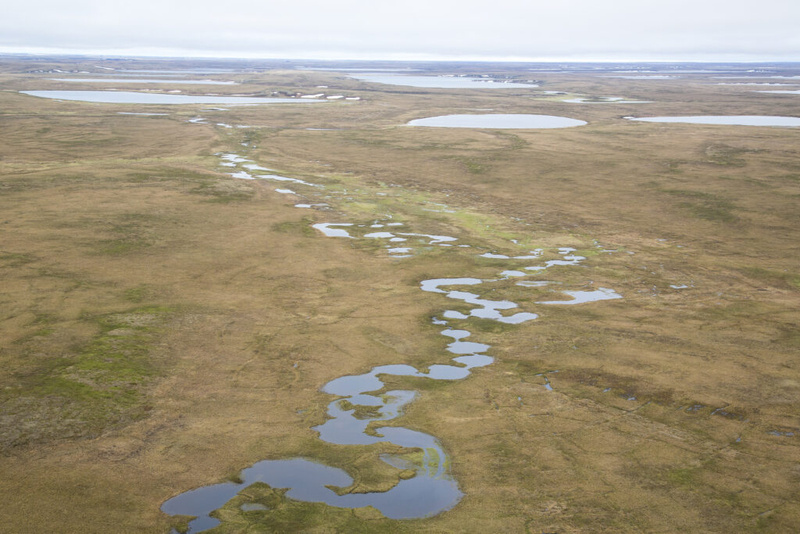
Tundra in the northeastern area of the National Petroleum Reserve in Alaska is seen from the air on June 28, 2014. A new U.S. Geological Survey resource assessment estimates undiscovered natural gas resources across the entire North Slope, including hte 23 million-acre petroleum reserve. (Photo by Bob Wick/U.S. Bureau of Land Management)
Alaska’s North Slope probably holds enough undiscovered natural gas to fuel the nation for nearly three years, according to a new federal report.
A resource assessment released Wednesday by the U.S. Geological Survey produced a mean estimate of 96 trillion cubic feet for undiscovered conventional natural gas reserves across the entire North Slope.
That is far more than the 35 trillion cubic feet of known reserves, most of which lie within the Greater Prudhoe Bay Unit, which has been producing oil since the 1970s.
The 96 trillion cubic feet estimate is “roughly three times the size of the known gas accumulations on the Alaska North Slope,” said Alicia Lindauer, coordinator of the USGS energy resources program, in a news briefing Wednesday.
“If you think about the total natural gas consumption across the country, it would be the equivalent of just under three years’ worth of U.S. natural gas consumption.”
The new assessment also contains a mean estimate of 17 billion barrels of undiscovered oil on the North Slope.
It is the first North Slope-wide resource assessment for natural gas. Past USGS assessments have been for portions of the North Slope. Recent USGS assessments for different areas were released in 2021, 2020 and 2017.
The total was not surprising, given that it was a North Slope-wide assessment, said William Craddock, a USGS geologist who was one of the report’s authors.
“In a sense, we think this is fairly consistent with how the province has been viewed in the past,” Craddock said at the news briefing.
The report incorporates new knowledge and new technology, the USGS officials said. Like other geologic reports, it does not consider the economics of extracting that oil and gas, they said.
Big oil discoveries at Willow, the huge project that ConocoPhillips is developing on the western North Slope, and at Pikka, the nearby project where operator Santos started production this year, were among the factors considered, the report’s authors said.
“Those plays in particular are very prospective, are highly prospective, for undiscovered oil and gas resources,” Craddock said. “The geology that defines those fields extends across vast portions of the northern part of this province, and so that prospectivity is reflected in the undiscovered oil and gas resource numbers.”
Like other USGS resource assessments, the new report does not consider economic factors. The new report also considers only conventional oil and gas, whether associated with oil deposits or independent of those liquids. It does not consider unconventional resources like gas hydrates or coalbed methane.
And like other USGS resource assessments, it includes estimate ranges. For natural gas, the range is between 17.3 trillion and 276.6 trillion cubic feet.
The new assessment includes three general geologic layers below the North Slope’s surface: the Brookian sequence, which holds rocks 140 million years old and younger, covering most of the Cretaceous era; the Beaufortian sequence, which holds rocks from about 140 million to 200 million years old, including the Jurassic period; and the Ellsemerian sequence, which has rocks as old as about 350 million years, and includes the Triassic period.
The Brookian sequence is the one most relevant to current and future oil activities on the North Slope. It holds formations that are important to current North Slope oil production, including the Sagavanirktok formation, which provides oil produced at Prudhoe Bay and other fields, and the Nanushuk and the Torok formations, which underlie newer fields on the western side of the North Slope.
Trump administration touts report
USGS officials said the new resource estimate was not ordered for any specific reason but is part of the agency’s normal operations, which include periodic assessments every few years of energy resources on the North Slope and elsewhere.
“This assessment was conducted as part of our regular process. We’ve had ongoing work to really assess both oil and gas resources across the Alaska North Slope. This one wasn’t prompted by a specific request but was part of that overall plan to assess the entire Alaska North Slope,” Lindauer said.
However, Department of the Interior leaders said the new assessment is in line with President Donald Trump’s policies and an Inauguration Day executive order called “Unleashing Alaska’s Extraordinary Resource Potential.”
“Alaska is one of America’s greatest energy frontiers, and President Trump is committed to unlocking its extraordinary potential,” Secretary of the Interior Doug Burgum said in a statement. “Alaska’s natural gas reserves can supply affordable, reliable, secure energy to Americans and our South Pacific allies for generations, and this assessment helps underscore the importance of understanding these vast resources beneath the North Slope and using world-class American science to turn that potential into opportunity. By advancing responsible energy development, we can strengthen American Energy Dominance, create jobs and deliver lasting economic benefits for Alaskans and the entire nation.”
For now, the 35 trillion cubic feet of known natural gas and the estimated 96 trillion feet of prospective natural gas remains stranded on the North Slope, hundreds of miles from any market. For that reason, energy companies have not explored for North Slope gas and have focused instead on oil, which has been shipped through the Trans Alaska Pipeline System since 1977.
Proposals to build a massive natural gas pipeline project to commercialize the North Slope’s gas — sending it either through Canada to Lower 48 markets or through an 800-mile pipeline to a liquefaction facility at tidewater for shipment to Asian markets — date back to the time even before oil production started at Prudhoe Bay in 1977.
None has been deemed economically viable.
Alaska natural gas pipeline dreams stretch over half a century
The Trump administration is the latest presidential administration to advocate for a massive natural gas pipeline project to ship North Slope reserves to markets.
Trump, his cabinet members, Alaska Republican Gov. Mike Dunleavy, U.S. Sen. Dan Sullivan, R-Alaska, and U.S. Rep. Nick Begich, R-Alaska, said last month that the Republic of Korea had pledged to invest $54 billion in the current project, which proposes to ship LNG to Asia using an 800-mile pipeline and a liquefaction plant at Cook Inlet.
The claim was false. The Korean government said it has not made any such commitment, though it is evaluating possible participation in the Alaska LNG project.
During an Oct. 13 campaign rally in Wasilla, Trump said the government of Taiwan has committed to invest in the project. In response, the Taiwanese government said it, too, is considering participation but has not yet made a commitment.
Juneau