Truckers lose bid to be reimbursed for legal bills in RhodeWorks toll fight
Mar 30, 2026 | 5:58 pm ET
Description
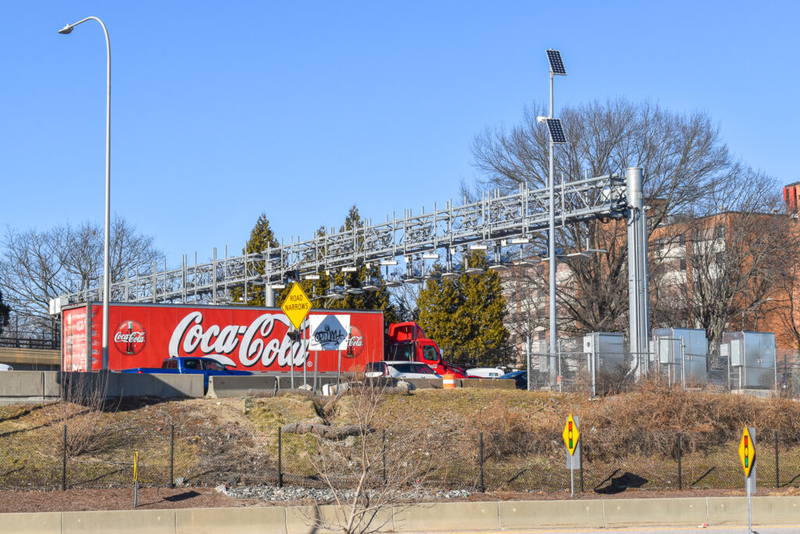
A Coca-Cola truck passes under an offline tolling gantry on Interstate 195 in Providence in March 2025. (Photo by Christopher Shea/Rhode Island Current)
Rhode Island will receive around $200,000 out of the $9 million in legal fees it had requested from the association that sought to topple the state’s ability to toll large tractor trailers on its highways, a federal judge ruled Friday.
John J. McConnell, chief judge of the U.S. District Court in Providence, rejected a motion by the American Trucking Associations (ATA) seeking to recoup $21 million in attorney fees from its 2018 lawsuit challenging the overall truck tolling system created under the Gina Raimondo-era RhodeWorks program.
Rhode Island’s tolling system went live in June 2018 with each of its 13 highway gantries charging an average toll of $3. A truck paid a toll only once in each direction, could not pay more than $40 per day, and could not pay more than $20 for making a single “through trip” from Connecticut to Massachusetts.
The system collected nearly $104 million in revenue before being shut down in 2022 after then-U.S. District Judge William E. Smith sided with the ATA and ruled the program’s $20 per day cap was unconstitutional. Smith said the state had placed the “lion’s share” of the tolling burden on out-of-state trucks. The ATA had argued that approximately 80% of the tolled vehicles came from out of state.
The state appealed the ruling that November. In December 2024, the federal appellate court in Boston found Rhode Island could charge trucks — but only if it eliminated a $20 per day cap.
The cap removal and initial District Court ruling led the association to declare itself as the prevailing party in the matter. But the state maintained it was the true victor because the Boston appellate court upheld the program’s constitutionality.
“While the court agrees that the defendants’ role in upholding the RhodeWorks program qualifies them as a prevailing party, it declines to find that ATA filed this action for any improper purpose,” McConnell wrote in his order on Friday.
McConnell said the ATA “vastly overstated the benefit, if any, that they have received from the ultimate resolution of their challenge to the RhodeWorks program.”
Both the association and Attorney General Peter Neronha’s office declined to comment on McConnell’s ruling. Gov. Dan McKee’s office did not immediately respond to inquiry from Rhode Island Current.
In civil courts, prevailing parties are typically entitled to get costs associated with filings and witnesses reimbursed by the lesser of the case, Niki Kuckes, a professor at Roger Williams University School of Law, expained. If a plaintiff wins against the government over a constitutional claim, that opens the door for attorneys fees to be paid. The rule was created by the federal government under the Civil Rights Attorney’s Fees Award Act of 1976 — also known as section 1988 to the U.S. Code.
“The idea is that there are certain kinds of cases that lawyers are not going to be willing to bring unless we bring this at a reimbursement,” Kuckes said. “The usual rule is each party pays their own attorney.”
That rule for reimbursements also applies to state defendants, but Kuckes noted governments have to show that the case against them was brought forward in bad faith.
“That’s why although the state of Rhode Island did prevail, they did not get their fees paid,” she said.
On Dec. 2, 2025, U.S. Magistrate Judge Patricia Sullivan recommended that the association be awarded $2.7 million for its win from the District Court case.
“ATA prevailed to the limited extent that it established by judicial imprimatur that Rhode Island cannot discriminate against its members — owners and operators of large commercial trucks traveling in interstate commerce,” Sullivan wrote. “RhodeWorks without the caps would not benefit but rather would increase the burden on ATA’s members in that large trucks traveling in interstate commerce (like local large trucks) would pay uncapped tolls.”
But McConnell’s analysis was that the association still isn’t a prevailing party under the law “because it failed to obtain any practical benefit from the 1st Circuit’s severance of the caps.”
“Specifically, the evidence from this dispute confirmed that the lack of daily caps will result in ATA paying a higher amount in daily tolls and that it does not receive any tangible financial benefit from their elimination,” he wrote.
In a footnote, McConnell noted the circuit court’s ruling could encourage other states to enact capless truck tolls on their highways.
Officials at the Rhode Island Department of Transportation (RIDOT) are still working to get Rhode Island’s gantries reactivated — most likely during the first quarter of 2027, its interim director told members of the House Committee on Finance’s Subcommittee on Environment and Transportation March 10.
McKee’s administration had planned on reactivating the tolling gantries some time this spring, but interim RIDOT director Robert Rocchio told lawmakers the entire system needs to be replaced after sitting dormant since 2022. Rocchio said the new hardware to get the system up and running again is estimated to cost $19 million.
RIDOT also issued a request for proposals to create a new back office system that will manage toll transactions. Nine entities responded by the state’s March 27 deadline: Bridge Atlantic, LLC; Electronic Transaction Consultants, LLC which would do business as Quarterhill; Emovis USA, Inc; Kapsch TrafficCom USA, Inc; Legnetix, Inc; Neology, Inc; SWC Group; ViaPlus, LLC; and Vitronic Machine Vision, Inc.
A contract is expected to be awarded some time in May, RIDOT spokesperson Charles St. Martin told Rhode Island Current.
McKee’s fiscal 2027 budget recommendation assumes the tolls will bring in $20 million for state coffers, increasing to $40 million in annual revenue starting in fiscal 2028.
Providence, RI