‘Light rail to nowhere’? Surging costs undercut I-5 bridge transit plan
May 29, 2026 | 7:00 am ET
Description
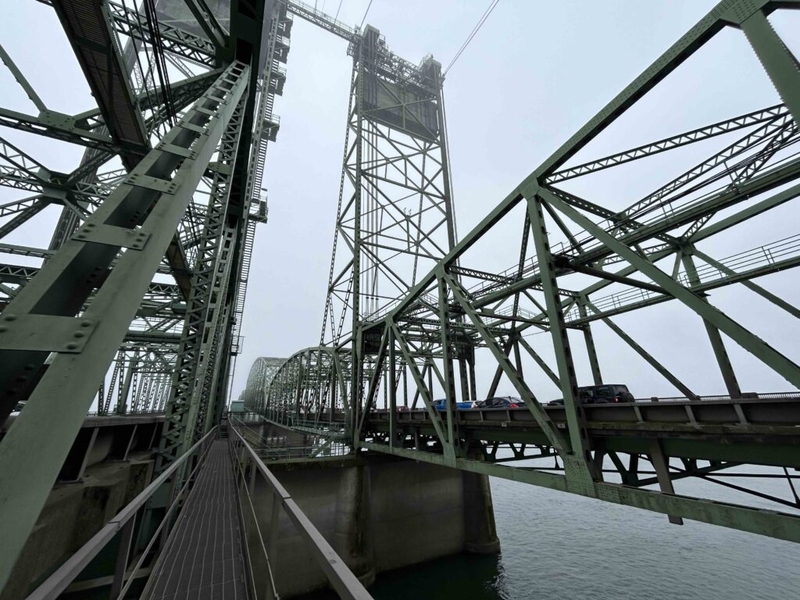
Rising costs have led state leaders in Washington and Oregon to pursue the building of a new bridge on I-5 across the Columbia River in phases. It has made for an unclear timeline for extending light rail into Vancouver, frustrating backers of that component. (Grant Stringer/States Newsroom)
A ginormous cost increase to construct a new bridge linking Washington and Oregon is forcing state leaders and program managers to rightsize public expectations for the megaproject.
And, some say, downsize the vision for a marquee component — light rail.
City officials in Vancouver, Washington, are incensed that plans for bringing light rail service into town, near the local library, are getting put off indefinitely. They worry the end of the rail line could be a station perched high above freight train tracks near the city’s waterfront because there’s no timeline for designing the final leg of the long-promised route.
As it is, service on the initial stretch to the waterfront is at least a decade away and requires federal funding that isn’t locked in.
Overseers of the Interstate Bridge Replacement Program have sliced the $14.4 billion undertaking into critical pieces in response to ballooning costs. They say the first funded phase, which would be paid for with $6 billion in hand, consists of building the new span and highway connections to it, tolling infrastructure, transit design and removal of the existing bridge.
The future bridge would be built to accommodate an extension of light rail from Portland into Vancouver. Installing tracks and running trains, however, hinges on securing a billion-dollar federal grant. Whether that money can be secured won’t be known for a few years.
The situation reflects what Gov. Bob Ferguson outlined in March when he revealed the project’s estimated price tag had doubled from prior projections and said the focus for now would be on completing core components.
Local leaders only learned about the change to the light rail plans the day before Ferguson’s news conference.
“We thought we were in a partnership on how this could look in Vancouver. We’ve had pretty good communication. Then boom, things stopped,” said Vancouver Mayor Anne McEnerny-Ogle. “That’s when they made a decision.”
She said when she shared her concerns with Ferguson at the time, “he didn’t seem to know how important this is to us. Are we willing to wait 10 to 15 years to get light rail to the library? No.”
Ferguson was not made available for this story.
Brionna Aho, the governor’s communications manager, said phasing is typical for large multi-year transportation projects. The project team brought forward a proposal on how to proceed, and Washington and Oregon agreed, she said in an email.
“There is no money to build light rail in the existing funding. That is the budget reality,” Aho said. “As we made clear at the press conference with the mayor, we will continue to fight for more funding. We appreciate the partnership of the mayor and the city.”
Phasing in, phasing out
State leaders have pursued a new bridge for years, amid worries the existing century-old drawbridge is seismically unsafe and could fail in a major earthquake.
The Interstate Bridge Program encompasses a buffet of improvements in both states throughout a 5-mile corridor. These range from the new bridge and light rail to new on- and off-ramps, bus shelters, and bike lanes.
Until March, planners estimated the price for the full project ranged from $5 billion to $7.5 billion. Staff began recalculating the estimate last year, examining more than 100 risk factors that could drive up costs, including tariffs and surging inflation on other transportation projects.
Ferguson rolled out the new estimated range of $13.5 billion to $15.2 billion, with a most likely cost of $14.4 billion, on March 17.
The current estimate for replacing the northbound and southbound spans, connecting them to the highway, removing the old bridge and extending light rail service to Vancouver is $7.65 billion, according to information presented to the Washington State Transportation Commission in mid-May.
Making room on the bridge for light rail, but not building it, drops the overall cost to $5.68 billion. That’s the current approach. Ferguson said a bridge construction contract will be issued next year. Cars could be driving across the new span by 2035, roughly two years later than previously announced.
If the two states secure the $1 billion federal transit grant they seek, light rail could be added in a later phase. A final decision on the application is not expected before 2030 and service is not anticipated before 2036.
‘Light rail to nowhere’
From the project’s outset, the vision has been for a 1.9-mile extension of the Metropolitan Area Express, or MAX, Yellow Line from the Expo Center station in Portland to a future station on Evergreen Boulevard near Interstate 5 in an area known as Library Square. New stations are planned at Jantzen Beach on Hayden Island and the Vancouver waterfront area before terminating at the Evergreen Boulevard property, where a transit hub is planned.
Things have changed. Funding in the first phase is to just design the section across the Columbia River ending at an elevated station between Columbia Way and 3rd Street near the Vancouver waterfront, according to environmental documents.
The station would sit 90 feet above ground, overlooking the BNSF railroad tracks. Riders would use stairs and elevators to reach the platforms. Because there are no parking lots in the area, park-and-ride lots would be developed, documents show.
McEnerny-Ogle said she has tried to steer planners and Ferguson advisers to consider a different option that could deliver a ground-level station and on-site parking, and reach the promised Evergreen station.
With their current proposal, she said, “We will have to deal with how people get to light rail. All of the opponents get it. They can say they’re building a light rail to nowhere.”
Interstate bridge program staff declined to comment on how the waterfront station site was chosen.
“The long-term vision is still to complete the extension to Evergreen Station,” they said in a statement.
It’s a view shared by State Sen. Marko Liias, D-Edmonds, chair of the Senate Transportation Committee.
“I’ve assured the Vancouver mayor we’re in it for the long haul,” he said. “We will get to the finish line. It isn’t fun to know that it will take longer than expected.”
Olympia, WA