Trailer park firm sued by Kris Mayes is the biggest donor to a PAC backing Warren Petersen
Jul 16, 2026 | 7:13 pm ET
Description
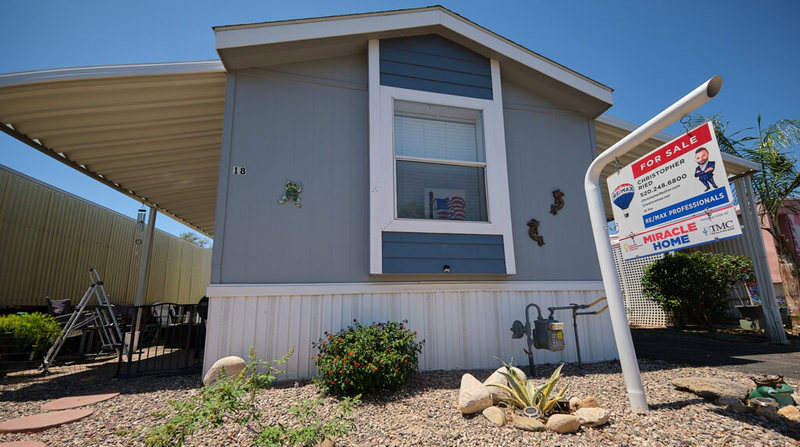
A mobile home in Tucson. (Photo by Michael McKisson/Arizona Luminaria)
A trailer park management company being sued by Democratic Attorney General Kris Mayes is spending big to back one of Mayes’ GOP opponents in a bid to defeat her in November.
Mayes filed a lawsuit against the BoaVida Group last year after electricity outages during a deadly summer heat wave left residents at Tucson’s Redwood Mobile Home Park in danger. BoaVida owns five other trailer parks in Arizona.
Now, BoaVida is the largest backer of the Restore Order Arizona PAC, which has been spending money on ads supporting Arizona Senate President Warren Petersen in his campaign to become the Republican nominee for AG in November. The company poured more than $600,000 into the pro-Petersen campaign through the end of June, according to a campaign finance report filed this month.
Other state AGs have also taken interest in pursuing the company over allegations of poor conditions at parks they manage, as well as rent hikes.
BoaVida accused Mayes of being unfair and “anti-business,” and said she should be replaced by Petersen.
“As a business owner in Arizona we support those who are not anti-business, those who are fair, reasonable, and seek to benefit the state as a whole, not just look for targets for publicity,” the company said in a statement to the Arizona Mirror. “We believe Warren Petersen reflects the conservative values of the state and support his candidacy.”
The company said it has not discussed any of the legal matters with Petersen.
Mayes’ campaign is unconvinced.
“In June, we said follow the money. Now we know where it leads. Four days after Attorney General Mayes asked a court to hold BoaVida in contempt for leaving Arizona families in dangerous, sweltering conditions, BoaVida’s companies wrote half a million dollars in checks to Warren Petersen’s PAC,” DJ Quinlan, a consultant for Mayes’ reelection campaign, said in a statement to the Mirror. “These corporate landlords and mobile home landlords aren’t donating — they’re shopping for an attorney general who will drop the cases against them. Warren Petersen is happy to oblige.”
Petersen did not respond to multiple requests for comment for this story.
BoaVida has been facing pressure from lawmakers across the country, as well as from tenants. It is also one of six companies that New Hampshire U.S. Sen. Maggie Hassan asked to produce internal documents and materials showing how their businesses have impacted mobile home parks across the country.
They also aren’t the only mobile home park owner investing heavily in the race.
Havenpark Management, Newbury Management, Comfort Communities and a number of small Arizona parks contributed more than $85,000 to the PAC. Those parks and BoaVida’s contributions combined make up almost half of the money raised by Restore Order Arizona.
These corporate landlords and mobile home landlords aren't donating — they're shopping for an attorney general who will drop the cases against them. Warren Petersen is happy to oblige.
The PAC also includes corporate landlord interests, with groups like American Homes 4 Rent contributing $10,000.
The PAC seems to be largely funded by a collection of special interest groups that Mayes has clashed with during her first term as AG. The largest individual donor is a major player in the nicotine vape industry in Arizona, which Mayes has aggressively sought to regulate.
Private prison company GeoGroup, which operates a number of detention facilities for U.S. Immigration and Customs Enforcement, is another major funder. GEO Group has reported record profits since Trump took office and has been pushing the administration for larger enforcement efforts.
And another $10,000 came from VGW Luckyland Inc., a company that operates a number of unlicensed sports betting sites that the Arizona Department of Gaming, backed by Mayes, has sought to shut down.
“This is the first time that I personally have looked and seen the donations that have happened,” Mary Alice Theroux, a Tucson mobile home park resident that has been organizing to push back against predatory practices, told the Mirror.
Theroux said that out-of-state companies have been largely contributing to issues at local mobile home parks that she said lawmakers have been largely ignoring. Theroux was able to get the ear of Mayes and others who have been working to try to pass legislation or file lawsuits against the park owners.
One of those major issues has been with how mobile home and manufactured home parks deal with utility metering.
Sub-metering is when the landlord or property owner is the “customer of record” for a utility company, which often leads to tenants not being able to get information from a utility company on outages. It is also leading to fees that residents say are unfair.
Lawmakers sought to address this issue during the last legislative session, but Petersen killed multiple bills. First, a bill that passed unanimously in the state House of Representatives dying in the Senate, which Petersen presides over. A second version of the bill was introduced later in the session, once again earning broad bipartisan support in the state House before once again stalling in the Senate, where it was never brought up for a vote.
“I think there is real bipartisan recognition that this is an issue happening in these parks,” Kelly McGowan, executive director at the non-profit Wildfire, which focuses on the issues of poverty, told the Mirror.
Theroux said she believes that the companies that own the parks are likely behind the bill’s demise.
“These parks that have donated were really upset because we got the bill passed 100% in the House, so they started coughing up their money when it got to the Senate,” Theroux said, adding that Petersen was responsible for the demise of the second bill. “He killed the bill, he would not put it forward.”
“We don’t see any reason that mobile home park tenants should have a different set of rules,” McGowan said.
The bills addressed protections that are within Arizona’s Landlord Tenant Act but not in the Mobile Home Parks Residential Landlord and Tenant Act.
The legislation sought to cap administrative fees for utility metering at $8 as park residents have reported high administrative costs for this service leading to outsized bills. It would also have made it easier for residents to speak directly with utility companies about issues regarding service.
And for both Theroux and McGowan, the parks represent a subsection of Arizonans that are especially vulnerable to a number of issues.
“I’m sick and tired of seeing elderly women and elderly men taken advantage of. They’re afraid to stand up because they’re afraid of getting threatened with eviction,” Theroux said, adding that a number of elderly heat-related deaths have been tracked to these parks.
“This is a really affordable housing stock for some of our most vulnerable community members,” McGowan said, noting that another piece of legislation aimed at adding protections for these residents under Arizona’s Consumer Fraud and Protection Act similarly failed. “These are people who have put their life savings into what in some cases is their only asset.”
But addressing the issues facing this population is likely to take more time as McGowan noted that she and others have been finding more and more issues to address.
“This is like an onion of an issue, and we have only just begun pulling it back, and I think we will be working on it layer by layer,” McGowan said.
Phoenix, AZ