Hobbs raised $2.6M in Q2, more than the GOP field, fueling her early ad blitz in reelection bid
Jul 16, 2026 | 8:56 pm ET
Description
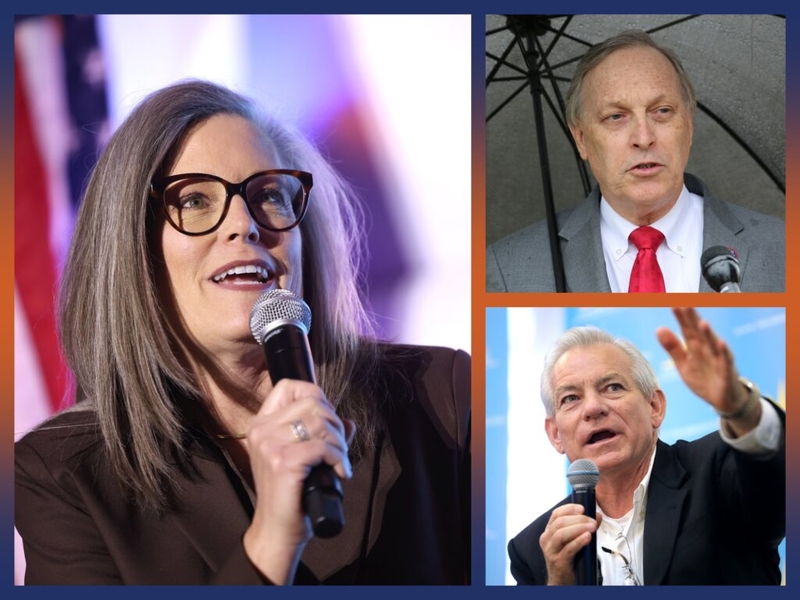
Clockwise from left: Gov. Katie Hobbs, U.S. Rep. Andy Biggs, U.S. Rep. David Schweikert. (Photos by Gage Skidmore and Cronkite News Service)
Arizona Gov. Katie Hobbs raked in campaign donations during the second quarter of 2026, collecting about $2.6 million — but she also spent big as she launched a high-dollar advertising campaign boasting about her record as governor.
Campaign finance reports for April 1 through June 30 show that Hobbs had more than $7.1 million in cash on hand at the beginning of the reporting period, but that she spent $7.4 million, leaving her with nearly $2.4 million in the bank.
The frontrunner in the Republican primary who hopes to face Hobbs in the November general election, U.S. Congressman Andy Biggs, scoffed at Hobbs’ big spending in a statement.
“Katie Hobbs lit $7.4M on fire during the second quarter of the 2026 cycle, stumbling into the general election after a 281% burn rate in the previous quarter,” Biggs’ campaign said in the statement. “Hobbs’ fundraising lead over Congressman Andy Biggs shrank by nearly $5M and is now roughly a $1M cash on hand advantage, a pitiful number for an incumbent governor who has held statewide office for nearly a decade.”
But Hobbs’ campaign bragged on Thursday that she’d again outfundraised the entire GOP field running for governor adding that she’d gotten a “historically early start on paid communication, which will only ramp up closer to the November election.”
The amount Hobbs spent in the second quarter on campaign infrastructure and advertising is more than double what Biggs has raised for his campaign.
And even after her big spending, Hobbs still has a significant fundraising lead over Biggs, who has the backing of President Donald Trump and Turning Point USA.
Biggs had just over $1.1 million on hand in the second quarter, and raised about $916,700 during that time. His campaign spent $770,000, leaving him with about $1.2 million in the bank, half the amount Hobbs has in her warchest.
In a statement, the Hobbs campaign said that the vast majority of her campaign funding came from small contributions of less than $100.
“Breaking fundraising records quarter after quarter, Katie is building a coalition that spans party lines, bringing Democrats, Republicans, and Independents together behind her Arizona First leadership,” Hobbs campaign manager Nicole DeMont said in a statement.
Biggs’ opponent in the July 21 Republican primary, U.S. Congressman David Schweikert, lagged far behind Biggs and Hobbs, taking in just $101,000 in donations during the second quarter. He had $86,388 on hand at the beginning of the quarter and spent $170,878, leaving him with only $42,494 on hand just weeks before the primary election.
In the contentious Republican primary for Arizona Secretary of State, Arizona Rep. Alexander Kolodin collected $73,370 in donations compared to his opponent, former Arizona Republican Party Chairwoman Gina Swoboda’s $58,730.
At the start of the second quarter, Kolodin had $300,355 on hand, $95,000 of that in loans he made to his own campaign.
During the second quarter, Kolodin spent $82,000, a big chunk of that — about $74,000 — paid to Forged Communications for advertising. Forged Communications is owned by Arizona Sen. Jake Hoffman, leader of the far-right Arizona Freedom Caucus, of which Kolodin is a member. Kolodin had $292,000 on hand at the end of the reporting period.
Swoboda had almost $60,000 on hand at the start of the quarter, including $53,000 that she loaned to her campaign. She spent $95,871 during the second quarter, leaving her with $22,575 in the bank.
Arizona Secretary of State Adrian Fontes, a Democrat, outfundraised his Republican opponents, bringing in about $519,000 in the second quarter. Fontes had $781,000 on hand at the start of the reporting period and spent more than $284,000, leaving him with about $1 million in the bank.
Attorney General Kris Mayes, a Democrat, had more than $2.5 million on hand at the start of the reporting period and took in more than $1.2 million in contributions. She spent more than $1.4 million, including more than $400,000 for advertising, leaving her with $2.3 million on hand.
Arizona Senate President Warren Petersen, a Republican who hopes to go up against Mayes, took in $275,416 during the second quarter of 2026. He had more than $1.5 million on hand at the start of the reporting period, including $123,000 that he loaned to himself. Petersen spent more than $1.2 million, leaving him with $523,862.
Petersen put about $900,000 of that into television ads and spent $3,000 on Google ads.
During the second quarter of 2026, Petersen’s opponent in the Republican primary and regular candidate for Arizona office, Rodney Glassman returned nearly $18,000 in payments he received beyond contribution limits in 2024, 2025 and 2026.
Glassman was facing possible legal trouble for accepting at least 30 contributions in 2024 and 2025 above the contribution limits spelled out in state law. His refunds appear to be an attempt to remedy that.
As of September, Coconino County agreed to investigate the allegations that Glassman violated campaign finance law, after Mayes said her office couldn’t do so since Glassman could potentially be her opponent in November. Coconino County Attorney Ammon Barker told the Mirror on Thursday that his office was still reviewing the referral from the Attorney General’s Office but that it should be completed soon.
Glassman had more than $4 million on hand at the start of the reporting period, including $1 million from a loan he made to his own campaign in 2024. He raised nearly $584,000 in the second quarter and spent about $2.2 million, with more than $2 million of that going toward advertising and signs. That left him with about $2.4 million in the bank.
Republican challenger for Arizona Superintendent of Public Instruction Kimberly Yee outraised Republican incumbent Tom Horne in the second quarter, bringing in more than $82,000 in donations to Horne’s just over $34,100.
Yee, who is currently the Arizona Treasurer, had $243,713 on hand at the start of the period and spent $80,271, leaving her with $245,600 remaining. A big chunk of Yee’s spending in the second quarter — $68,046 — went to Forged Communications for consulting. Hoffman, Forged Communications’ owner, recruited Yee to challenge Horne after the incumbent angered school voucher families with increased restrictions on their spending.
Horne had $829,478 on hand at the start of the second quarter, with $651,000 of that coming from loans he made to his own campaign. He spent $474,474 leaving him with $389,000 in the bank.
Phoenix, AZ