As Trump administration offloads federal office space, what takes its place?
Jul 16, 2026 | 8:37 pm ET
Description
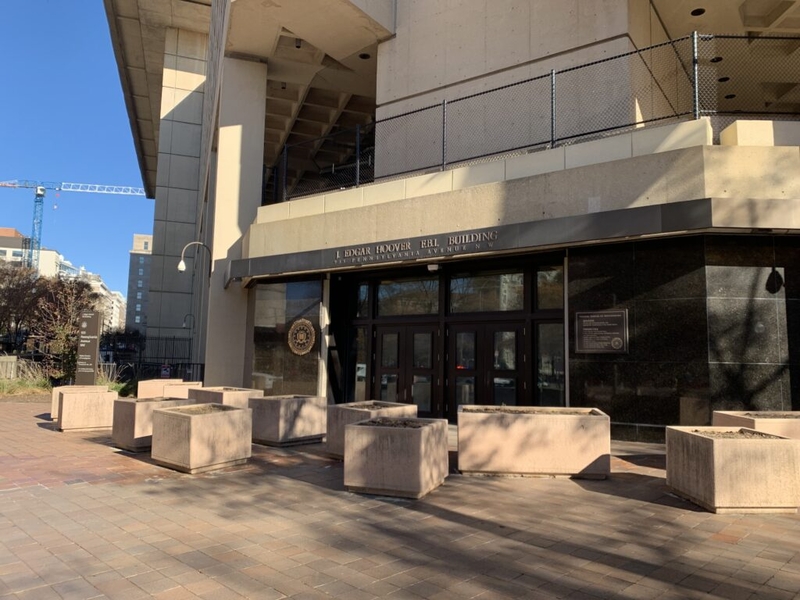
The J. Edgar Hoover Building in downtown Washington, D.C., has been the FBI headquarters for 50 years, but the agency is abandoning it, one of many properties the federal government is trying to get rid of. (Photo by Jane Norman/States Newsroom)
By Jory Heckman
The Trump administration is moving more aggressively than prior administrations to shrink the federal government’s massive real estate portfolio.
The General Services Administration, which manages 40% of the federal government’s office space, is accelerating plans to offload underutilized buildings and those falling into disrepair as part of a $50 billion maintenance backlog.
But what happens next for these recently sold buildings — and those marked for disposal — is still coming into focus.
Some buyers, are looking to convert former federal office buildings into apartment buildings. Others are marked for demolition, while a former federal building site in San Antonio will eventually become an arena for the city’s basketball team.
One former Agriculture Department building is now a luxury apartment building. Nearby, part of USDA’s headquarters complex is also on the market: The South Building, once the largest office building in the world, until the Pentagon was built in 1942, is the largest single liability in GSA’s portfolio, with $1.6 billion in delinquent maintenance costs and
The Trump administration, spurred by reports of federal office buildings that have been largely empty since the start of the COVID-19 pandemic, is offloading government real estate nationwide. But its disposal efforts have the potential to reshape whole neighborhoods in the nation’s capital.
While 85% of the federal workforce lives and works outside of the national capital region, much of the consolidation is happening in Washington, D.C., where several agency headquarters buildings could be on the market.
In Southwest Federal Center, the administration is planning to sell the headquarters for three agencies — the Department of Housing and Urban Development, the Energy Department and Voice of America.
USDA reasserts plan to shutter Beltsville, part of reorganization to move thousands of federal jobs
The Public Buildings Reform Board, created by Congress in 2019 to help GSA fast-track disposal of underutilized federal buildings, is looking at more opportunities to shrink this cluster of federal buildings. The board estimates underutilized federal office space costs GSA more than $1 billion annually.
Former Rep. Mike Capuano (D-Mass.), a member of the board, said members are looking at the USDA’s Beltsville Agricultural Research Center — which is set for closure under the department’s sweeping relocation — the Denver Federal Center and the Southwest Federal Center for its next and final round of disposal recommendations.
Capuano said the board has been assessing federal buildings in Southwest D.C. over the past year.
“However, we have thus far refrained from making any additional disposal recommendations,” he said at a June 25 board meeting. “Absent an identified anchor tenant for Southwest, the market is not ready to absorb all of this additional square footage.”
Without a master plan for redevelopment — similar to the blueprint that transformed the nearby Navy Yard neighborhood — Capuano said the future of Southwest D.C. remains unclear.
“As it stands, without a comprehensive district development plan, underwriters are not willing to assume the risk and the unknowns for these properties, which is why selling the properties piecemeal won’t work,” he said. “An entity can lead disposition and redevelopment planning, helping to attract an anchor tenant and ensuring the proper phasing occurs to bring the right properties to the market at the right time.”
Board member David Winstead, a former commissioner of GSA’s Public Buildings Service, said GSA “is very involved” in discussions with the D.C. government and the National Capital Planning Commission on a potential master plan for redeveloping Southwest Federal Center.
Capuano said the board has received eight unsolicited letters of interest from parties looking to acquire federal assets that may soon hit the market.
“This proves we’re digging in the right spots and knocking on the right doors,“ he said.
The PBRB’s third-round disposal recommendations are due to the Office of Management and Budget by December 2026, when the board is scheduled to sunset. Congress extended the board’s authorization last year, and Capuano said lawmakers should consider keeping the board around a bit longer.
“If you believe, as we do, that more work remains and taxpayer savings can still be reaped, we’re happy to continue serving the American people,” he said.
GSA has sold and offloaded several buildings from PBRB’s most recent round of recommendations — but most of those properties are on hold until agencies can relocate their employees.
PBRB’s second round of disposal recommendations includes the Wilbur Cohen Building, which is home to Voice of America and rare New Deal-era murals, Energy’s James Forrestal Building and the Maryland headquarters for USDA’s Animal and Plant Health Inspection Service. The list also includes federal buildings in Miami, Atlanta, Chicago, Boston, Nashville and Houston.
Rich Butterworth, a senior adviser for GSA’s Office of Real Property Utilization and Disposal, said most relocations are scheduled for 2028 and 2029, “due to the need for funding for those tenant relocations and buildout in order to move them.”
GSA Administrator Edward Forst told the Senate Appropriations Committee in May that half of GSA’s real portfolio of buildings is in “fair” or “poor” condition.
Forst led the heads of 22 agencies in a recent letter asking Congress for full access to the Federal Buildings Fund, a pot of money that includes all rent payments GSA receives from tenant agencies. Over the past 15 years, Congress has skimmed about $1 billion annually from the fund to cover other expenses.
But those funds are not enough to address a $50 billion backlog in maintenance and repair projects — more than double GSA’s previous highest estimate — according to a report released in March by the PBRB. The board recommends a “radical reduction” of GSA real estate to address this backlog.
“Our administrator has been very clear that, no, we cannot appropriate our way out of problems,” Butterworth said.
Prior presidential administrations focused on freezing and shrinking the federal real estate portfolio, but these efforts were put on hold at the start of the pandemic. But GSA is now hitting milestones in its accelerated disposal efforts.
GSA announced last week that it had sold all 12 federal buildings that PBRB recommended selling in its first recommendations seven years ago. Its last sale from the “high-value” list was the former Chet Holifield Federal Building, a step-pyramid building on nearly 90 acres in Orange County, California. Sales from these properties have generated more than $533 million that will go toward further consolidation activities.
GSA also recently sold a federal building and nearly six acres of land to the city of San Antonio, which plans to use the site to build a new arena for the San Antonio Spurs. GSA said it completed that sale five years ahead of schedule.
Former federal buildings are also being adapted for residential use: Winstead said GSA’s former national capital region building, at 7th and D streets SW, is being converted into apartments.
If they have low occupancies and they take a lot of money to bring back up to functional Class A space, it’s on our radar screen, and we’re looking to recommend that the government get rid of it. The government does not appropriate enough money to renovate all the buildings that the government owns.
“It’s going to be challenging. But the city’s looking for housing in Southwest. There is very little. So that’s potentially a benefit,” Winstead said.
Winstead said the recently sold Liberty Loan building, the former home of the Treasury Department’s Bureau of the Fiscal Service, would be another strong candidate for residential conversion.
“In the case of Liberty Loan, it’s got one of the best views in town. It could either be a commercial hotel, it could be residential,” he said.
The board’s next round of disposal recommendations is focused on finding federal buildings with especially low occupancy rates and high deferred maintenance backlogs.
“If they have low occupancies and they take a lot of money to bring back up to functional Class A space, it’s on our radar screen, and we’re looking to recommend that the government get rid of it,” said former Rep. Nick Rahall (D-W.V.), another member of the board. “The government does not appropriate enough money to renovate all the buildings that the government owns.”
Rahall said the board’s review of the federal real estate portfolio turned up “leaking roofs, unsafe elevators and flooded basements” — as well as air-handling systems from the 1940s that are still in use.
“The maintenance backlog translates into unhealthy and sometimes unsafe work environments for our federal employees,” Rahall said. “The federal buildings that the PBRB has toured are in poor repair, are in need of extensive capital investment, and cannot possibly be serving the best interests of the agencies they house.”
The former Department of Government Efficiency spent much of last year focused on reducing the government’s real estate portfolio — but primarily on cutting federal leases. At DOGE’s urging, hundreds of federal leases were canceled, but hundreds of lease terminations were also walked back.
Maryland sues Trump administration for ‘illegal’ action to keep FBI headquarters in D.C.
Rahall said the PBRB is not part of DOGE or GSA, but is instead an “outside set of eyes” meant to reform the process of offloading excess federal buildings.
Despite the Trump administration’s push to bring workers back to the office full-time, Rahall said new occupancy data collected by GSA shows that federal employees fill “somewhere between a quarter to a half of those buildings.”
“The vast majority of federal office space remains vastly underutilized. This means that taxpayers are paying enormous sums to provide for the few who do come to work,” he said.
In March, GSA published its first governmentwide snapshot of federal building utilization data. That data shows that none of the federal buildings that submitted data are meeting a minimum benchmark that would spare them from mandatory consolidation.
Under the USE IT Act, which former President Joe Biden signed in his final weeks in office, agencies must demonstrate that their buildings meet at least a 60% utilization rate or develop plans to downsize their office space.
But GSA is taking a closer look at the data. Acting Public Buildings Service Commissioner Andrew Heller recently told the House Transportation and Infrastructure Committee that USE IT Act data looks at total square footage, and doesn’t distinguish between office space and auditoriums, conference rooms, libraries and spaces “where people shouldn’t be reasonably expected to work during a given day.”
Former PBS Commissioner Dan Mathews, another board member, said there are “some issues with the data, but it’s a good first step,” that will help identify where GSA should focus its future disposal plans.
“There are some details that are going to be improved, but this is absolutely critical to make good decisions,” he said.
While the USE IT Act data gives some indication of building utilization, Mathews said it doesn’t tell the whole story. He said no FBI field office, for example, would meet the 60% occupancy threshold without differentiating office space from holding cells, evidence rooms and armories.
There are other issues. The PBRB wrote on June 29 that GSA’s data only accounts for around 275,000 federal employees — a small fraction of the 2 million in the federal workforce.
“The conclusions that can be drawn from the data are not generalizable to the entire portfolio,” the board wrote. “The veracity of the data is unknown, as well.”
Annapolis, MD