Immigration dominates first Maine U.S. Senate debate days after fatal shooting
Jul 16, 2026 | 10:13 pm ET
Description
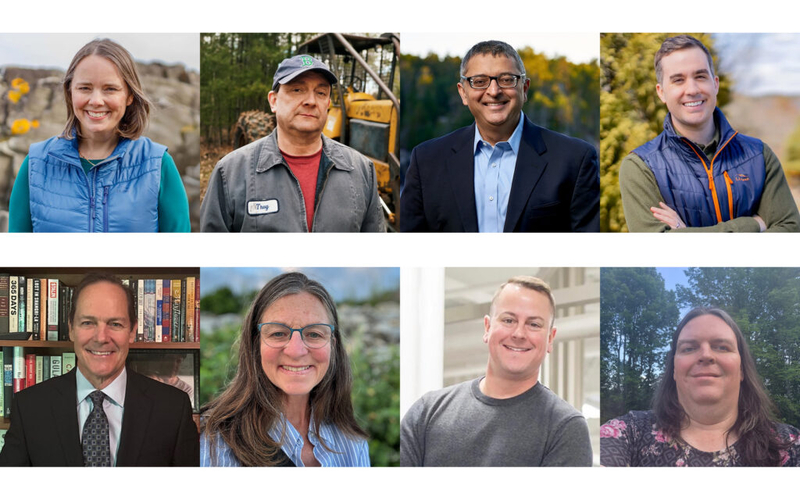
Several of the candidates vying for the Democratic U.S. Senate nomination debate on July 16, 2026, from left to right: Shenna Bellows, Troy Jackson, Nirav Shah, Jordan Wood, David Costello, Elizabeth Dickerson, Dan Kleban and Ashley Webb. (Pictures courtesy of the Maine Democratic Party)
All of the candidates vying for Maine’s Democratic U.S. Senate nomination called to eliminate U.S. Immigration and Customs Enforcement during their first debate Thursday night, three days after ICE shot and killed a 25-year-old in Biddeford.
Given that abolishing the agency is unlikely to happen during President Donald Trump’s administration, the candidates were pressed by moderators on what reforms they’d push for, and, again, there was largely uniformity in calling for requiring body cameras, banning masks and stripping agents of immunity.
The debate, hosted by News Center Maine, underscored that many of the candidates align on policy, including supporting Medicare for all and ending U.S. involvement in foreign wars.
Graham Platner, who had secured the Democratic nomination on June 9, dropped out of the race a week ago after his support from the party tanked following an accusation of sexual assault, which he has denied. His exit restarted the race for long-time Republican U.S. Sen. Susan Collins’s seat, which Democrats consider pivotal to winning back the U.S. Senate majority.
“The problem with all of this is that we really can’t get to work on any of these things until we vote Susan Collins out of there and get a Democrat in there,” said Elizabeth Dickerson, a former state representative who is now vying for the U.S. Senate seat. “The top priority for everybody watching at home is to make sure that they are registered to vote, that they go vote. If we are all angry about ICE, this is really what we have to do.”
Thursday was the first Maine U.S. Senate debate this cycle, though not all candidates could participate and those who did weren’t onstage all at once based on thresholds set by News Center Maine.
The first hour of the debate was between Shenna Bellows (current Secretary of State), Troy Jackson (former state Senate President), Nirav Shah (former director of the Maine Center for Disease Control and Prevention), and Jordan Wood (former congressional aide), because they each received more than 20% of the vote in their respective Democratic primaries in June. Wood ran for the U.S. House, while the other three ran for governor.
Other candidates who had filed their declaration of intent to run with the Maine Democratic Party by Tuesday participated in the second hour. That included Dickerson, David Costello (who formerly worked in Maryland government and for the now-defunct federal foreign aid agency), Dan Kleban (Maine Beer Company co-founder) and Ashley Webb (who said she writes songs and books). Costello ran for the U.S. Senate in the primary but only secured 8% of the vote. Kleban dropped out well before the primary, and the other two did not run in any June races.
Latest filings show Susan Collins widened cash advantage against Democrats
Four other candidates who turned in their declarations of intent to the Maine Democratic Party by the party’s Wednesday deadline did not qualify for the debate. In order to qualify for the convention on June 25, at which the new nominee will be selected by 601-delegates, candidates still must turn in 500 signatures each from Democratic voters in support of their candidacy.
Just hours before the debate Thursday, Paige Loud, a 29-year-old social worker who also previously ran for the U.S. House, announced she was withdrawing her candidacy, writing in a post on social media that she could “no longer participate in a process that has now turned into a deeply unserious spectacle.”
Throughout the debate, moderators returned to themes that had dominated the Democratic U.S. Senate primary when Platner was still in the picture: immigration, government corruption, abortion and fighting the uber-wealthy’s grip on politics. Platner had weathered a litany of earlier scandals, as many Mainers were energized by his progressive, anti-establishment pitch.
Given that, the candidates were asked which of Platner’s policies they would embrace and pursue if elected.
Jackson said Medicare for all, and Shah said abolish ICE — two stances shared by all the candidates.
Bellows and Kleban offered comparable responses, saying that the political system is deeply corrupted by those in power in Washington and rigid against hardworking Mainers. Costello said taking money out of politics. Webb also mentioned going after corruption, as well as setting term limits for the U.S. Supreme Court.
Dickerson argued Platner’s ideas weren’t new, but that he tapped into a desire for change in Mainers that all of the candidates should continue to build on.
Wood said pushing for Palestinian statehood and a two-state solution. He called what’s happening in Gaza a genocide, which he said was a term he was convinced to embrace after hearing Platner discuss it on the campaign trail.
Thursday’s debate offered a first look at foreign policy positions for many, as several candidates had previously run for state office.
The candidates shared widespread opposition to the war in Iran and said they’d work to stop funding to Israel — two stances many candidates also cited as cost cutting measures when asked how to address the federal government’s growing debt.
In response to the debt question, several mentioned weeding out fraud and abuse — an issue the Trump administration has been vocal about — but were quick to explain how their approach would be different from the president’s.
“But not the Elon Musk-style, DOGE, random and often inhumane cuts,” Kleban said, “targeted cuts that actually go after real waste, fraud and abuse.”
Costello compared his approach to a Base Realignment and Closure Commission, which is the primary way the Justice Department and Congress determine how to dispose of military infrastructure. “This commission needs to be apolitical,” Costello said.
While Mainers were familiar with many of the faces on the debate stage Thursday, several recent entrants into the race are little-known. Those candidates were asked what makes them qualified to be a U.S. senator.
Kleban said starting a business and serving on nonprofit boards, a similar pitch he’d made when he initially ran for Senate. Dickerson pointed to her masters in business administration and previous work as a town manager. Webb said her top qualification is transparency.
“I wouldn’t deceive the people like we are being deceived right now,” Webb said. “I’m just an angry citizen now, and if I got elected, I’d be an angry senator, and I think that would probably be their worst nightmare.”
Augusta, ME