Shapiro pitches sustainability, transparency requirements for data center developers
May 27, 2026 | 5:16 pm ET
Description
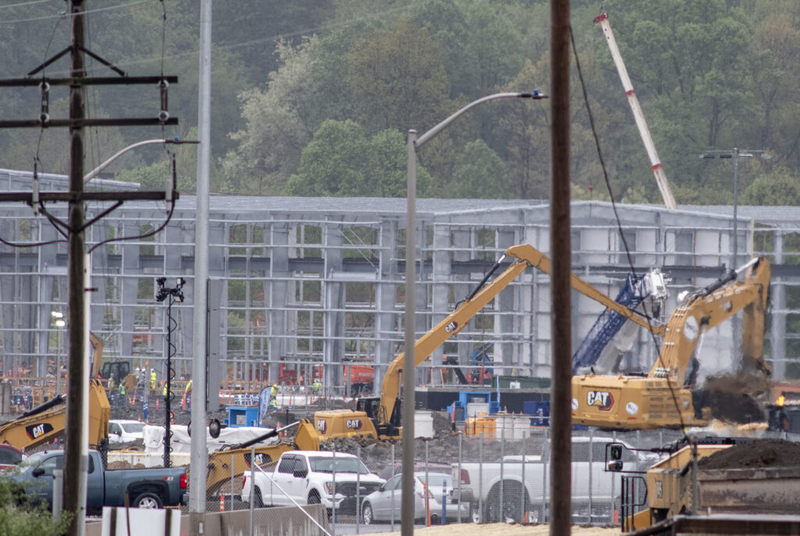
Construction continues on a data center being built at the former Homer City Generating Station in Center Township, Indiana County May 14, 2026. Previously, the largest coal-burning power plant in Pennsylvania, the plant is being transformed into a natural gas-powered data center campus. (Photo by John Beale for the Pennsylvania Capital-Star)
After broadly sketching a plan to manage data center growth during his February budget address, Gov. Josh Shapiro delivered details of his Governor’s Responsible Infrastructure Development (GRID) Standards that developers would be required to satisfy to claim tax benefits from the commonwealth.
Acknowledging Pennsylvanians’ concerns about energy affordability, air and water pollution, noise and the overall impact on the quality of life near data centers, Shapiro said the state needs to be selective about the projects built here.
“As Pennsylvania continues to compete for major economic development projects and lead on innovation, we have a responsibility to set strict accountability standards and ensure these projects create real opportunity for our communities,” Shapiro said in a statement.
While some environmentalists applauded the standards as strong guide rails for the data center industry, others were critical that they would be voluntary and not prevent a developer from building an ill-conceived project.
“Shapiro’s GRID plan reads like a Big Tech wish list,” Megan McDonough, state director for Food and Water Watch Pennsylvania, said. “This plan is an admittance that Pennsylvania has a data center problem — but this is no solution.”
The tech industry group Data Center Coalition, which lists Amazon, Google and Microsoft among its top tier members, said it’s concerned the plan would create a complicated framework challenging development in the commonwealth.
Dan Diorio, state policy director for the coalition, said data center owners recognize the importance of responsible development.
“At the same time, it is fair to ask why this industry — which is central to modern life, economic growth, national security, cloud computing, cybersecurity, and our broader digital culture — would be held to a set of standards and requirements that are not similarly applied to other major energy users, large-scale industries, or economic development projects,” Diorio said.
Two GOP state lawmakers, meanwhile, said they were introducing a package of bills to repeal a sales tax break on computer equipment for data centers. It would redirect sales tax revenue on the equipment to reduce the state gas tax.
The legislation by Sen. Jarrett Coleman (R-Lehigh) and Rep. Jamie Walsh (R-Luzerne) would also give municipalities the option to impose an 18-month moratorium on new data center applications to allow them time to update zoning ordinances and other policies on power supplies, water consumption, noise and setbacks.
An outpouring of frustration over Pennsylvania’s rapid data center growth
In a policy statement Wednesday, Shapiro’s office detailed the proposal to require data center developers to prove that they are entitled to tax benefits available from the state. Those would include an exemption from sales tax on certain computer equipment and tax incentives for building in designated economic development zones.
With AI gaining a foothold in everyday life, developers have proposed and built hyperscale data centers to continue developing AI models and house the computing resources needed for their commercial deployment.
Large modern data centers resemble distribution warehouses, but house thousands or millions of servers. Data centers that support internet streaming services, e-commerce and other online resources have been around for decades.
But hyperscale facilities can consume as much electricity as a small city, require water for cooling and are equipped with natural gas or diesel generators to allow operations to continue uninterrupted in the event of a power cut.
Many of those living near proposed data centers across the state have strongly voiced opposition and pressured local officials to block them. But developers get the benefit of land use regulations that are in effect at the time a plan is filed, so some municipalities are scrambling to pass zoning amendments before new proposals are filed.
The GRID Standards would require developers to apply for certification, outlining how they would satisfy mandates for protecting energy affordability, promoting transparency and community engagement, supporting workforce and economic development and protecting the environment.
If an application satisfies the requirements, the state Office of Transformation and Opportunity and Department of Revenue would certify the project. It would then be eligible to participate in the PA Permit Fast Track Program, which streamlines permitting for major infrastructure and economic development projects that require permits from multiple state agencies.
Data center developers can currently be certified by the Revenue Department to qualify for a sales tax exemption on computer equipment. Shapiro called on the legislature to amend the Computer Data Center Equipment Exemption Program to make it part of the GRID standards.
The current sales tax exemption would cost the commonwealth $517 million annually by 2030. Under the GRID Standards, applicants would be required to spend their tax savings on key public priorities including investment in education, infrastructure, public safety, workforce development and environmental protection.
The Office of Transformation and Opportunity would post detailed information about projects granted GRID certification on its website. Once operational, data center developers would be required to maintain certification and tax breaks by providing audited documentation of compliance with the standards or face revocation of benefits.
Among the requirements, a developer must submit a plan detailing how it would provide for its energy needs by building, bringing or buying power capacity without affecting other utility customers. Projects over 100,000 square feet would be required to have provisions for rooftop solar panels and clean energy requirements would increase over time.
To foster transparency and community engagement, a GRID application would be required to reveal the name of the company that will manage the facility or use at least half of its capacity; notify local governments of its plans, hold public meetings to allow meaningful public input; and provide a detailed timeline and number of public meetings the developer will hold in addition to meetings for zoning applications or other local permitting.
Developers would also be required to meet benchmarks for workforce and economic development that include a commitment of $250 million in new investment. They would also be required to create at least 200 jobs during construction that pay the minimum prevailing wage, at least 50 permanent jobs paying at least 125% of the statewide average wage, have a payroll at the data center of at least $1.5 million annually by the fourth year of operation and have a hiring plan for recruiting and training local workers.
It would also be mandatory for them to work with local government to develop a community benefits agreement covering the phases of development; noise, vibration and lighting studies; a traffic study; air quality protection consistent with state and federal standards; a plan to address aesthetic concerns; emergency management training, coordination and resources for first responders; and financial contributions to local priorities.
Finally, developers would have to submit a sustainability plan detailing technologies to minimize power and water consumption by obtaining certification under a recognized efficiency standard such as the Leadership in Energy and Environmental Design green building rating system or the U.S. Environmental Protection Agency’s Energy Star program. They also must minimize local air pollution by using emission free backup energy sources such as battery storage or using generators that meet the strictest standards for diesel engine emissions.
Some environmentalists applauded the proposal, saying it would bring long-overdue accountability to the rapidly expanding data center industry.
“These standards recognize that we cannot allow Big Tech to threaten our environment or our financial stability,” Molly Parzen, executive director of Conservation Voters of Pennsylvania, said.
Clean Power PA Chair Katie Blume said the group is particularly encouraged by the provision that participating data centers would be required to use progressively more clean energy over time to maintain their certification. It would count solar, wind, nuclear, hydro, geothermal in conjunction with storage as qualifying sources. Clean energy requirements would ramp up from 10% in 2027 to 14.5% in 2030 and 32% by 2035.
“Pennsylvanians are right to expect that massive new electricity users won’t drive up everyone else’s bills or strain a grid that’s already under pressure,” Blume said, adding they set clear expectations for projects seeking state support. “Data centers should cover the full costs associated with their interconnection and load, and they should build, bring, or buy new electric capacity to match their growth — not shift costs onto ratepayers.”
Parzen said it’s now up to the state legislature and Shapiro administration to follow through on the mandates, putting the onus on Senate Republicans to act.
She noted the House has already passed legislation that would require data centers to pay their fair share for grid upgrades and fuel their growth with new clean energy resources to minimize the impact on energy prices. Other bills are focused on providing municipalities with tools to respond to data center proposals.
“The ball is now squarely in the court of the Senate, particularly Republican leadership,” Parzen said. “They must decide whether they will stand with multi-billion-dollar tech corporations or Pennsylvania families struggling under skyrocketing electricity costs.”
Senate Majority Leader Joe Pittman (R-Indiana), who has been a champion of large-scale data center development, said data centers have become an intensely debated national issue and lawmakers have seen “an evolving view” of their development.
“The broad construct of the Governor’s current proposal aligns in many ways with shared concerns expressed by many Pennsylvanians,” he said. “I fully expect legislative discussions on this matter to continue throughout the coming months, as the topic requires thoughtful consideration to contemplate all consequences intended, or unintended.”
Harrisburg, PA