States could purge voter rolls close to elections if Supreme Court takes Trump's side in Arizona case
Description
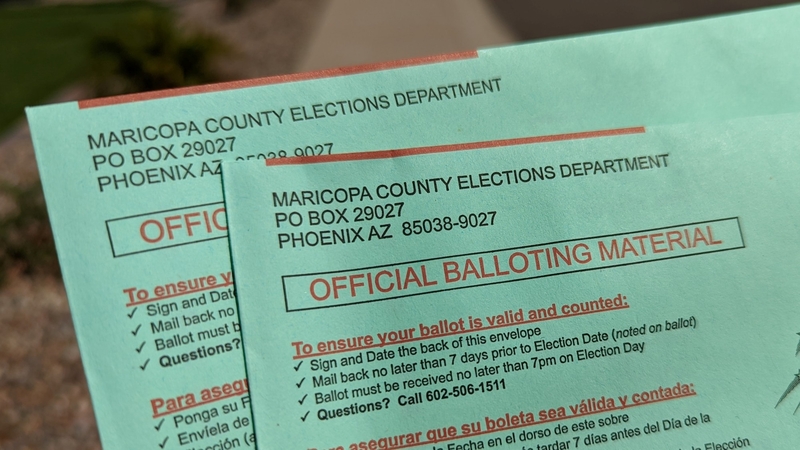
The U.S. Department of Justice asked the Supreme Court on Tuesday to take up a case casting the Republican National Committee against a host of Democratic and voting rights groups over voting restrictions in Arizona. (Photo by Jim Small/Arizona Mirror)
The Trump administration wants the U.S. Supreme Court to empower states to review their voter rolls for noncitizens just days before elections, a change that voting rights advocates say would risk disenfranchising Americans.
The U.S. Department of Justice asked the Supreme Court on Tuesday to wade into a legal fight between the Republican National Committee and a host of Democratic and voting rights groups over a series of voting restrictions in Arizona.
If the court takes the case, it could lead to a significant decision granting states greater leeway to purge alleged noncitizen voters close to elections and mandate that voters prove their citizenship — a key aim of the SAVE America Act, President Donald Trump’s signature elections legislation that’s stalled in Congress.
The high court’s decision could arrive prior to the 2028 presidential election.
Voting in Arizona
Arizona requires individuals to provide proof of citizenship, such as a birth certificate or passport, to vote in state elections. Residents who don’t offer documentation can still use a federal form to register, but can only vote in federal elections.
Election officials must run the names of federal-only voters through a U.S. Department of Homeland Security computer program that can identify possible noncitizens.
The Justice Department argues that the Supreme Court should affirm the Arizona law and find that it doesn’t violate the National Voter Registration Act, a 1993 federal law that sets rules for how voters are registered and when states can remove them from their rolls. The NVRA imposes strict limits on canceling registrations in the 90 days before a federal election.
The U.S. 9th Circuit Court of Appeals previously ruled that Arizona’s law violates the NVRA.
“But that decision eliminates the flexibility the Act promises to States when enforcing their voter qualifications,” the Justice Department says in its brief.
While the Trump administration wants the Supreme Court to take the case, the underlying petition was filed by the Republican National Committee. Its chairman, Joe Gruters, in a statement said it was “unacceptable” that the RNC was still having to defend the Arizona law.
“Federal law is clear: only U.S. citizens have the right to vote in American elections,” Gruters said.
Appeals court ruling
Mi Familia Vota, a Latino voting rights group that’s opposing the RNC in court, said in a statement the Justice Department’s brief shows “MAGA Republicans and their friends in the Trump Administration are once again trying to disenfranchise Latino voters in Arizona.”
Opponents of Arizona’s law argue the 9th Circuit decision was correct. The state law, they say, goes well beyond what’s allowed under the NVRA. Election officials may remove individual voters in certain circumstances in the run-up to an election but the law prohibits sweeping purges.
“States cannot circumvent the limits on systematic removals that Congress — exercising its express constitutional authority to regulate federal elections — put in place to ensure that eligible voters have adequate time to correct erroneous removal procedures, thereby protecting Americans’ fundamental right to vote,” the Democratic National Committee and the Arizona Democratic Party argued in a brief filed Tuesday.
Democrats and voting rights groups warn about expanding use of Homeland Security’s SAVE system, short for Systematic Alien Verification for Entitlements, that’s mandated under Arizona law.
Initially a program used by states to check whether individual noncitizens were eligible for government benefits, the Trump administration has overhauled it into a tool that can verify citizenship by checking information in federal databases.
SAVE can now check millions of names simultaneously. Many Republican states have begun uploading their voter rolls into SAVE to search for potential noncitizens.
Critics of the program say SAVE has falsely flagged U.S. citizens, a problem that could be exacerbated if the Supreme Court allows its widespread use in the weeks before an election. Last-minute misidentifications could leave little time for voters to prove their citizenship.
Justin Levitt, who served as senior policy adviser for democracy and voting rights in the Biden White House and is now a law professor at Loyola Marymount University, said in an interview that the 90-day period serves as a “pencils down” time to minimize the possibility of errors just before elections.
“Anytime you’re matching one giant list to another giant list, you’re going to have mistakes,” Levitt said. “If you execute this systemic list maintenance two days before the election, those mistakes are going to keep eligible voters from voting.”
Voter purges
At a U.S. House hearing on the NVRA in December, Sophia Lin Lakin, director of the ACLU’s Voting Rights Project, pointed to several voter purges, including a 2024 effort in Virginia, to highlight the dangers of last-minute removals.
That August, Virginia’s Republican governor at the time, Glenn Youngkin, ordered election officials to scrub the state’s voter list for noncitizens. More than 1,600 voter registrations were canceled, with citizens swept up in the purge. The Supreme Court in October 2024 declined to overturn the purge.
“There is no dispute that states and localities must keep their voter rolls accurate and up to date,” Lakin wrote in her opening statement. “But the integrity of our elections is not threatened by the phantom menace of widespread noncitizen voting — it is threatened by aggressive purge practices that wrongfully strike legitimate voters from the rolls and by unnecessary barriers to registration that prevent eligible Americans from getting on those rolls in the first place.
Noncitizen voting
The specter of noncitizen voting has been a central focus of Trump’s second term, despite studies showing it’s an extremely rare occurrence. One study of the 2016 election placed the prevalence of noncitizen voting at 0.0001% of votes cast.
Utah recently announced that a review of its 2 million registered voters identified just 27 confirmed noncitizens and an additional 25 “probable” noncitizens — a miniscule percentage of voters.
The Justice Department has sued 30 states and the District of Columbia in a so-far unsuccessful effort to force them to hand over private voter data so the information can be run through the SAVE system to search for noncitizens. In late March, Trump signed an executive order to restrict the transmission of ballots through the mail, though several lawsuits have been filed against it.
Trump also continues to demand that senators pass the SAVE America Act, even though it has stalled in the U.S. Senate. While the legislation would set a national proof of citizenship rule, some states have enacted or are weighing their own requirements.
Republican attorneys general
Five states — Alabama, Arizona, Louisiana, New Hampshire and South Dakota — ask for proof of citizenship when voters register for the first time, according to the National Conference of State Legislatures. One state, Wyoming, also requires proof when voters update their registration.
But Arizona was the only state before 2025 to maintain two separate voter rolls to enforce its proof of citizenship rules, according to the Brennan Center for Justice at New York University. The distinction helps explain why the Arizona case is now poised for consideration by the Supreme Court.
A host of Republican state attorneys general, led by Kansas’ Kris Kobach, have filed a brief urging the Supreme Court to take the Arizona case. They say the 9th Circuit gutted Arizona’s “common-sense measures” to protect its elections.
“This case presents yet another assault on State efforts to promote election security,” the states’ brief says.
In addition to Kansas, Alabama, Alaska, Arkansas, Florida, Georgia, Idaho, Indiana, Iowa, Kentucky, Louisiana, Mississippi, Missouri, Montana, Nebraska, New Hampshire, North Dakota, Ohio, Oklahoma, South Carolina, South Dakota, Tennessee, Texas, Utah and West Virginia signed on to the brief.
The Supreme Court has sent conflicting signals about proof of citizenship laws in the past. In August 2024, the court issued an unsigned order on its “shadow docket” allowing Arizona to enforce its proof of citizenship requirements for the 2024 election.
But four years earlier, the justices declined to take a case over a Kansas proof of citizenship law. That left in place an appeals court decision blocking the law, which remains unenforceable.
The Arizona case would offer the Supreme Court a way to provide a more definitive opinion. If the justices decide soon to take it, they would likely hold oral arguments in the fall and potentially issue a decision next spring, more than a year before the 2028 presidential election.
The Justice Department’s brief says the case “offers an opportunity to resolve these important election-law issues outside the setting of a contested election.”
All States Newsroom content is free to republish. Read our republishing policy for more information.