Iowa Democrats tell DNC why their caucuses should be first in the nation in 2028
May 27, 2026 | 5:21 pm ET
Description
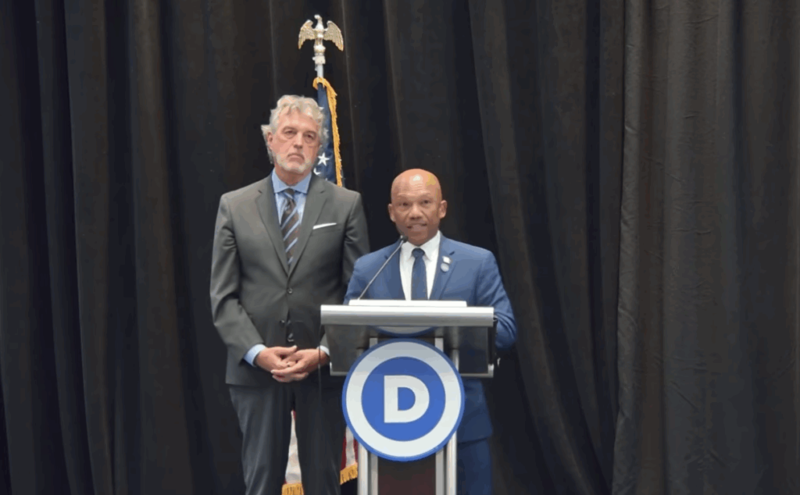
Scott Brennan, an Iowan who is a member of the Democratic National Committee, and Rep. Ross Wilburn, D-Ames, presented their case before the DNC Rules and Bylaws Committee in Washington, D.C. Wednesday, May 27, 2026 on why Iowa should be granted a waiver to hold its contest first in the 2028 Democratic nominating cycle. (Screenshot via DNC livestream)
Iowa Democrats told members of the Democratic National Committee Wednesday the national party cannot afford to lose Iowa voters — or the input of rural Midwesterners at large — as they craft the presidential nominating calendar for 2028.
Scott Brennan, an Iowan who is a member of the DNC, and state Rep. Ross Wilburn, D-Ames, who was previously chair for the Iowa Democratic Party, spoke to the DNC’s Rules and Bylaws Committee Wednesday. The committee heard presentations from states hoping to hold their presidential nominating contests in the early window in 2028.
Iowa lost its long-held first-in-the-nation spot in the Democratic nominating cycle in 2024. Problems with reporting results in the 2020 Iowa Democratic caucuses, longstanding Democratic criticisms of caucuses being less accessible than primaries, and former President Joe Biden’s support for states like South Carolina to lead the party coalesced after the 2020 election cycle. That led to the DNC approving a new calendar in 2022 which had South Carolina hold the first presidential nominating contest in 2024, followed by Nevada, New Hampshire, Georgia and Michigan.
Democrats’ decision to change the nominating calendar did not alter Republicans’ schedule, which began in 2024 with the Iowa Republican caucuses, followed by the New Hampshire primary, the Nevada caucus and South Carolina primary. This early state lineup was previously shared by both parties.
Because there were issues with implementing the 2024 calendar in states like New Hampshire and Georgia, the DNC agreed to restructure their nominating calendar again ahead of 2028. States were asked last year to submit their proposals to earn a waiver to hold a contest ahead of Super Tuesday in 2028.
On Wednesday, the Rules and Bylaws Committee began hearing from Democratic state officials about why their state should be awarded an early spot, with presentations from New Hampshire, Delaware, Illinois, Michigan and Georgia — as well as Iowa.
Wilburn and Brennan said they were not just asking the DNC to grant them a waiver to hold a contest in the early window, but asking for the Iowa caucuses to go first in the nominating process in 2028. The Iowa Democrats repeated arguments for why Iowa should lead the process that were made in 2024 — such as the state’s ability to provide a less expensive environment that allowed candidates like former U.S. Transportation Secretary Pete Buttigieg, then mayor of South Bend, Indiana, to compete as a legitimate candidate. They also cited the need for Democrats to win support from rural voters.
The Iowa officials also presented their plan for Iowa to hold a caucus process that would allow Democrats to participate both using mail-in presidential preference cards as well as in-person expressions of presidential preference on caucus night. The in-person presidential nominating contest will not look the same as in previous Iowa caucus cycles, when Democrats would have to move physically around a room to gather support for their candidate and then go through a “realignment” process where supporters of a candidate who did not earn at least 15% support would have the option to back another candidate.
Democrats have been critical of Iowa’s previous caucus system, which some argued was inaccessible to people with disabilities, parents and others who could not attend the in-person, evening event. Brennan said the new proposal addresses these concerns in addition to simplifying the caucus process.
“This in-person expression will be combined with the mail-in results,” Brennan said. “The results will no longer include complicated math. It will be one person, one expression of preference, and we will release caucus results on caucus night in 2028. In addition to presidential preference, Iowa caucus night will also retain its full party business agenda, and at its heart, conversations between friends and neighbors.”
But they also presented “lessons learned” 2024 nominating cycle and election, when the Iowa Democratic Party abided by the DNC calendar and released results from its fully mail-in presidential preference contest on Super Tuesday.
In 2024, Wilburn said “a vast majority of the center of the country was left out” of the early DNC nominating calendar, with no states primarily located in the central or mountain time zones included in the window. This oversight, he argued, put Democrats on the back foot in much of the Midwest heading into the 2024 general election, and would cause similar problems in 2028.
“Iowa Republicans will hold their nominating process caucus first in 2028, and potential Republican candidates are already visiting Iowa, bringing with them the national media spotlight,” Wilburn said. “The perceptions of Democrats abandoning rural America and Iowa continues to be a difficult narrative to overcome, especially when significant Republican funding pours into our state. As the slide shows in 2024, Republicans spent $120 million in ads during their caucuses, just in Iowa — far more than other early Republican states combined.
“It’s not an exaggeration. Iowa and national Democrats were overwhelmed by early Republican messaging last time. Republican attacks don’t just impact Iowa, it has a ripple effect across the entire Midwest.”
Brennan, who previously served on the RBC and lost his position on the committee in June 2025, also said the discussion is coming as Iowa is potentially poised to return to a “purple” state make-up after having several election cycles of overwhelming Republican victories. The speakers pointed to Iowa’s midterm elections where political forecasters say the state’s gubernatorial election and some congressional races are among the most competitive in the country.
These competitive races also signal a need for the DNC to delay its decision on the 2028 nominating calendar, Brennan said.
“That is why this committee should also consider holding off making a decision about the calendar until after the midterms,” he argued. “Shame on us if we negatively impact any races in any of the applicant states.”
Michael Kapp, a committee member from California, asked Wilburn and Brennan about the potential for Iowa Democrats to hold a “rogue” contest outside of the calendar set by the DNC in 2028 if the state party is not granted a waiver. He referenced a report published by NOTUS Wednesday which quoted Iowa House Minority Leader Brian Meyer saying he “triple dog dares” the DNC to not seat Iowa delegates in the 2028 Democratic National Convention if the state holds an unsanctioned contest.
Brennan said “the Iowa Democratic Party has long striven to comply with this committee’s restrictions, and certainly, that would be our goal this time.” He also noted that Iowa is holding its primary elections in less than a week, June 2, saying “it’s the silly season, so it’s time for people to make sure if there’s a camera around to say something.”
The IDP released findings from a survey conducted in 2025 among Iowa Democratic voters about the future of the Iowa Democratic presidential caucuses, in which 65.3% of the more than 750 Iowans surveyed said they want Iowa to be first or early in the nominating process. However, the results also showed a majority, 51.1% of Iowans said they do not believe Iowa should defy the DNC calendar, “even if it means Iowa is not in the early window.”
When asked to clarify if Iowa was seeking a waiver to hold its contest first or in the general early window, Brennan answered that state law requires the Iowa Democratic Party to hold a caucus, and for the caucus to be held “before any competing process.”
“We’re here to work in good faith with y’all, we would like to comply with whatever the committee does,” Brennan said. “But the bottom line is that … ultimately, you know, Iowans will decide, but we want to be in the pre-window and we want to be first.”
The Rules and Bylaws Committee will hear from more states seeking a waiver in meetings Thursday and Friday.
Des Moines, IA