A rare showing of bipartisanship on Mackinac is overshadowed by old wounds, bad blood
May 28, 2026 | 5:36 am ET
Description
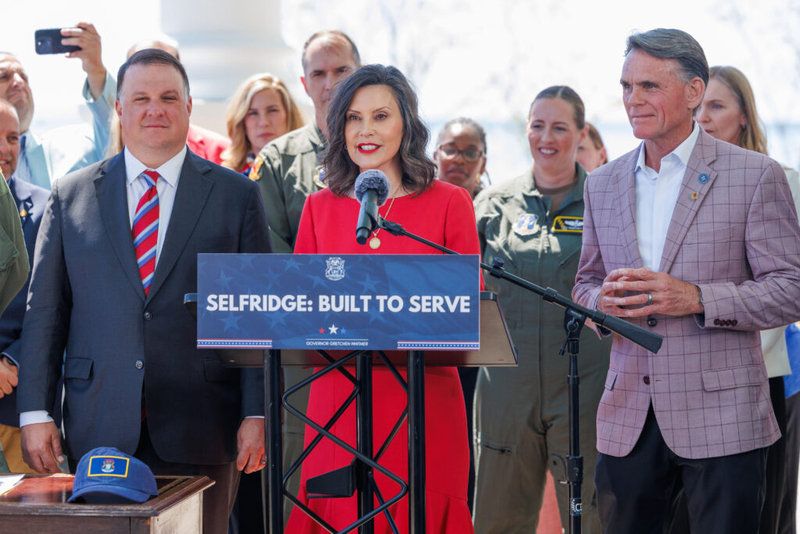
Michigan Gov. Gretchen Whitmer speaks at a bill signing ceremony during the Mackinac Policy Conference on Mackinac Island, Mich., on May 27, 2026. The bill provides $152 million in funding to upgrade the runways and infrastructure at Selfridge Air National Guard Base to help unlock $792 million in federal investments in the base. (Photo by Andrew Roth/Michigan Advance)
MACKINAC ISLAND — As the state’s politicians and business leaders continued their quest for common ground on Wednesday at the annual Mackinac Policy Conference, no one wanted to acknowledge the sleeping tigers of partisanship and karma lounging in the main hall of the Grand Hotel.
Over the last several years, the Michigan Legislature has been locked in an ideological battle of wills over state spending, hard policy, and which chamber controls more power to get legislation across the finish line. The sniping has been vicious at times and the last two years have been particularly damaging.
The Republican-controlled House of Representatives and the Democratic-led Senate nearly let a game of budgetary chicken throw the state over a fiscal cliff in 2025. The House’s aim to gut administrative work projects and the Senate’s fight to restore school meals in the base education budget led to more bad blood.
On the island, as patrons bounced around between presentations and while I conducted interviews, it became apparent the muck left over from those old wounds is seeping through the bandages — whether the House and Senate want to admit it or not.
This year, the conference’s organizers are trying their best to forge common ground between the business community and Michigan’s public servants from the wide spectrum of local, county, state and federal governments.
As the conference kicked into full gear on Wednesday, its presenters preached deep listening and new ways of communicating, all with a list of heavy hitters to hammer that message home.
Whitmer signs Selfridge airbase repair funding bill, locking in new F-15EX fighter wing
Earlier in the day, Gov. Gretchen Whitmer’s communications team put out an advisory notifying reporters on the island that she would sign a bill funding repairs for the Selfridge Air National Guard base located in Macomb County.
Last year, Whitmer and House Speaker Matt Hall (R-Richland Township) convinced President Donald Trump to install a new mission of F-15EX Eagle II fighter jets at the base — something that Whitmer had asked previous administrations, including during Trump’s first term in the White House, but was turned down each time.
In 2025, Whitmer went on a mission of her own with Hall to the White House to discuss Selfridge and other pressing items that needed federal support. Whitmer was squarely in her second term, with her first term punctuated by battles with Trump over COVID policies and other points of contention.
Much of that opposition dried up in Whitmer’s second term, and in April 2025, she walked her way into a hornet’s nest. When she was invited to the Oval Office, the press was waiting for her and Hall. Whitmer was unaware that it would be so high profile, and hid her face with a blue folder from photographers who were snapping photos in the room.
EPIC TROLL: Governor Whitmer, expecting a private meeting, was brought into the Oval Office as Trump signed EOs. She attempted to hide her face from the media.
h/t @OcrazioCornPop pic.twitter.com/2cvRrawMJN
— @amuse (@amuse) April 12, 2025
MIRS, an insider news publication covering state government, noted that the moment was a low point for Whitmer, who had shown much grit against Trump in the past.
The meeting was a high point for Hall. The speaker routinely shows photos of him and Whitmer working to lobby Trump for Selfridge funding at his weekly news conferences. When Trump visited Michigan to announce the new fighter mission, Whitmer and Trump hugged on the tarmac after the president departed his own plane. That turned into yet another bizarre photo opportunity for Hall to display his might — something he’s gotten good at as House speaker.
While his use of that meeting has been perceived as a dig against Whitmer, Hall has very much positioned his influence in the matter as one of the main reasons the Selfridge deal got done.
As they communicated with the White House and their federal partners, it became clear to both Whitmer and Hall that it would be quite a while before the state received the new jets because Selfridge had fallen into disrepair. Hall had aims to get the fighter jets in state before Trump leaves office in 2028, and he devised a plan to fund upgrades to the runways as a way to accelerate the timeline. Whitmer was on board, and Hall just needed the Michigan Senate to act once the House passed House Bill 4572, sponsored by state Rep. Ron Robinson (R-Utica).
The Senate dragged its feet a bit while state Sen. Kevin Hertel (D-St. Clair Shores) worked in the Senate to move the funding forward. When there were delays, it was Hall who was turning up the heat to get it done.
Who’s to blame? And who gets the fame?
Jump forward to Wednesday on the island when Whitmer was gearing up to sign the bill. U.S. Army Maj. Gen. Paul D. Rogers, adjutant general and director of the Michigan Department of Military and Veterans Affairs, began by first laying high praise on Whitmer for getting the deal done. He also praised Hertel’s work in the Senate.
When he turned to Hall, Rogers thanked him but also praised the entire Legislature for getting it done. While Hall smiled, clearly happy knowing he had a major hand in the win, one couldn’t help but feel like he was slighted in that moment by not being held up as the funding’s prime champion.

That appeared to be a bit of a running theme for the Republican caucus at the conference, as state Rep. Ann Bollin (R-Brighton Township) told Michigan Advance.
I asked Bollin about the conference’s theme, whether the common ground it was trying to espouse felt like a relic of the past, and if Michigan’s house was really “on fire” as conference organizers from the Detroit Regional Chamber have contended. Bollin placed the blame for the latter on the state’s Democrats who held the House before she and Hall took over in 2025.
“They set the house on fire because they have been happy to take all of the pork, all of the government spending for special interests and different initiatives,” Bollin said. “I’m here because I want to hear what’s going on, to hear from people who have big, bold ideas. But I would say, Why are we holding the Detroit Regional Chamber meeting here on Mackinac Island? Why aren’t we in the city of Detroit, talking about how important our urban core, our big cities, are in the state of Michigan?”
In her view, it was the House Republican caucus who was listening to the people by fighting against corporate interests in last year’s budget.
“We are actually transforming government,” Bollin said. “We’re transforming government spending, state spending. … I don’t think there is an understanding that we led the charge, we drove the agenda, and I don’t mean a Republican agenda or Democratic agenda, but for the people of Michigan. I think that’s extremely important to remember and acknowledge, and I’m very disappointed that it hasn’t been acknowledged.”
Just before I spoke with Bollin, I had the same conversation on Main Street with state Sen. Darrin Camilleri (D-Trenton). Camilleri called the Selfridge funding a bipartisan win, again downplaying Hall’s contributions. He also called on his colleagues to continue working in a bipartisan fashion to pass bills like his Senate Bill 700, which aims to bring relief to people who were fraudulently told they owed money to the Unemployment Insurance Agency. The bill was passed unanimously by the Senate last December.
When asked if that bill hadn’t been brought up in the House because of the sharp partisan divide between the chambers, Camilleri said yes and called Hall’s House the worst he’s worked with during his time in government.
“It’s really telling, as you’ve seen from the amount of bills that have made it to the governor’s desk. That’s the fewest ever in Michigan history,” Camilleri said. “And even when I was in the super minority, we still found ways to get Democratic pieces of legislation and Republican pieces of legislation across the board that made sense for Michigan. That’s all we should be focusing on right now, is what are the pieces of legislation that do make sense for Michigan that we can all work on together? And we just haven’t been able to get that type of agenda to work.”
Lansing, MI