At Mackinac conference, calls for common ground meet political reality
May 27, 2026 | 5:35 am ET
Description
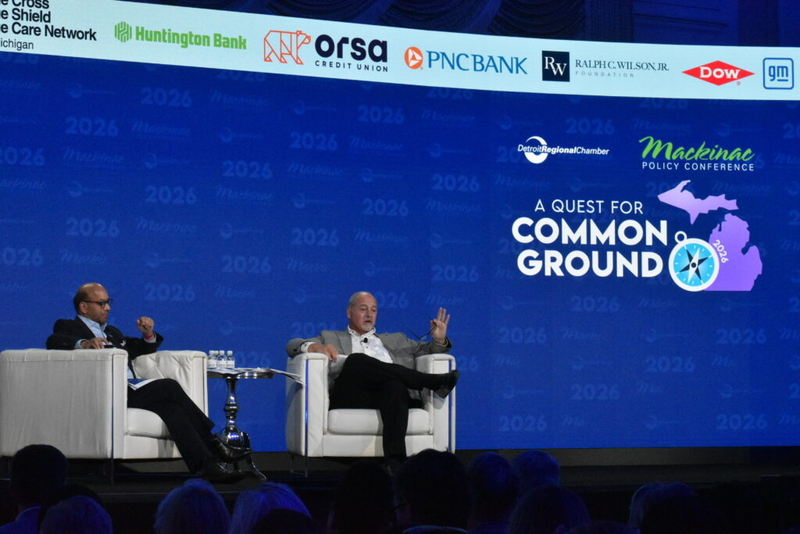
Bob Riney, president and CEO of Henry Ford Health System (right),speaks during a panel with Sandy Baruah, president and CEO of the Detroit Regional Chamber, during presentation at the Mackinac Policy Conference on Mackinac Island, Mich. May 26, 2026 | Photo by Ben Solis/Michigan Advance
MACKINAC ISLAND — I arrived Tuesday at the Straits of Mackinac around 1:30 p.m. after racing up I-75 at 80 mph.
The Michigan Advance has me covering the Mackinac Policy Conference this year, the annual gathering of business leaders and politicians who hope to hash out the pressing issues of our day. Presented each year by the Detroit Regional Chamber, its patrons do so over cocktails and expensive meals, all with a grand sense of urgency to serve the state.
Its theme is “A Quest for Common Ground,” and across the program, the conference is asking the state’s elite to put away differences, prejudices and assumptions about each other — political, economic or otherwise — to forge meaningful solutions to Michigan’s various problems.
It remains unclear if the type of common ground the chamber is looking for still exists in an age of growing inequality, deeply divided government and more deeply divided people. It’s also unclear if a confab of wealthy businesspeople and politicians at the highest levels of government still has the capacity to fix its ills.
In that vein, the conference has faced skepticism for being all talk and no action.

Meanwhile, Sandy Baruah, president and CEO of the chamber, has been calling attention to the state’s poor economic standing, as well as its population loss and other major challenges on the horizon. That includes worries about the regulation of data centers, voter displeasure with the two-party system, concerns about jobs and runaway inflation.
Baruah said Tuesday, as the conference opened, that Michigan’s slump from being a Top 20 state in terms of economy and education standards began 20 years ago, and over that time, the state has had both Democratic and Republican governors. The state has also had its mix of Republican-led and Democratic-controlled legislatures. Each has tried different approaches to solving the slump, and still the problems persist.
To his point, 25 years ago, Michigan was 21st in the nation for employment. Today, the state ranks 46th. Labor force participation has gone from 21st to 39th.
As Baruah puts it: Michigan’s house is on fire, and he’s not wrong.
The respective chambers of the Legislature have been at odds for the last two years, bickering over budgets, “ghost jobs” and funding for school lunches. There have been lawsuits over the funding for state work projects and bills that were never sent to the governor, even though they passed out of both chambers in the previous session.
At the same time, the business world has been unable to keep up with the swings. That shows Baruah that the solutions must go beyond politics, and must be solved with both sides putting down their swords to address a common goal.
“This is a Michigan problem,” Baruah said. “And if anyone thinks this is a Democrat issue or a Republican issue, not only is that wrong, it’s also supremely unhelpful. And we as a state, especially us in the business community, are striving hard to find common ground and reverse these numbers, because these numbers are not pretty.”
A mini boycott
It’s 3 p.m. on Tuesday, and almost everyone I’ve spoken to on the island, on record and off, seemed to hint at the inside joke that the conference is just a party where sometimes magic happens and the right people get into the right rooms to make a breakthrough.
Attorney General Dana Nessel and three Democratic state representatives — Betsy Coffia of Traverse City, Carrie Rheingans of Ann Arbor and Erin Byrnes of Dearborn — are among those who have shared the most skepticism about what happens, or doesn’t happen, at the Mackinac Policy Conference.
Last week, on Friday, Nessel and her legislative colleagues held a press conference that was in many ways counter-programming to the Mackinac Island conference. Nessel plainly said during that news conference that she won’t be there, and that she was instead going to use her time talking about the kinds of structural, big idea government transparency that she’s been championing since taking office in 2018. Nessel will likely leave office at the end of this year with few of those reforms getting signed into law.
“I don’t know that anyone on the island is having conversations about how to reform state government and make sure that we’re more transparent and doing strong ethics,” Coffia told me, before questioning its utility to average working people. “If it’s supposed to be making decisions for 10 million Michiganders, but the asking price to get in is $6,000 and it’s literally on an island that you can’t stand outside of unless you pay to get there, that’s already a little weird to me. This is where the best and brightest ideas go?”
Nessel, Michigan Dems push Whitmer to confront Lansing’s ‘quid pro quo’ political culture
Coffia thought all of those legislators, business leaders and candidates for office who attended would better serve people by going on listening tours throughout Michigan’s 83 counties to learn about what the biggest challenges in the state were for working people.
Being on the island this year also feels pivotal, with the conference occurring at a major point in Michigan’s history, economic woes aside. Michigan faces a pivotal election where the governor’s office, the state’s two top executive offices, a U.S. Senate seat, vital congressional seats and control of the state Legislature are all on the line.
As with every year, the four leaders of the Michigan House and Senate will convene for a panel at the end of the week, and those leaders have already shown they have a penchant for throwing dirt when necessary. It feels like last year’s budget cycle partly ended on a miracle, or maybe just frustrations that the 2025-26 budget didn’t appear until after the constitutional deadline of Oct. 1 and was the product of an hours-long government shutdown.
What will Speaker Matt Hall (R-Richland Township) and Senate Majority Leader Winnie Brinks (D-Grand Rapids) say about civility — especially when we know from press conference after press conference that Hall likes to poke Brinks and House Minority Leader Ranjeev Puri (D-Canton) with a sharp stick whenever he has a chance?
What will Senate Minority Leader Aric Nesbitt (R-Porter Township), a candidate for governor, have to say about common ground when he’s called for the federal government to take over the state’s elections because he doesn’t trust Democratic Secretary of State Jocelyn Benson, also a candidate for governor, to run elections as other secretaries of state who were seeking office have done before?
The end of an era with Whitmer
Ahead of the conference, I was invited to a reception for the press and Gov. Gretchen Whitmer’s cabinet members at her summer residence on the island, all off the record, of course.
The only way to get up to the governor’s residence is via two hills, one steeper than the other, adjacent to Fort Mackinac. Along the way, I ran into state Rep. Parker Fairbairn (R-Harbor Springs). The island is his territory and he was in high spirits. He and his wife are expecting a child and the due date was likely going to be the end of this week.
Fairbairn also was optimistic about what state business could be done in just a few short days. He expected conversations on the 2026-27 budget to take place, with a potential deal coming out of those meetings.
When asked, Fairbairn said that despite the criticisms, the island offers the Legislature and its business stakeholders an opportunity to turn off politics for a moment.
“I think we’re all friends on the island,” he said. “The island really has that way of bringing people together. That’s the best part of it. People can be skeptical about it, but we’re working when we’re here. We’re able to have these conversations with people we don’t see eye to eye with, and I do think that’s valuable.”
Enter Whitmer’s summer home. It’s airy and magnificent. The view from the top is breathtaking. They served beer and wine and cucumber water.

The governor floated through the reception on a cloud of accomplishment. The chamber’s polling released before the conference showed that the governor was riding high in approval ratings, and that unlike Michigan governors before her, her numbers hadn’t slumped — to the contrary, they’ve only grown in her second term.
I asked Whitmer the usual questions: Was she planning to run for president? Was the island able to make the change it sets out to each year, especially in an era of divided government? Will the budget really get done on time, and what’s up with the property tax reforms the House is pushing?
I am ethically obligated to not tell you what was said between us. But what I can tell you is that there was a real sense of finality there; that Whitmer and her team, through thick and thin, believed they did everything they could for the state, whether people agreed with her methods or not.
There was also some ambiguity there on whether the decisions made on the island had a real, lasting impact on people’s lives.
Burning down the house
Bob Riney, president and CEO of Henry Ford Health System, is the conference’s chair this year. He was knee-deep into a discussion about Michigan’s blazing home when I got back to the Grand Hotel around 5 p.m.
Riney noted that healthcare, as a practice, has a multidisciplinary and coordinated team approach to solving what he called “vexing issues.” Adopting such an approach could be the fire truck needed to put out the metaphorical house fire, but Riney said the problem is that the fire truck was “going in the opposite direction, and therein lies our challenge.”
Riney said that in his line of work, he hears about affordability as the number one issue people have with the healthcare industry, but he was dismayed that he doesn’t hear about population growth, and whether there will be enough young people in the state to help Michigan get better when it needs them most.
“We will work, as a healthcare industry, with our partners in insurance to continue to get more efficient, but none of that will overcome the trajectory of a population that is older,” Riney said. “If we want to talk about affordability, let’s connect it to population growth. We want to talk about education. Let’s connect it to population growth.”

Leaving the Grand Hotel to depart back to the mainland, I noticed a group of demonstrators on the outskirts of the hotel, all wearing matching shirts, carrying signs and handing out pamphlets on the lawns that lead up to the island’s main attraction.
The group was composed of Teamsters-represented nurses at Henry Ford Genesys Hospital in Grand Blanc — the very same health system that Riney oversees. The nurses told me that they’ve been striking for about eight months, fighting to get better staffing levels and safer patient ratios. Some of the nurses there had worked at the facility for more than 20 years, and while on strike, they’ve had to look for other work to make ends meet.
They came to the island in hopes that Riney would talk to them while he was on the island as he engages on a quest for common ground at the conference.
Crystal Dhooghe, an emergency room nurse at Henry Ford Genesys Grand Blanc, said that if Riney was going to preach an end to conflict and promote an end to divisiveness, he could start by ending the strike with the hospital’s nurses.
“It’s hypocritical, I guess, is the best way to word it,” Dhooghe said. “Our strike has been going on for nine months. He has not been receptive to us at all. … That goes against everything he is preaching to all these people throughout our state, these politicians and other people that he should be setting an example for.”
Lansing, MI