Cuba’s hypocrisy argument against U.S. won’t help Castro in court, legal experts say
May 22, 2026 | 4:35 pm ET
Description
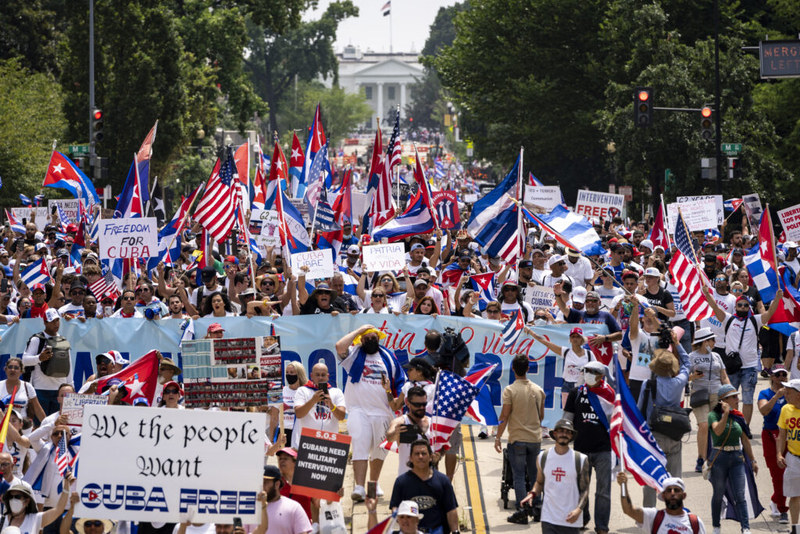
Cuba's claim that the U.S. is hypocritical in its charges against Raul Castro won't hold up in court, experts say. (Photo by Drew Angerer/Getty Images).
Hours after the Justice Department announced it had charged Raul Castro with murder for the 1996 shoot-down of two U.S.-based rescue flights, the island’s government accused the United States of hypocrisy.
The U.S. had used “disproportionate” military force against suspected Venezuelan drug boats, Cuba said in an official statement, and it argued Washington lacked authority to prosecute Castro.
But while Cuba’s argument made the rounds on social media and the court of public opinion, it won’t matter in a Miami federal courtroom if the 94-year-old somehow winds up there, according to career former prosecutors and defense attorneys.
“It’s not a legal argument nor do I see how it could conceivably be admissible as a defense should there be a trial,” said Dan Gelber, a former federal prosecutor, state legislator, and former Miami Beach mayor.
“The trial would be about Raul Castro’s intent 30 years ago and, obviously recent conduct by the U.S. government has nothing to do with that intent.”
Four men with the aid group Brothers to the Rescue were killed in the attacks that happened on Feb. 24, 1996. The incident led to the codification of the Cuba embargo into federal law under what is called the Libertad Act.
Castro and five others were formally charged with murder and other crimes on April 23 by a grand jury, but the indictment was unsealed Wednesday during a Cuban Independence Day commemoration by Acting Attorney General Todd Blanche and other officials.
Blanche said the indictment, although long overdue, was made in the interest of justice.
Cuba’s government was quick to condemn the charges against Castro and announced it would celebrate his 95th birthday next month.
“It is highly cynical that this accusation is made by the same government that has murdered nearly 200 people and destroyed 57 vessels in international waters of the Caribbean and the Pacific,” the Cuban government statement said.
Marcos Jimenez, a former U.S. attorney for the Southern District of Florida, said the statement isn’t much of a defense for Castro if he stands trial.
“So, is this a ‘two wrongs make a right’ argument?” Jimenez said.
The back-and-forth comes amid renewed tensions between the United States and Cuba, marked by Trump’s warnings that Castro would be “next” after the Trump administration seized Venezuelan dictator Nicolas Maduro, secret meetings with Cuban officials involving Secretary of State Marco Rubio and CIA Director John Ratliffe, and reports that Cuba has amassed more than 300 military drones.
This week, Rubio pointedly told the Cuban people that their nation is economically starved because of their government. Two days later, he announced that ICE had arrested Adys Lastres Morera, sister of the president of the Cuban military business conglomerate GAESA — which controls 70% of Cuba’s economy — after he cancelled her permanent resident status.
Cuba, meanwhile, referred to the Brothers to the Rescue pilots as “terrorists” in its Wednesday statement, defending the shoot-down. “Cuba’s response to the violation of its airspace constituted an act of legitimate self-defense,” the government said.
Attorneys say otherwise, stressing the discrepancy between U.S. and Cuban statements: Americans say the planes were over international waters when they were downed; Cubans insist they were over their waters.
“Self defense would require some facts pointing in that direction, which I really don’t see existing given the starkly different capabilities of the aircraft,” Gelber said.
“The U.S. will argue that this was an unjustified murder over international waters and I suspect the defense will argue that Castro was protecting his country/people from an illegal incursion into their airspace,” theorized Miami criminal defense attorney William Barzee.
“It’s going to come down to GPS coordinates, witnesses, testimony.”
Despite the indictment, legal experts said Castro is unlikely ever to appear in a U.S. courtroom because Cuba is not expected to extradite him.
“It’s going to sit there just as an indictment and be a political document unless they can find their way to get their hands on him,” said Joseph DeMaria, a former federal prosecutor with the DOJ’s Miami Organized Crime Strike Force.
“The Cubans are never going to turn over Raul Castro.”
Tallahassee, FL