After failing for the second year in a row to pass a budget on time, the Florida Legislature has cobbled together this year’s Appropriations Act, to be voted on and sent to Gov. Ron DeSantis by the end of the week.
The budget chairs for the House and Senate spent most of the Memorial Day weekend exchanging offers before finally concluding their work Sunday night.
The Republicans leading the negotiation closed out all action related to the $115 billion Fiscal Year 2026-27 budget and the accompanying tax relief plan. The budget would be in effect from July 1 through June 30, 2027.
The accompanying tax relief package, valued at $150 million, was revealed in the last round of budget negotiations. The bill provides a three-year exemption from sales taxes on windows and doors meant to withstand strong winds, such as those experienced in hurricanes.
The bill includes a sales tax exemption for gun accessories, including silencers. At one point Sunday, the National Rifle Association and other gun rights organizations contended the tax break was being opposed by Senate President Ben Albritton. The NRA posted on X that Albritton was “attempting to compromise your Second Amendment rights by removing suppressors from the tax-exempt list.”
ATTENTION Florida residents!
Senate President @Sen_Albritton is attempting to compromise your Second Amendment rights by removing suppressors from the tax-exempt list in HB 7031E.
Contact Florida Senate leadership now and tell them DO NOT COMPROMISE MY SECOND AMENDMENT… pic.twitter.com/Sf2uOc9lVn
Lawrence McClure, Republican from Hillsborough County, didn’t say why the exemption was important but said his job as chief budget negotiator for the House was to defend the position pushed by Rep. Wyman Duggan, R- Jacksonville, the main architect for the House’s tax package.
There are no exemptions in the tax package for state and local gas taxes, an exemption the Legislature agreed to pass in 2022 at the behest of the governor.
“Gas prices have been rising due to inflationary pressures from bad federal policies, so we here in Florida need to step up and provide relief to our citizens,” DeSantis saidwhen he announced his plans to waive the tax that year, claiming it would bring $1 billion in tax relief for Florida families.
Fast forward four years and now it’s Florida Democrats who pushed for a sales tax reprieve. And although DeSantis recently said he’d be willing to support the tax break, his comments about the savings for families have been more reserved, including that he wasn’t sure how effective it was.
So, to answer your question, is $10 million enough? I sure hope so, but probably not … I think I feel confident, at least from the House's position, that it is a huge step in the right direction.
– Rep. Lawrence McClure discussing state funding for programs that assist people with intellectual and developmental disabilities
The spending plan covers everything from public education to health care to the environment and the criminal justice system.
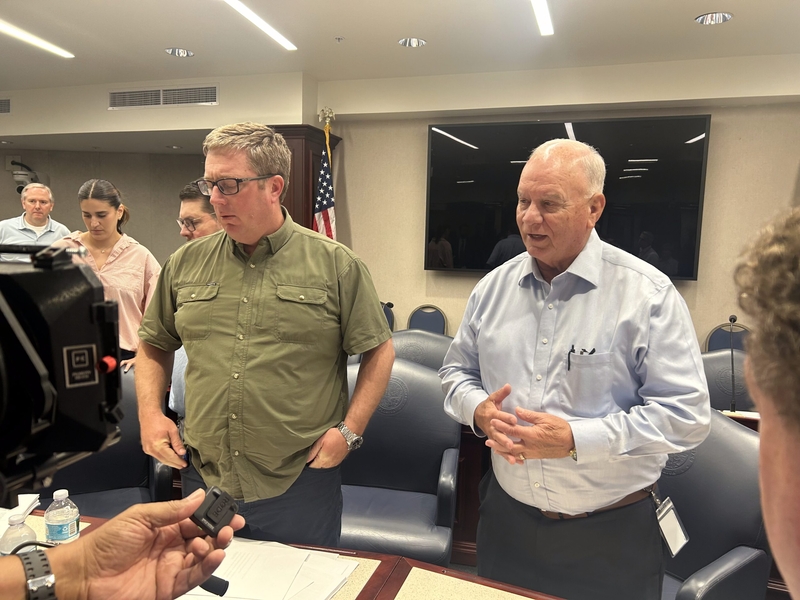
Chief legislative budget negotiators Rep. Lawrence McClure (L) and Sen. Ed Hooper (R) talk to the media Sunday afternoon after they announced some of the spending agreements in the state fiscal year 2026-27 budget that would take effect July 1. (Photo by Christine Sexton/Florida Phoenix)
In the end, negotiators agreed on a wide range of spending, from whether to hire new judges — the answer was no — or to award across-the-board pay raises for all state employees. In the end, only state law law enforcement officers, firefighters, and correctional officers will get raises, with those in the state prison system getting at least $24 an hour — nearly $50,000 per year — or a 4% raise.
The negotiators agreed to spend more than $500 million for Everglades restoration. They settled on $425 million for the state’s rural and land conservation easement program while putting $60 million-plus into the main land buying program identified as Florida Forever.
The negotiators have agreed to spend $75 million to keep a drug program for people with AIDS operational, a decision lauded by the AIDS Healthcare Foundation.
“Florida’s Health Department walked away from people living with HIV. Lawmakers brought them back,” AHF director of advocacy and Legislative Affairs Esteban Wood said in a prepared statement.
Wood referred to the DOH’s unilateral drastic reductions to the AIDS Drug Assistance Program (ADAP) without passing the requisite rules, purporting a $120 million deficit.
Following legal wrangling with the AHF and lobbying efforts spearheaded by Fort Lauderdale community activist Michael Rajner, the Legislature during its regular session agreed to pass a stop-gap measure to keep the program funded through June 30.
The ’26-27 budget does more than keep the program funded, though. The agreement allows ADAP patients to once again access Biktarvy and Descovy, which had previously been removed from the formulary and their use restricted.
Waiting list
Negoriators agreed to direct $10 million to continue to whittle away at a wait list for a Medicaid waiver program for people with intellectual and developmental disabilities called the iBudget. There’ve been lengthy delays for these services for decades.
“When you think about that population, it’s the toughest part of the job. … You have kind of these moments where you stop and you pause and you think about the human side of it,” said McClure.
“So, to answer your question, is $10 million enough? I sure hope so, but probably not. … I think I feel confident, at least from the House’s position, that it is a huge step in the right direction.”
The proposed budget includes $4 million for the “Groveland Four,” the name given to four Black men — Charles Greenlee, Walter Irvin, Samuel Shepherd, and Ernest Thomas — who were wrongly accused in 1949 of raping a 17-year-old white woman.
The Pulitzer Prize-winning book “The Devil in the Grove,” captures the story.
Gov. DeSantis pardoned the men in 2019 following the Florida Legislature’s 2017 concurrent resolution apologizing and acknowledging that the four “were the victims of gross injustices and that their abhorrent treatment by the criminal justice system is a shameful chapter in this state’s history.”
They were fully exonerated in 2021 when a court in Lake County entered a final order dismissing their indictments.
The budget bill contains $50 million for “campus improvements” at Hillsborough College, which is where a proposed stadium is planned so the Tampa Bay Rays can play in Tampa instead of neighboring St. Petersburg.
The hefty state investment was offered after local governments committed hundreds of millions in city and county funds to help finance the $2.3 billion project.