Poll shows Michigan’s economic, education standing in free fall — and few comprehend how bad it is
Description
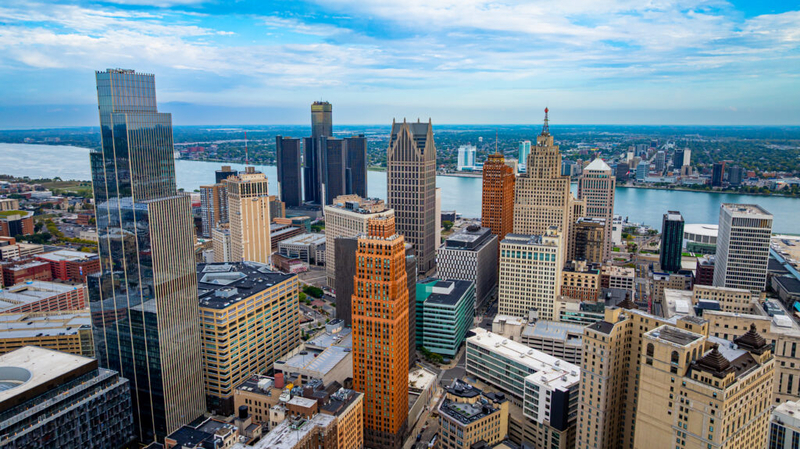
Downtown Detroit skyline and river | iStock / Getty Images Plus
Voter misconceptions on how well Michigan compares to other states should be seen as a warning flag for the state’s business, education and government leaders, according to new polling data from the Detroit Regional Chamber released Monday.
The chamber’s latest statewide poll asked 600 registered voters about their thoughts on the state’s economy, AI data centers, the ability of Washington and Lansing to compromise, and the race to be Michigan’s next governor. The poll was conducted by the Glengariff Group between Jan. 27 and Feb. 2.
Among those findings, the chamber said it noted a clear disconnect between how well Michigan was actually doing on those metrics versus how voters interpreted the state’s standing.
“On nearly every metric we tested, Michigan voters believe the state is doing average against the other states,” said Richard Czuba, president of The Glengariff Group, Inc, in a statement. “The reality is that Michigan is doing far worse. Michigan voters have no clue how we stack up against the other states, even on those metrics where Michigan is at the bottom of the list.”
Across consistent party affiliations, respondents placed Michigan in the middle of the pack between 25th and 28th out of the 50 U.S. states, whereas the reality was far off the mark on some key metrics.
Detroit Regional Chamber Feb 2026 Survey ReportOn the percentage of the population with college degrees, respondents thought Michigan ranked around the 25th percentile, whereas the state was actually 33rd in the measure. Student performance in reading was ranked around 26th in the nation, whereas Michigan’s student reading performance is actually ranked 44th among U.S. states.
While respondents ranked Michigan at 27th in terms of average income per person, that number is closer to 40th in the nation. The state’s ability to attract high-tech jobs and its unemployment rate were ranked 28th and 29th by respondents, respectively, but both rankings actually fall to 45th in the nation.
Sandy Baruah, president and chief executive officer of the chamber, said that in many ways, Michigan’s “house is on fire.”
“In just one generation, Michigan has fallen from a top 10 or 20 state to a bottom 10 state in per capita income and educational achievement, which is not a recipe for long-term economic success,” Baruah said in a statement. “We need to come together and start having the candid and hard conversations about Michigan’s shortfalls. Our state needs to embrace what it takes to thrive in the innovation economy, or accept being ranked dead last in the nation, something that was inconceivable not that long ago.”
From the chamber’s perspective, no other state has fallen as hard or as fast in per capita income and educational performance as Michigan has.
“Michigan’s poor performance on these key metrics should serve as a wake-up call for business leaders, lawmakers, and voters,” the chamber said in a news release on Monday. “Michigan continues a precipitous, long-term decline to the bottom of national rankings, which poses a serious threat to the state’s long-term economic competitiveness, as other states like Mississippi have reversed key metrics like reading scores and climbed from the bottom to the top third (16th) nationally.”
The chamber said the low rankings reflect the state’s inability to commit to long-term strategies that support education, economic development and infrastructure investment, among other factors that drive economic growth.
If Michigan is going to thrive in the future, the chamber suggests that the state and its Detroit region needs to ensure all residents have a pathway to obtaining skills and higher education credentials needed to earn good-paying jobs in a continuously competitive and ever-evolving global economy.
Specifically, it pointed to the adoption of what it called a “K-12 + 2” mentality with the expectation that Michigan kids will at least get two years of training or education in a skill or certification after graduating high school.
Lansing, MI