Pennsylvania doubles dollars devoted to rape crisis centers
Jul 13, 2026 | 5:19 pm ET
Description
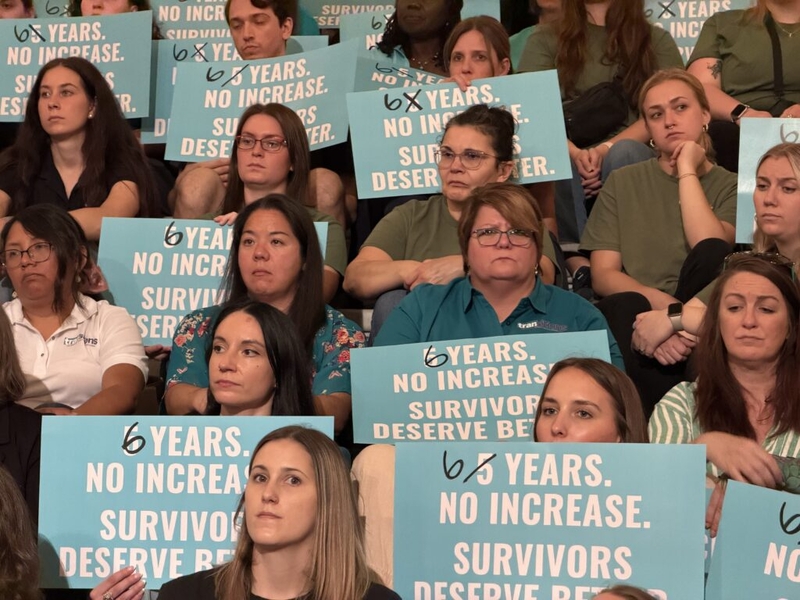
Advocates for rape crisis centers call for more dollars after six years of relatively stagnant funding on June 8, 2026. The crowd holds signs from last year's rally, with handwritten sign changes. (Photo by Whitney Downard/Pennsylvania Capital-Star)
While most of the reactions to Pennsylvania’s new $50.8 billion budget from elected leaders focused on its imperfections due to the need to compromise, the mood of the commonwealth’s 47 rape crisis centers is much more celebratory.
“I’m just astounded in the best way. I cried when I realized this was happening,” said Gabriella Romeo, the public policy director at the Pennsylvania Coalition to Advance Respect. “We’re very grateful for the legislative champions that helped bring this to fruition through the negotiating process.”
Funding will jump from $12.1 million in last year’s spending plan to $24.1 million, bolstering many centers that were devastated by last year’s 135-day budget impasse. Due to the delay, many organizations laid off their employees — some nearly three-quarters of their staff — and staffing levels have struggled to recover.
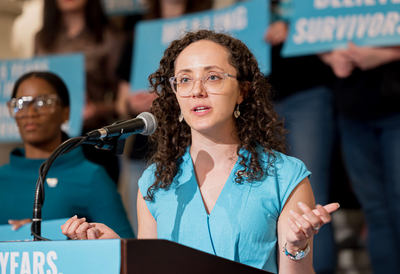
“Today’s $12 million investment in Pennsylvania’s rape crisis centers is a powerful commitment to survivors of sexual violence across the Commonwealth,” said Sadie Sterner, the executive director of Pittsburgh Action Against Rape. “Today is a victory for survivors, and we are proud to continue this work alongside leaders who understand that supporting survivors is not a partisan issue, it is a shared responsibility.”
Though Gov. Josh Shapiro didn’t name PAAR by name, he spoke about visiting an organization in Pittsburgh in his Sunday night budget speech. saying he heard firsthand “how hard it is to provide essential services to support victims of rape and sexual assault on a really tight budget.”
“When I called the leaders in Pittsburgh (Sunday) morning, I thanked them for the education they gave me and so many others, and the work they do,” he continued.
Republicans also lauded the investment, including Sen. Lisa Baker, of Luzerne County, who included funding for rape crisis centers as a highlight of the budget compromise.
“As chair of the Judiciary Committee, I know the lifesaving work these centers offer survivors, and the importance of increased funding so they can continue to support individuals during horrific times,” Baker said.
Last year, rape crisis centers got a $250,000 boost to funding that put them over $12 million after five years at $11.9 million.
Where the funds will go
At a June rally where organizations pushed for funding, center CEOs reported that a $12.5 million infusion would increase advocate salaries from $16 an hour to $21.50. Such an increase would help with recruiting and retaining staff, many of whom have a master’s degree, said Romeo.
“Many, if not all, of these programs were understaffed because they simply didn’t have the funds to be fully staffed,” added Romeo. “They had to make tough choices when it came to being able to provide an equitable or living wage for the staff they had on hand, and still continue to provide services.”
The 47 centers vary in their programming, but offer services in all 67 counties, including 24/7 hotlines, counseling and therapy, and someone to support a survivor during a forensic examination or in the courtroom — usually at no cost.
Gov. Shapiro signs $50.8 billion compromise budget, despite some opposition in both parties
“These types of jobs are very demanding. They’re often experiencing secondary trauma and they deserve adequate wages,” she said. “When we have fully staffed programs, that’s going to strengthen the response to survivors.”
Some organizations may be able to expand prevention education services, which are often the first service to be cut, according to Romeo.
“This is an historic investment, which will give us the opportunity to rebuild and restabilize these services, but we also recognize that we have to continue to protect this investment,” continued Romeo.
In the commonwealth, emergency rooms might have on-call advocates and law enforcement must direct people to their local rape crisis centers. University campuses must also have advocates and prevention education reviewed by local organizations.
“Part of our ultimate mission is to eliminate and prevent sexual abuse, assault and harassment. But we can’t work toward that mission if we don’t have uncomfortable conversations,” said Romeo. “Why this funding is important, why these services are important and what other pieces of policy work do we need … to create safer communities across our state and work toward eliminating gender-based violence.”

Harrisburg, PA