DMACC steering committee works to create AI guidelines for use and innovation
Jul 13, 2026 | 7:03 pm ET
Description
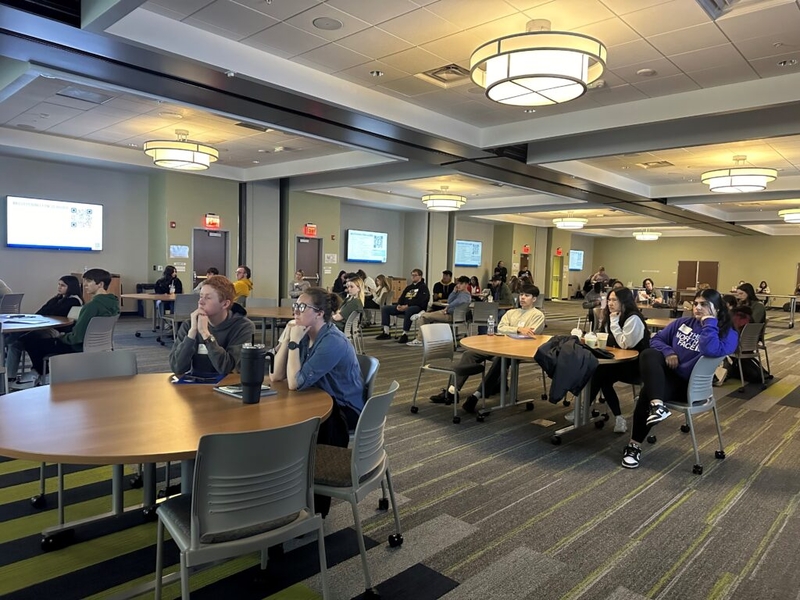
DMACC officials have created a steering committee with the goal of developing a framework for AI adoption and innovation. (Photo by Brooklyn Draisey/Iowa Capital Dispatch)
Des Moines Area Community College is moving into a new phase of artificial intelligence integration, with college leaders hoping to turn AI innovation from isolated to integrated.
DMACC vice president for student affairs Erica Spiller and Amee Austin, associate executive director of human resources, presented to the college’s board of directors Monday on how DMACC is moving from early adoption of AI to developing an institution-wide strategy.
The pair said they’ve sponsored a steering committee with the goal of adopting AI “as an institutional capability rather than an isolated tool or one-off project,” Spiller said.
“When we step back, we see that AI isn’t really influencing or changing our strategic direction; it’s expanding our ability to achieve it, and we think it should become an intentional part of that direction,” Austin said. “And with your guidance and support, and some of the discussion from today, our goal is to help formalize an AI strategic priority that gives this work the intentional leadership resources and accountability that it needs to be maximized for students, employees, and our community.”
Board members, some of whom already use AI tools in their business and personal lives, were on board with crafting college-wide AI policies to guide use of applications whose ability “is up to your imagination,” board member Chaz Allen said.
DMACC already has AI programs and tools available for student training and use, Austin said, including an artificial intelligence associate’s degree and partnerships with Intel and the National Applied AI Consortium Mentorship program. Faculty are using AI tools in their own work as well, including in skills evaluation and to “improve learning and student support.”
Both Austin and Spiller were previously involved with a “digital resilience” group focused on changes happening in the digital landscape, Spiller said, and AI dominated the conversation. While the pair saw that AI would need to be its own focus within a different group, one insight they found was that early efforts were being made to understand and bring in AI, but separate from one another.
“We realized that these pockets of innovation meant that sometimes this pocket and that pocket were doing similar things, but they weren’t working together on that, and of course, there’s all sorts of challenges and missed opportunities that come along with that,” Spiller said.
In order to connect these efforts and guide the college in its entirety through AI adoption and integration, the steering committee is working to develop guidance, including a draft charter and a vision statement that aligns with the college’s mission as a whole.
An initial vision statement shared with the board Monday stated that “DMACC will leverage AI ethically, transparently and responsibility” to improve student access and success, operational efficiency and employee effectiveness “while preserving human-centered services.” It adds that AI will be brought in as “an institutional capability rather than isolated tools or one-off pilots.”
Board members also completed a first reading of proposed additions to college policy relating to AI, stating that AI must be used in an ethical and transparent manner that respects people’s rights and dignity, and its use must be acknowledged. The proposed policy is high-level, Spiller said, and more detailed guidelines are available for instances where students or staff use AI.
The goal isn’t to slow any innovation down, Austin said, but to create a framework that supports “continued experimentation while also ensuring that we have the appropriate governance, guidance and guardrails to manage any risk and maximize the value for the college.”
Board member Angela Jackson joined Allen in saying she uses AI in her work duties and she believes it’s an “excellent resource from a business perspective,” as well as an educational one, that will help keep DMACC competitive.
Fred Greiner, another board member, described AI tools as potentially “scary in what it can do and the effect it can have,” saying his wife told him not to show an AI-generated photo of his parents kissing on their wedding day to his siblings.
In areas of college financials and operations, Greiner said artificial intelligence can be used as long as the data put in is accurate, and it could potentially lead to people losing their jobs.
“Developing a plan and a process, and making sure everybody’s on the same page is going to be a necessity,” Greiner said. “Otherwise, it’s going to get misused and could lead to disaster at some point, but I think the college, it might replace a few employees, but we have to look at that from the operations side. But I just think there’s tremendous potential, with the guidance that’s going to be needed now … kids are all using it, my grandkids are using it, it’s just scary what’s out there.”

Des Moines, IA