Pawtucket lawmaker’s bill clarifies tenant and landlord responsibilities in the event of bed bugs
Mar 19, 2026 | 5:59 pm ET
Description
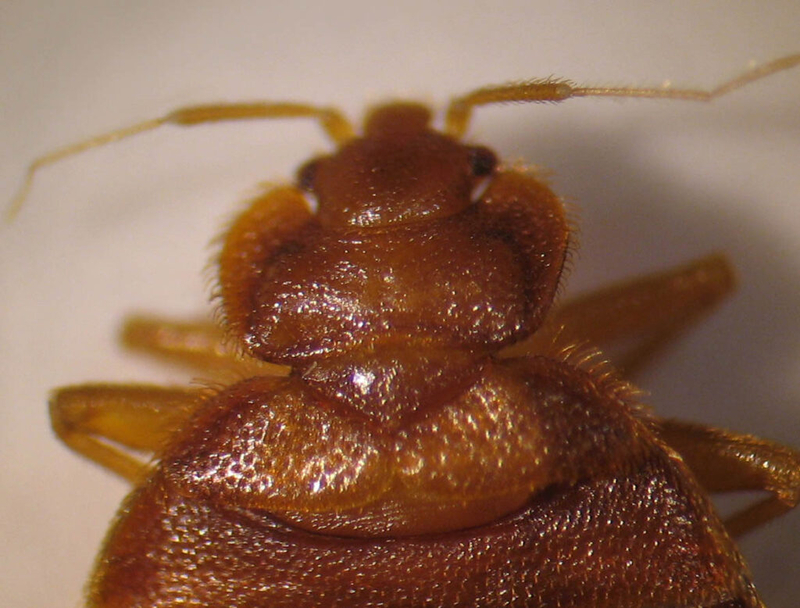
A close dorsal view of the head and thorax regions of an adult Cimex lectularius bed bug. (Photo by Blaine Mathison CDC/ CDC-DPDx/2010)
A four-and-a-half hour hearing Wednesday night of the House Committee on Judiciary drew a long parade of landlords who rallied against a number of perennial housing-related legislative pushes like rent control and just cause evictions.
Hiding among all the big ideas were the bed bugs.
Bill H7758 — sponsored by Rep. Cherie Cruz, a Pawtucket Democrat — would outline more transparent terms for landlords and tenants alike in one of the most dreaded apartment scenarios: a bed bug infestation.
State housing regulations prescribe that tenants take care of “any insects, rodents, or other pests” if only their unit is affected. Property owners, meanwhile, are tasked with ending infestations that spread to multiple units or shared living areas. Still, the law does not specify steps for bed bugs, which the state health department describes as “hitchhikers” who tend to ignore cleaning measures that may repel other pests like rats or cockroaches.
Cruz described the bill Wednesday as one in which landlords and tenants share responsibilities for eradicating the pests.
“Everyone wants a safe residential unit, and this really just spells that out,” Cruz told her fellow committee members. “It’s pretty straightforward.”
Under Cruz’s proposal, tenants would be responsible for notifying their landlord upon suspicion of a bed bug infestation. Landlords would then have 96 hours to enlist an inspector, and five days to begin treatment if an infestation is confirmed. Landlords would shoulder all costs for inspection and treatment, the bill says, although tenants would also have to comply with the process and they would be responsible for costs involved in “preparing” the unit for inspection and treatment.
The bill would also stop landlords from putting units on the market if they know or reasonably suspect the unit hosts bed bugs, and owners would be required to disclose to prospective tenants whether a unit had bed bugs in the last eight months. Landlords would have no responsibility to pay for or replace a tenant’s damaged property, nor would they have to pay for alternative living arrangements during cleaning.
Cruz’s bill received little fanfare in person, with only one testimony in support and one in opposition at Wednesday’s hearing, the latter threaded into a landlord’s larger argument against most of the night’s bills. Still, there were 35 pieces of testimony on the bed bug bill submitted ahead of time, most of them similarly worded messages of opposition. Opponents mostly claimed the bill would unfairly saddle landlords with the onus and expense of bug annihilation, claiming that it’s new tenants who typically bring the bugs into previously untainted units.
“I don’t even know what to say about this absurd Bill!” wrote Kathy Del Sesto of Narragansett in her testimony. “If a black widow spider gets into the apartment is the landlord responsible for the spider?”
Rose Russell, a Providence landlord, shared in her testimony three stories of tenants who she claimed brought bed bugs into her units. She criticized the bill’s allowance for tenants to sue for damages if landlords don’t comply, the timeline for cleaning and inspection, and the clause instructing landlords to disclose a unit’s bed bug status.
“If the current tenants living there have no issues, that’s my proof,” Russell wrote.
While introducing her bill, Cruz acknowledged that new tenants can “unknowingly” move in with bed bugs in tow. But, she added, “Bed bugs can live dormant for a year in walls and furniture, whatever’s left in the unit,” thereby affecting an apartment’s new inhabitants.
There was one voice uplifting Cruz’s legislation: Nathan Jewett, who offered testimony on behalf of the New England Pest Management Association and Providence’s Big Blue Bug Solutions, where he works as director of field operations.
Jewett said studies from Chicago — which has the dubious distinction from national pest control outfit Orkin as being the most bed bug-infested city in the U.S. for five consecutive years — show the critters “disproportionately impact lower income communities, making this not just a pest issue but an equity issue.”
In his experience, Jewett has found that infestations get worse because tenants may delay reporting “out of fear of blame or repercussions,” while landlords may be unclear on their duties and delay taking action.
“Untrained individuals attempt to self-treat often, making the situation much worse,” Jewett said. “Bed bugs are definitely not a do-it-yourself problem.”
Perhaps, Jewett offered, the bill could help eradicate the bugs in Rhode Island.
“That would be nice, right?” Rep. Carol Hagan McEntee, the committee chair, replied. “No more bed bugs.”
Cruz is joined by fellow progressive-leaning Democrats in the bill’s sponsorship, which mirrors closely a similar bill introduced last year by the more progressive faction of the Senate. That bill died in committee.
Cruz’s bill was held for further study Wednesday night, which is standard practice for a bill upon introduction.

Providence, RI