Minnesota led the nation in farm bankruptcies in the first quarter, and farmers are anxious
May 26, 2026 | 7:00 am ET
Description
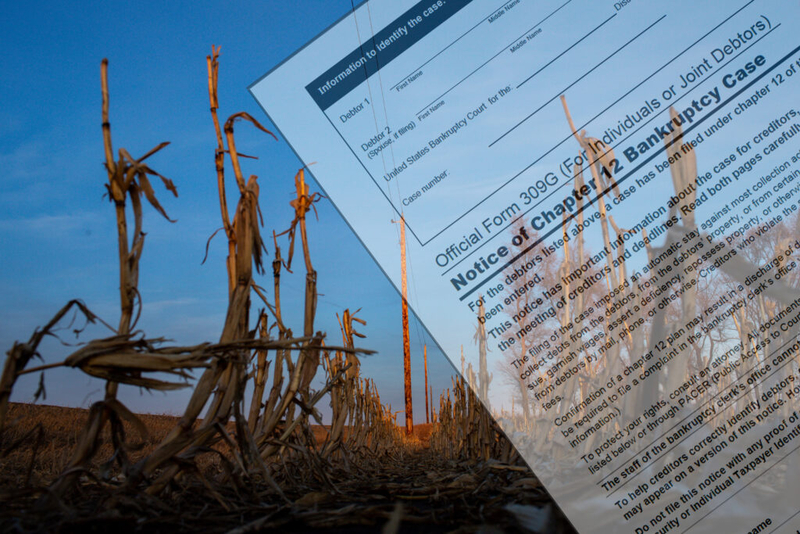
Minnesota led the nation in farm bankruptcies for the first quarter of 2026. Farm bankruptcies are climbing nationwide, with Midwest farmers hit particularly hard. (Photo illustration by Nicole Neri/Minnesota Reformer)
Minnesota led the country in farm bankruptcies during the first quarter of 2026, continuing last year’s steady nationwide climb that was particularly steep for Midwest farmers. Eight Minnesota farmers have already filed for bankruptcy this year, double the amount for the entire year of 2024.
“I know a lot of farmers that are really struggling,” Bob Worth, who farms corn and soybeans in southwestern Minnesota, said in an interview.
Worth, 74, was sitting in the driver’s seat of his planter, taking a brief pause from planting his 56th crop on his Lake Benton family farm.
In over half a century of farming, Worth has seen a lot of ups and downs. Lately, it’s been much more down than up. With fertilizer and fuel costs on the rise as crop prices sink, the past few years have taken a toll on farmers.
“It’s really this margin squeeze on an industry that already operates on extremely thin margins,” Samantha Ayoub, the agricultural economist who authored an American Farm Bureau Federation report on rising farm bankruptcies, said in an interview.
Chapter 12 of the U.S. bankruptcy code was established after the 1980s farm crisis to help struggling family farmers reorganize their debts. Many filing for Chapter 12 continue to farm after filing for bankruptcy, though farm closures are also on the rise, according to the Farm Bureau report.
Worth said that he knows plenty of farmers engaged in mediation steps that precede bankruptcy, and many who are just plain old quitting. “They just don’t want to lose any more money,” Worth said.
When Worth first felt the pinch four years ago, he expected things to bounce back quickly and money to start flowing again. That never happened, he said, and now, reserves saved to get through tough times are running out.
“It’s been a tough time for too long,” Worth said. Net farm income hit a low point in 2016, climbed to a peak in 2022 amidst pandemic-era federal relief, and is now again on the decline.
Even on Worth’s long-established farm — free from the debts that younger producers often take on when starting out — Worth said his cash flow is in the negative. “That’s how serious this is,” he said. Young producers may be even worse off, both with less on the asset side of their balance sheet and without established relationships with lenders to get through tough times.
The reality on the ground for farmers reminds Worth of what it was like during the 1980s farm crisis, when Minnesota’s total net farm income fell 58%, the number of farms in the state decreased by 13,592, and over 1,000 farmers facing foreclosure nationwide died by suicide. Having struggled with depression during that period, Worth knows firsthand that economic hardship can have a direct impact on farmers’ mental health.
“Some really bad things are happening,” Worth said, citing suicides and domestic violence amongst farmers in his community.
“It’s ugly,” Worth said. “But I survived.”
Ayoub said many are drawing comparisons to the 1980s farm crisis from an economic perspective, but there are also key differences. For one, land prices are much better off for farmers now than they were in the 1980s. And farmers have tools now that didn’t exist in the 1980s, Worth said, like crop insurance programs implemented to protect farmers when they harvest a bad crop.
For Worth, life experience is another factor that makes this moment feel different. “A lot of the farmers of my age have lived the 80s. We learned a lot in the 80s and what not to do.”
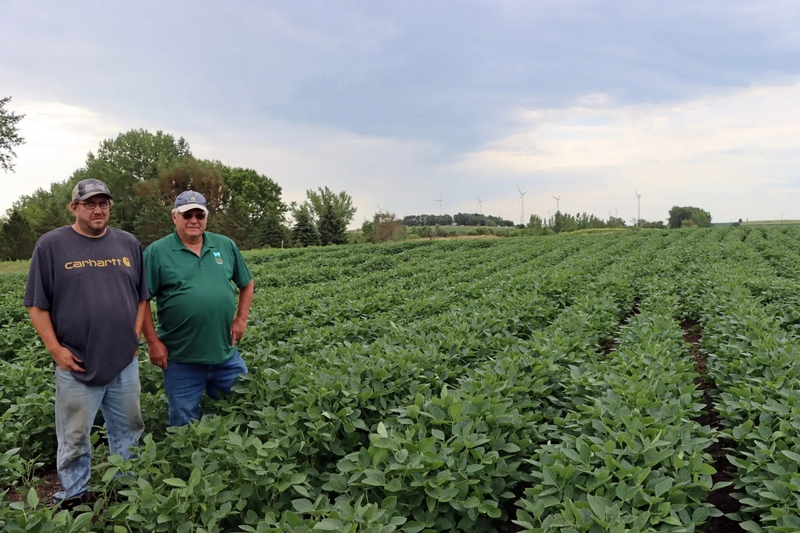
Bankruptcy filings are a lagging indicator, depicting the past few years — not months — of economic pressures on farmers. Worth looked back to inflation under the Biden administration as when input costs started to rise and squeeze margins, but cited policies under the Trump administration as making matters worse.
“The trade war hasn’t helped a thing,” Worth said, referring in part to Trump’s tariffs on China, which have dampened demand for soybeans. According to the White House, China agreed during Trump’s recent visit with Chinese President Xi Jinping to buy $17 billion in U.S. agricultural products annually through 2028, still far below what it would purchase before the trade war.
Kyle Jore, a Thief River Falls grain farmer, agricultural economist, and Secretary of the Minnesota Soybean Growers Association, said that while he has been able to find some new buyers, he is not selling at nearly the prices they were getting before the trade war.
The war with Iran is adding insult to injury, pushing fertilizer to what Ayoub calls “near-record prices” in recent months and diesel fuel to $5 per gallon in parts of Minnesota.
Jore, who like many farmers uses a diesel truck for towing, said he was filling up his tank recently when the pump turned off unexpectedly. The tank wasn’t full, but he had hit the price maximum.
“We’re absolutely feeling it,” Jore said. “And it’s happening right at the time we’re planting.”
Trump’s approval rating remains higher than the national average in many rural parts of the state. Justin Meyer, a grain and cattle farmer in southeastern Minnesota, primarily blames inflation under the Biden administration for the strain, not Trump’s policies.
“Farmers haven’t seen fair prices (in) forever,” Meyer said. “It’ll be a tight year. But it’s nothing different than what’s been happening for years.”
The Trump administration doled out $12 billion in one-time payments to farmers in February, piling onto the $30 billion in aid given during 2025. The newest bailout may cover only one-third of farmers’ estimated losses and primarily benefit larger, wealthier farms. Cash assistance to farmers — which flowed steadily under the Biden administration as well — has certainly helped many farmers stay afloat, but it hasn’t done enough to reverse or even slow down the trend toward bankruptcy.
“To have that (assistance) and still to have an increase (in bankruptcies) is unfortunate to see,” Jore said.
Ayoub said cash assistance can have a “buoying” effect for a couple years, but it is unclear how much sustaining it can do in the long term. What’s really needed, Ayoub said, is “domestic demand across the board.”
Farmers would “rather have a market than assistance,” Jore said.
“I don’t necessarily think that direct payments are the answer,” Jore said. When speaking with policymakers in Saint Paul and Washington, Jore advocates for increased domestic use of crops and renewable biofuels. Jore thinks the farm bill passed by the U.S. House on April 30 includes some of the needed reforms, but worries about other parts of the bill, including the new pesticide language limiting use of products.
The bottom line: “we need to have a market that operates in its own effect,” Jore said.
“It really takes a shock to bring it back to a high point,” Ayoub said. In the meantime, “(we) don’t necessarily have a clear view of where there’s an endpoint for our farmers.”

Saint Paul, MN