NJ car insurance rates soar, driving some to dump coverage
May 26, 2026 | 6:33 am ET
Description
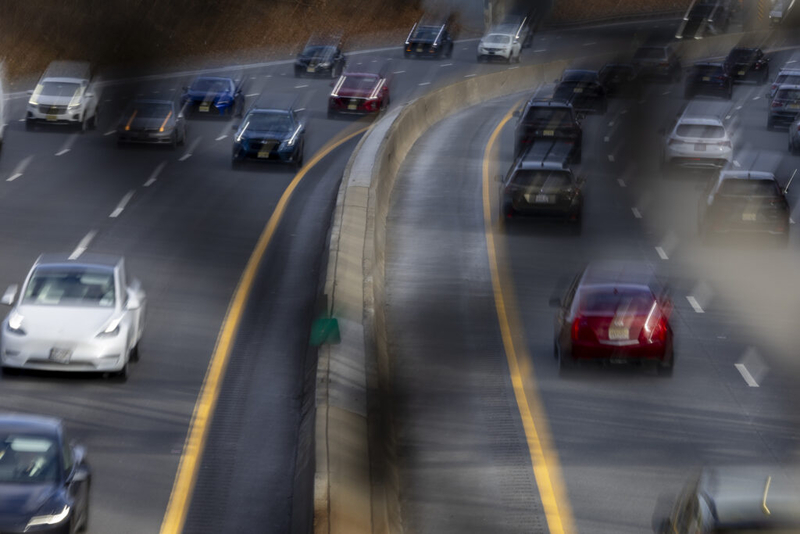
New Jersey regulators approved over 300 car insurance rate hikes since 2022, a trend critics say worsens affordability and uninsured driver rates. (Photo by Anne-Marie Caruso/New Jersey Monitor)
Some New Jersey motorists, already shouldering car insurance costs that are among the highest in the nation, saw their rates rise as much as 32.5% in the past two years — far faster than inflation and nearly five times the rate that triggers regulatory review.
Most of the 77 insurers that write auto insurance in New Jersey have sought rate hikes every year since 2022, with companies seeking about 90 double-digit increases as high as 63%, according to data the New Jersey Monitor obtained through public records requests.
The state approved the rate requests most of the time, approving 69 double-digit increases since 2022, the data shows.
The trend worsened a broader affordability crisis in New Jersey and fueled a spike in uninsured motorists, critics say.
Brian Lipman is the state’s ratepayer advocate as director of the state Department of Rate Counsel. He’s tasked with reviewing requests for rate hikes higher than 7% and filing comments with the state Department of Banking and Insurance, the agency that ultimately approves them.
“Since the pandemic we have seen a large uptick in insurance rate filings and that many of those filings are requesting much more significant increases. This is yet another part of a resident’s budget that is impacted and has had a negative impact on affordability for New Jersey customers,” Lipman told the New Jersey Monitor.
“Unfortunately, in many instances, the math does support an increase, many times a significant increase,” he added. “We push back when we see that there are concerns with the filing and when we cannot, we remind DOBI of the financial impact on ratepayers of such large increases, and suggest that a policy of gradualism, where rates go up more slowly to allow customers to be able to absorb the increases, be implemented.”
Industry observers blame a bevy of problems, both national and local, for sending the rates surging.
The cost to buy new and used cars — and to repair them — has shot up since the COVID-19 pandemic, largely due to inflation, supply chain disruptions, rising labor costs, and vehicles’ advancing technology. People are driving more dangerously and crashing more, resulting in more losses and litigation. And President Donald Trump’s tariffs have impacted rates, as well.
Michael DeLong, a research and advocacy associate with the Consumer Federation of America, said in New Jersey, weak regulation has also enabled profit-hungry insurers to continually raise their rates.
State law does not limit how often an insurer can request a rate increase nor cap how much they seek. Companies that write auto insurance have sought, and regulators approved, more than 300 increases in the past four years, 30% of which were high enough to trigger Lipman’s review, state data shows.
Yet even when the state Department of Banking and Insurance denied the eye-popping rate increases some companies sought, department officials still approved double-digit hikes, data shows. For example, officials green-lighted a 32.5% hike in 2024 for the Harleysville Insurance Company of New Jersey, which insures close to 17,000 drivers, only about 10% lower than the 42.1% increase it sought. And when the Metromile Insurance Company, which insures about 5,000 motorists, applied for a 63.1% rate increase that same year, the state approved a 22.9% increase.
“Frankly, the New Jersey Department of Banking and Insurance doesn’t reject a lot of rate increases, and often gives the insurance companies what they want,” DeLong said.

Department spokeswoman Dawn Thomas disputed that, saying officials do not rubber-stamp rate change requests and instead conduct actuarial reviews, “often” challenging requests for rate hikes and denying those it deems “inadequate, excessive or unfairly discriminatory.”
The department blocked almost $1.2 billion of premium increases since 2023 through that rate review process, Thomas said.
“The Department recognizes that auto insurance can be a significant expense and takes seriously its responsibility to hold the industry accountable and regulate in a manner that promotes consumer protection and the stability of the industry,” she said.
The department approved 68 rate hikes last year ranging from less than 1% to 30%, with 20 rate change requests over the 7% threshold for Lipman’s review, data shows.
Companies do occasionally seek rate reductions. That happened more often during the first two years of the pandemic when more people worked or studied from home and didn’t drive as much. The department approved 16 rate reductions (and 12 increases) in 2020, and nine reductions (and 10 increases) in 2021, data shows. In comparison, companies sought just five rate reductions last year out of 75 total requests.
Protecting consumers — or their ‘side hustle?’
Beyond regulation, both advocates and industry insiders blame state legislators for soaring car insurance costs.
DeLong pointed to state inaction on one controversial cause of increases: some insurers’ practice of charging customers more for things that have nothing to do with driving, such as their credit score, marital status, occupation, and education level. The NAACP’s New Jersey state conference and two Latino groups sued the state and the Department of Banking and Insurance in November over the issue.
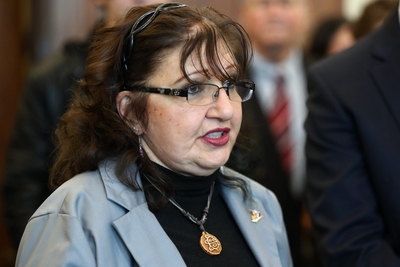
Cuqui Rivera of North Brunswick suspects that’s why she used to pay three times as much for the same coverage than she does now. She was a single mother of six children who hadn’t gone to college and lived in a community of color when she first learned about discriminatory car insurance pricing and decided to shop around and switch carriers.
Rivera is a founder and advisor of the Latino Action Network, one of the plaintiffs in the lawsuit seeking to force state regulators to bar insurers from basing rates on socioeconomic factors. New Jersey legislators have introduced a bill five times in the past nine years that would do just that, but it remains stalled in the Statehouse. Rivera suspects legislators — some of whom are personal injury lawyers — have not prioritized its passage because they’re protecting their “side hustle.”
“I think it’s criminal that the laws in the state of New Jersey can feed off of the most vulnerable communities in this way,” Rivera said.
Industry insiders say New Jersey’s car insurance costs more because the Garden State’s nearly 7.1 million licensed drivers have more coverage than those in other states. That’s partly because the state requires higher minimum liability limits than most other states, but also because drivers here tend to buy more than the minimums the state requires, said Gary La Spisa, senior vice president of the Insurance Council of New Jersey.
“Our consumers may be paying more than most other states, but they’re also getting more coverage than consumers in most other states,” La Spisa said.
La Spisa and others in the insurance industry also blame lawmakers for climbing costs, although for different reasons than those advocates cite.
Christine O’Brien, president of the Insurance Council of New Jersey, said legislators passed laws in the early 2000s to bring car insurance rates — “astronomical” at that time — back in line with the rest of the country.
But two decades later, legislators passed five laws between 2019 and 2024 that ballooned car insurance rates, in large part by making lawsuits stemming from vehicle accidents more lucrative, O’Brien said. Those measures:
- Allow accident victims to claim “uncompensated economic loss” in civil lawsuits for medical expenses their personal injury protection policy doesn’t cover, up to $250,000.
- Require drivers to disclose their insurance policy limits to victims’ attorneys in lawsuits.
- Lowered the standards of proof for bad faith lawsuits against insurers in cases involving uninsured and underinsured motorists and hiked the damages allowed. While the law was meant to ensure the “fair conduct” of insurers, the council says its unclear definition of what constitutes “unreasonable” delays and denials has lowered the bar for litigation.
- Raised the minimum liability insurance drivers of private passenger vehicles must have.
- Raised the minimum liability insurance commercial drivers must have.
“The market had finally settled out over the past 20 years, and New Jersey has been basically a quiet market and a very healthy, vibrant, competitive market for probably 15 years,” O’Brien said. “These laws put us on a train heading backwards.”
More than half of the legislators who sponsored the measures are lawyers, with two — Senate President Nicholas Scutari (D-Union) and Sen. Jon Bramnick (R-Union) — specializing in personal injury law. Bramnick even advertised one of the bills (of which he was a legislative sponsor) before its passage on his law firm’s website.
“Those sound like some pretty serious conflicts of interest, if legislators are promoting and encouraging bills that they stand to benefit from, and that their clients stand to benefit from,” DeLong said.
Maura Collinsgru, director of policy and advocacy at New Jersey Citizen Action, seconded that sentiment. Collinsgru has lobbied lawmakers for years to end discriminatory pricing in car insurance and otherwise act to rein in runaway car insurance costs and other drivers of unaffordability.
“He’s got skin in the game as an attorney,” Collinsgru said of Scutari. “It’s obvious that the concerns of the legal community have a seat at the table. What’s not clear is that the concerns of the people who are struggling have a seat at the table.”
Scutari did not respond to requests for comment.
Bramnick bristled at the blame lobbed at him, saying rising crash rates have sent car insurance rates up. The state Department of Transportation reported 236,601 wrecks on municipal, county, state, and interstate roadways in 2024, up 9% from 217,778 in 2022.
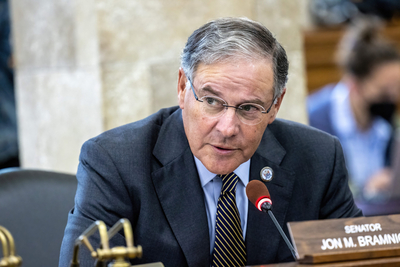
He defended the laws he and Scutari shepherded through passage, calling them consumer protection measures and saying compensation for crash victims needed to rise because it had not kept up with inflation.
“Nobody wants to pay the rates until they’re injured,” he said. “Then all of a sudden, it’s: ‘Oh, you mean I only get $15,000 in medical coverage?’”
He rejected claims that his involvement in such legislation posed a conflict of interest, saying other legislators introduce and speak out in support of bills that align with their professions.
“There are teachers that advocate for teachers. There are doctors that advocate for doctors. There are consumer lawyers, such as myself, that advocate for consumers,” he said. “How do you say I have a conflict? When I didn’t hear, for 20 years, any of those people had a conflict?”
Bramnick added that Department of Banking and Insurance officials should better scrutinize rate requests and demand thorough justifications before approving them.
“Insurance companies are not the Red Cross, and therefore not a charitable organization. People have to look closely as to what they do and how they do it,” he said. “Let me come in with President Scutari, with our forensic accountants, and let us review their books. Then we can decide whether or not we have a problem here. But since I’m not invited in, I’m not going to take a profit-oriented company’s word for me being the problem.”
He said he’ll always be a “fierce advocate” for crash victims, instead of the insurance industry.
“Guess what? I’ll support the person who’s missing a limb,” he said.
The impact
Motorists in New Jersey are required by state law to insure their vehicles, but they increasingly cannot afford car insurance, and that has spawned new problems, DeLong said.
“They either have to take public transportation, which is slow and unreliable and may not exist in many areas, or they have to drive illegally, which breaks the law and puts themselves and others at risk and drives up costs for everyone,” he said.
More than 14% of Garden State drivers were uninsured in 2023, up from 3% in 2019, according to the Insurance Research Council.
“It’s like a game of dominoes. Which is the thing that tips people over? We are seeing across-the-board increases, whether it be insurance, food costs, gasoline, housing, all of it. And at some point, people just have to say no, right? They can’t invent money that they don’t have,” Collinsgru said. “This is why we are seeing people drop things that are — what’s the right word for it? — ‘optional.’ ‘Alright, it’s illegal to drive a car without insurance, but my car will still start if I don’t have insurance.’”
The average annual premium in New Jersey for full coverage, including comprehensive and collision, is $3,254, according to April data compiled by BankRate. In comparison, the least expensive state was Idaho, where full coverage averaged $1,476 a year, while Louisiana, at $4,135, came in highest.
Whatever the reasons for New Jersey’s rising car insurance rates, advocates and insurers alike agree there’s one easy answer for anyone feeling the pinch: compare prices to find the best deal.
“It is a very competitive market, and auto carriers are in the business to write your auto insurance. So shop around,” O’Brien said.
Trenton, NJ