Pa. Senate Majority Leader weighs in on midterm election, skill games and gift ban proposal
Sep 28, 2026 | 6:33 pm ET
Description
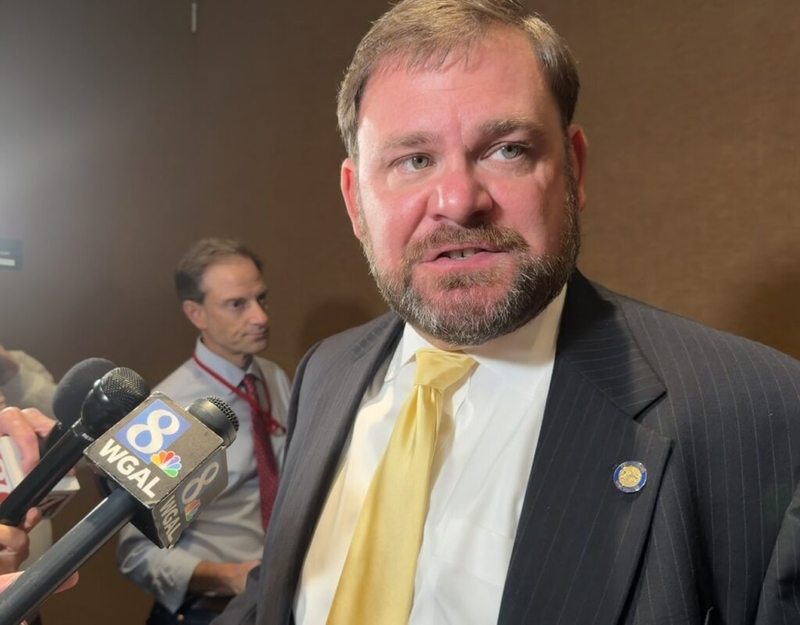
Senate Majority Leader Joe Pittman (R-Indiana) speaks to reporters about skill games and other legislative priorities following a Pennsylvania Press Club luncheon on Sept. 28, 2026. (Photo by Whitney Downard/Pennsylvania Capital-Star)
With just five weeks until Election Day, Senate Majority Leader Joe Pittman (R-Indiana) isn’t worried that his party will lose control of the legislature’s upper chamber. Instead, despite warnings of a “blue wave” in November, he believes Senate Republicans will widen their four-seat edge.
“We have very strong incumbents that know how to reach their constituents and communicate with them,” Pittman told reporters on Monday. “Our incumbents know exactly what we’re doing, and we’re also going to pick up a seat.”
Half of the commonwealth’s senators are on the ballot this year alongside every House member.
Pa. House lawmakers reintroduce gift ban bill despite decades of legislative inaction
Pittman, speaking at the Pennsylvania Press Club, touched on numerous issues before lawmakers — including a proposal to ban lobbyists from giving gifts to lawmakers, which a House Republican tried to advance later that afternoon.
Near the top of the agenda for Pittman in the coming weeks: skill games and felony murder, two policy areas disrupted by recent Pennsylvania Supreme Court rulings.
Justices ruled that mandatory life sentences without the possibility of parole for felony murder were unconstitutional in the spring, giving legislators until late July to act. They failed to come to a consensus, leaving judges without any sentencing guidelines for the charge, which is levied when someone dies during the commission of another felony such as robbery — whether the death was intentional or not.
The General Assembly still has time to meet a court-mandated deadline on skill games, which justices determined should be regulated like other gambling devices. They opted to delay their ruling until Oct. 13 so lawmakers could come to an agreement before Pennsylvania State Police seize the terminals.
Pittman pointed to a proposal from Senate leadership to tax the gaming terminals at 35%, below the 52% proposed by Gov. Josh Shapiro. Small businesses like laundromats, grocery stores, gas stations and fraternal clubs have come to rely on skill games as a source of revenue, and warn that a high rate will hurt their bottom line.
“Figuring out a regulatory path on them makes sense. Whether we can get there is a very open question,” said Pittman. Stakeholders also disagree whether taxes should be deposited into the state’s general fund or be earmarked for public transit.
Though he hedged on what bills might move before lawmakers adjourn for the year — including whether there will be any response to grassroots concerns about data centers — Pittman ruled out any action to legalize marijuana in Pennsylvania for recreational use.
“People tend to forget that recreational marijuana, for better or worse, is a scheduled narcotic at the federal level. And I think we would all be well served to have some more national direction on how to deal with this issue,” he added, also criticizing the state’s handling of its medical marijuana program.
Reforming Harrisburg
As one of just four states where the two major parties split control of the legislature, Pittman said the arrangement “puts us in a unique position and oftentimes a very difficult position.”
“Make no mistake, there are deep philosophical divisions in Harrisburg, and that’s OK. It’s OK to have deep philosophical divisions on policy, but it also requires us to give and take and compromise on issues when the moment arises and requires it,” Pittman said.
He pointed to budgets that “spent more than I certainly would prefer” as an example of a concession, saying his caucus brought “balance to the conversation.”
In response to another question, he said he believed removing cameras from chambers would make Harrisburg more efficient, only adding that “people like to talk in front of cameras.”
Pittman also spoke about proposed “gift bans” that would ban lobbyists from giving gifts to lawmakers, saying he believed the state’s current system works. Current law, as well as chamber rules, are “very clear that we cannot accept anything of value for official action,” he said.
State law requires lawmakers to report gifts over $250 as well as hospitality, such as meals or travel, over the amount of $650 in their yearly ethics disclosure.
“I would be very willing to look at efforts on transparency and figure out where loopholes may or may not be, but I will just further underscore that we have a very robust ethics commission,” Pittman added. “We have an ethics act in place, and I think that does a very good job at shedding light on anything that may occur that shouldn’t.”
Others disagree.
Pittman’s comments came the same day Rep. Mike Jones (R-York) introduced a discharge petition in order to force a committee vote on House Bill 744. Sponsored by Rep. Jared Solomon (D-Philadelphia), it would prohibit cash gifts in any amount as well as aggregated gifts of more than $50 from one person over the course of a calendar year.
“For too long, both parties have failed to act on this bipartisan legislation, not even allowing for an up or down vote,” said Jones. “Assuming we get our 25 signatures, which we are confident we will, it at least forces the committee to act.”
Jones said the $133,000 salary and per diem were “more than sufficient” for lawmakers, adding that discharge petitions to force votes on certain issues are one of the few tools available to Republicans in the House, where they are in the minority.
A gift ban has long been a priority for Michael Pollack, who is the co-founder and executive director of March on Harrisburg. The advocacy group pushes to reduce the influence of money on politics and improve government transparency.
“Because as long as money talks, the voice of the people just is not heard. As long as unlimited gifts are legal, those of who can’t afford to take somebody to Austria or to the Super Bowl just don’t get our point across as effectively,” said Pollack.

Harrisburg, PA