Nevada joins multi-state task force to update the region’s transmission lines
Jul 01, 2026 | 8:00 am ET
Description
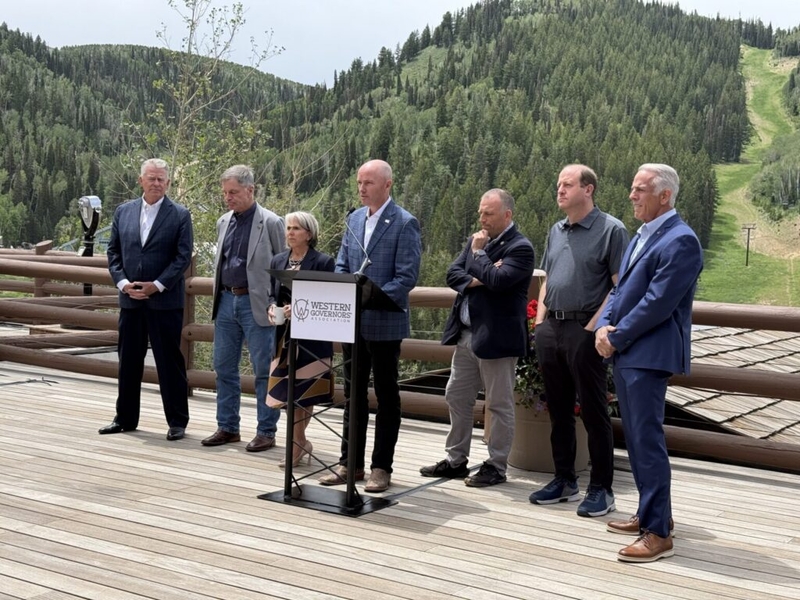
Governors Brad Little of Idaho, Mark Gordon of Wyoming, Michelle Lujan Grisham of New Mexico, Spencer Cox of Utah, Josh Green of Hawaii, Jared Polis of Colorado and Joe Lombardo of Nevada stand together during a news conference in Park City, Utah on June 30, 2026. (Alixel Cabrera/Utah News Dispatch)
Fragmented energy planning and transmission bottlenecks are pushing the Western U.S. power grid to the brink and threatening energy stability as the region faces an aging grid, surging demand and extreme weather events.
On Tuesday, Gov. Joe Lombardo signed Nevada onto a multi-state task force along with 10 other western states to develop an action plan that will serve as a blueprint to update the region’s energy grid.
The bipartisan taskforce was announced at the 2026 Annual Meeting of the Western Governors’ Association in Deer Valley, Utah. The agreement formally endorses the Western Transmission Expansion Coalition, or WestTEC, roadmap.
“This agreement shows that Western states can work together to modernize our grid, protect ratepayers, and build the transmission network needed to power the next generation of economic opportunity,” Lombardo said in a statement.
As part of the policy initiative to improve the Western grid and expand transmission infrastructure across the West, the association also released a report titled “Energy Superabundance: Unlocking Prosperity in the West.”
The report notes that permitting and regulatory challenges have hindered the development of energy projects by creating delays, increasing costs, and adding uncertainty to infrastructure investments.
Those barriers have slowed the deployment of energy resources and prevented critical energy infrastructure from keeping pace with growing demand, according to the report.
In 2024, the Department of Energy released the National Transmission Planning Study, which found that to maintain reliability, the U.S. will need to more than double its transmission capacity over the next two decades.
Across the West, demand for electricity is expected to increase by more than 20% over the next decade, according to the Western Electricity Coordinating Council’s most recent assessment of “resource adequacy.”
The assessment also found that the West’s planned resource buildout will likely not keep up with anticipated load growth over the next decade, adding that any delays or project cancellations would exacerbate energy security risks.
In Nevada, the vast majority of that demand growth is attributable to new and expanding data centers, which consume large amounts of power to serve artificial intelligence companies, cloud computing services and other related technologies.
Existing infrastructure is also struggling to keep up with demand. The Department of Energy estimates that nearly 70% of the transmission lines in the U.S. are over 25 years old, leading to increased failure rates and operating costs.
The association’s report urged federal decision makers to implement a series of recommendations to ensure a more resilient energy system in the West, including streamlining permitting and modernizing regulations.
“Nevada’s continued economic success depends on reliable, affordable energy,” said Lombardo. “As our state expands and attracts new businesses, we need the infrastructure to support that growth.”
Governors of Colorado, Wyoming, Utah, Idaho, Oregon, Montana, North Dakota, Arizona, New Mexico and Washington joined Lombardo in signing the letter endorsing the Western Transmission Expansion Coalition.
The bipartisan 11-state policy resolution urges Congress and the Trump administration to streamline the review of critical infrastructure projects and land management activities.
In Nevada, several solar projects have been delayed after Interior Secretary Doug Burgum issued an order in August requiring that Burgum personally review all applications for approval, bringing the permitting process to a crawl.
One of the recommendations pushed in the report was wind and solar, which have “relatively short construction timelines, mature supply chains, and favorable market conditions that allow them to be deployed faster,” the report notes.
“Expanding these resources can help meet demand while resources with longer lead times continue to be developed.”
The permitting policy resolution seeks to create a governor-led framework to expand transmission infrastructure, improve coordination across state lines, and accelerate permitting under existing law without reducing environmental protections or requiring new federal legislation.
The permitting policy resolution noted governors are concerned by the shortage of specialists in local field offices, especially those responsible for permitting projects. Western governors urged the federal government to prioritize hiring qualified permitting staff in local field offices to speed up permit processing.
The governors also announced the approval of five other bipartisan policy resolutions designed to advance federal policy recommendations regarding agriculture, rural development, broadband connectivity, veterans affairs, the missing and murdered indigenous persons crisis.
“We’re all working to find common sense, practical solutions, and meetings like this give us an opportunity to do that, to learn from each other, to exchange ideas, to look for common ground, and to benefit from our collective experiences and wisdom,” said WGA’s Chair, Utah Governor Spencer Cox in a statement.
Las Vegas, NV