MUSC Health weighing deal for control of struggling Grand Strand hospitals
Aug 20, 2025 | 3:03 pm ET
Description
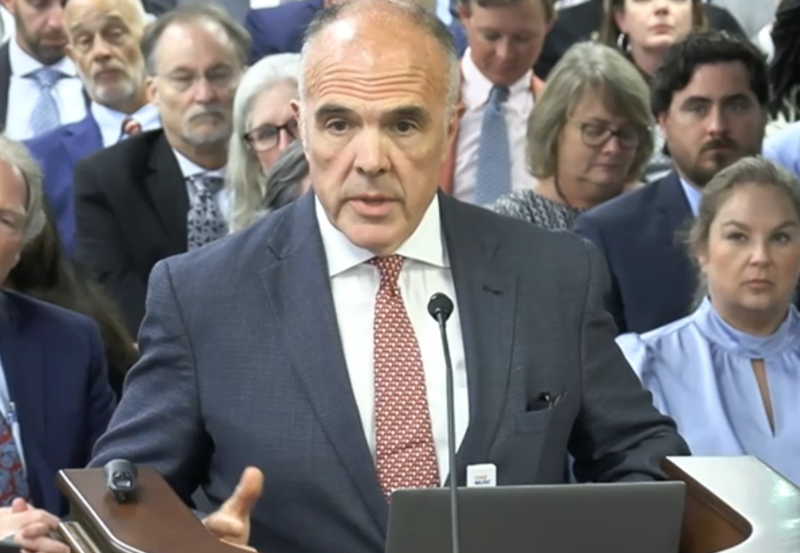
Medical University of South Carolina Health CEO Dr. Patrick Cawley speaks Tuesday, Aug. 19, 2025, before legislative members of the Joint Bond Review Committee. (Screenshot of SCETV legislative livestream)
COLUMBIA — South Carolina’s state-owned hospital system plans to take a controlling stake in a struggling Grand Strand hospital operator.
A legislative oversight committee gave the initial nod Tuesday for the Medical University of South Carolina’s hospital system to purchase a more than 50% share in Tidelands Health.
Legislators revealed, during a meeting of the Joint Bond Review Committee, that Tidelands is operating at a $50 million deficit. The private hospital company has asked MUSC to step in and help.
Neither MUSC nor Tidelands disclosed how much the deal would cost. According to the two hospital systems, negotiations are ongoing.
SC-owned hospital system set to double debt with 2 new hospitals
Tidelands employs more than 2,500 people in coastal Georgetown, Horry, and Williamsburg counties, according to its website.
“From Georgetown to Murrell’s Inlet, they’re really the only game in town,” state Sen. Stephen Goldfinch told the SC Daily Gazette. “We need it. We can’t let it fold up.”
The Murrell’s Inlet Republican said he supports the deal with MUSC.
Tidelands owns a pair of hospitals in Georgetown and Murrell’s Inlet with a total of 170 beds. It also owns a pair of medical rehab centers. And it has regulatory approval to build a small, 36-bed hospital that could treat patients in the fast-growing retirement communities surrounding Myrtle Beach.
“There are things we can do to strengthen them financially and turn them around,” MUSC Health CEO Dr. Patrick Cawley told legislators.
For example, he said MUSC has buying power and can get equipment and expensive medical records software at a reduced price.
“Our health systems have worked together to improve health care for more than a quarter century,” according to a statement from Tidelands. “A closer alignment would allow us to build on that important work and continue meeting the needs of the people and communities we serve. Patients would benefit as we recruit additional physicians, purchase leading technology and expand clinical research — delivering increased value while controlling costs.”
For nearly 200 years, MUSC had stayed largely contained to its Charleston base.
But beginning in 2019, the hospital system went on an expansion spree. It purchased four rural community hospitals in Florence, Marion, Chester and Lancaster counties.
Two years later, MUSC again expanded with the purchase of three hospitals and a standalone emergency room in the Midlands. Those hospitals, previously owned by Providence Health, had a $70 million deficit.
And in 2023, it took over operations of Orangeburg’s hospital, where there was a $30 million deficit.
MUSC was able to return Orangeburg to fiscal health within two years, Cawley said. And the Midlands hospitals are expected to be back in the black by next year — a five-year turnaround.
Cawley pointed to that track record when making his pitch to legislators.
Democratic Rep. Gilda Cobb-Hunter, whose district covers Orangeburg, praised MUSC for major improvements in the health care available to that community since the organization stepped in, including oncology, orthopedics and new treatments for sickle cell disease.
“Y’all must be doing something right,” Senate Finance Chairman Harvey Peeler, of Gaffney, chimed in.
MUSC already has a 30% stake in Tidelands and controls six seats on Tidelands’ governing board, according to documents provided to the Joint Bond Review Committee. This deal would up its buy-in at the small hospital system.
Goldfinch said Tidelands, with its roughly $540 million in annual operating revenue, never really recovered from the financial hardships caused by the COVID-19 pandemic, when hospital systems had to cancel surgeries that earn income and focus solely on treating those infected with the virus.
MUSC Health, on the other hand, is a $4.7 billion operation with the support of state funding and larger cash reserves that helped it weather the pandemic challenges.
“Health care is hard when you’re the small guy,” Goldfinch said.
Tidelands has about two years’ worth of cash reserves, so that’s how long MUSC has to make improvements, Cawley said. If the effort ultimately fails, the state-owned hospital system would be financially liable.
By 2043, SC hospitals could receive $2.4B less to treat Medicaid patients
The deal comes as hospitals gear up for other looming financial changes.
In 2028, South Carolina will start losing its ability to pay hospitals for treating Medicaid patients at similar rates as private insurance following changes included in Republicans’ “big beautiful” spending package.
The law signed July 4 phases out the so-called state directed payment program that South Carolina has used since 2023 to hike Medicaid payments to hospitals by a whopping 70% on average.
For the 60 general care hospitals in the Palmetto State, that collectively means a looming loss of roughly $150 million annually over 15 years, according to the state’s hospital industry group.
Instead of hospitals getting reimbursed with rates that align with private insurance — as they have for the last two years — payments will sink back to near Medicare levels. The higher rates come from the state taxing hospitals to draw down even more federal Medicaid dollars ultimately funneled back to the hospitals.
For the fiscal year that ended June 30, Tidelands received $40 million from these payment boosts, according to data provided by the state Medicaid agency.
South Carolina is among 10 states that never expanded Medicaid coverage to all adults up to 138% of the federal poverty level, as intended under the 2010 law commonly known as Obamacare. For that reason, most other Medicaid changes in the spending package don’t apply to the Palmetto State.
But the state also has a higher percentage of uninsured residents, giving hospitals much less wiggle room to absorb the impact of payment reductions.
In Georgetown County, 21% of the population (adults and children) relies on Medicaid for health insurance, which mirrors the state average. Horry County’s rate is 18.8%, according to US Census Data.
Columbia