Michigan Supreme Court tosses state regulator’s approval of Line 5 tunnel project
Jul 31, 2026 | 7:07 pm ET
Description
Laina G. Stebbins
The Michigan Public Service Commission must revisit its order approving the Enbridge Energy Line 5 tunnel project because it did not properly examine environmental harms that might arise from extending the pipeline’s lifespan, the Michigan Supreme Court ruled Friday.
The controversial pipeline runs from Superior, Wisconsin to Sarnia, Ontario, with a 4.5-mile segment of dual pipelines running through the Straits of Mackinac, where Lake Michigan and Lake Huron meet.
The decision written by Justice Elizabeth Welch was nearly unanimous — Justice Brian Zahra, the lone Republican-nominated justice, issued a dissent. Welch was joined by Chief Justice Megan Cavanagh and Justices Richard Bernstein, Kyra Harris Bolden, Kimberly Thomas and Noah Hood, all nominated or appointed by the Democratic Party.
Welch ultimately determined that the commission needed to assess the potential environmental harms in a new review, and compare those impacts with presented alternatives.

“The PSC must consider the extent to which the replacement project may pollute, impair, or destroy public trust resources,” Welch wrote.
The commission in December 2023 approved the project’s permit application, determining that the tunnel project would be the best available solution to mitigate concerns of an oil spill from the 4.5 mile-segment of dual pipelines running through the Straits of Mackinac.
The Bay Mills Indian Community, Grand Traverse Band of Ottawa and Chippewa Indians, Little Traverse Bay Bands of Odawa Indians, and Nottawaseppi Huron Band of the Potawatomi and several environmental advocacy groups challenged the decision.
They argued the commission failed to consider several alternatives to the Line 5 tunnel project, and that the commission had improperly limited the scope of its review by blocking parties from submitting evidence on the scope of the project’s environmental impacts and detailing whether there is a public need for the petroleum products Line 5 transports.
A Court of Appeals panel upheld the permit. The lawsuit rose to the Michigan Supreme Court, where the justices heard oral arguments in March.
Welch wrote that the commission also inconsistently considered greenhouse emissions from the pipeline as a whole in its harms analysis, and declined to consider other environmental risks — like oil spills — using that same scope.
“The inconsistencies in the PSC’s comparisons did not allow for such a ‘reasoned choice,’” Welch wrote. “The PSC incorrectly compared the environmental effects of alternatives that would fully replace Line 5 with the effects of the Replacement Project alone.”
The commission erred by failing to determine whether the project would pollute, impair, or destroy public trust resources, as well, Welch said.
As for the Court of Appeals’ error, Welch said the panel relied on state agency decision making, more specifically the commission’s Michigan Environmental Protection Act determination. It should have looked at the case without any deference toward the commission’s determination.
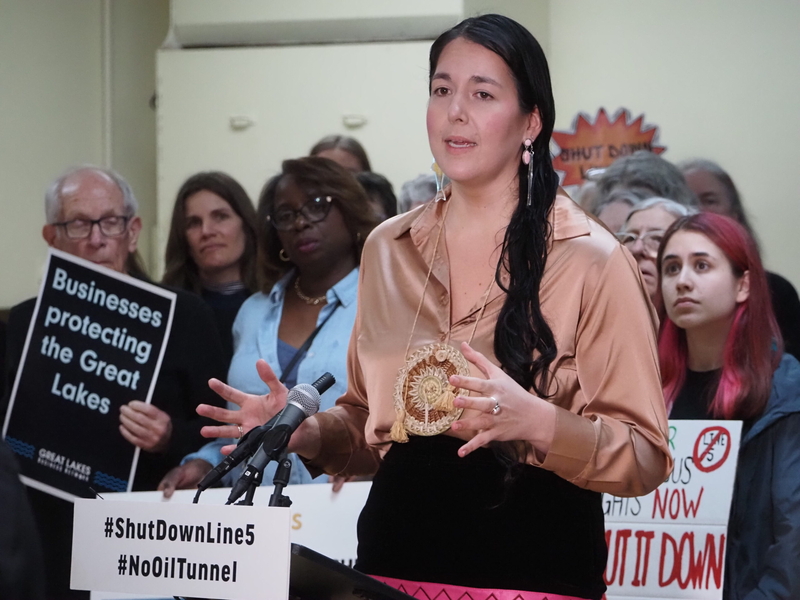
Bay Mills Indian Community President Whitney Gravelle said the ruling was “a reminder that when people stand together with courage and conviction, change is possible.”
“For years, Tribal Nations, communities, and thousands of people across the country have raised their voices to protect the Great Lakes,” Gravelle said in a statement. “This decision gives us another opportunity to honor our treaty rights, protect our waters, and consider the generations who will inherit this place.”
Gravelle said the Straits of Mackinac were not simply a route for an oil pipeline “to be abused. They are sacred waters, the heart of creation for Anishinaabe people, and a source of life for millions.”
“Some things are simply too sacred to be buried beneath a tunnel,” Gravelle added. “Our work continues, and we remain committed to protecting the Great Lakes for generations to come.”
Earthjustice and the Native American Rights Fund represented the various Tribes in challenging the permit.
“This ruling is an inspiring victory for Tribes, environmental advocates, and everyday people who’ve joined hands in the fight to stop the dangerous Line 5 tunnel project,” Earthjustice Senior Attorney Adam Ratchenski said in a statement. “The Court’s decision upholds the bedrock principles of Michigan environmental law. Enbridge’s application to build the tunnel now heads back to the Michigan Public Service Commission, where we will be prepared with robust arguments in defense of Tribal rights and the Great Lakes.”
Lansing, MI