Former state agency directors call new Medicaid fraud task force a ‘sham’
Jul 31, 2026 | 5:57 pm ET
Description
Two former directors of the state agency that oversees Medicaid fraud investigations are raising objections to a new Medicaid fraud task force led by Attorney General Brenna Bird. (Stock photo by zimmytws/Getty Images)
Two former directors of the state agency that oversees Medicaid fraud investigations said Friday that Iowa Attorney General Brenna Bird’s newly formed fraud task force is “political theater.”
Dean Lerner and Kevin Techau, who served as directors of the Iowa Department of Inspections and Appeals under Democratic governors Tom Vilsack and Chet Culver, said Bird, a Republican, is “leaving millions of dollars on the table” by not working to fully fund Iowa’s existing Medicaid Fraud Control Unit.
Bird, who is seeking reelection this year, heads the newly formed, 11-member Medicaid Fraud Elimination Task Force, which was created to develop recommendations on how to reduce fraud to stop incidents of fraud in the taxpayer supported healthcare program.
Gov. Kim Reynolds signed an executive order July 1 creating the task force, which is expected to produce a final report that will be submitted by Oct. 29, 2026.
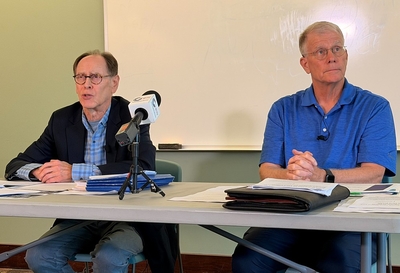
Techau, who has served as the U.S. Attorney for Northern District of Iowa, and Lerner held a press conference Friday at which they described the task force as a “sham.” The two said Iowa’s Medicaid Fraud Control Unit, which was created in the 1970s and operates within the state agency they once headed, is best suited to address Medicaid fraud — in part because 75% of the cost of its operations is funded by the federal government.
Also, Techau said, for every dollar the unit spends, it generates $4 to $5 in revenue that’s collected through reimbursements and civil and criminal penalties.
Calls and emails to Bird’s office were not returned Friday.
Lerner said Friday that part of the problem is that Iowa has chosen not to fully staff its Medicaid Fraud Control Unit. That decision, he said, limits the number of cases that can be investigated and the amount of taxpayer dollars that can be recovered.
While each of the 50 states has its own Medicaid Fraud Control Unit, a 2024 report from the Office of Inspector General at the U.S. Department of Health and Human Services says that Iowa has a history of providing far less funding for its MFCU than states with comparable levels of Medicaid spending.
Data from the National Association of Medicaid Fraud Control Units indicates there were five states that in 2022 had Medicaid budgets within $1.5 billion of the $8 billion spent by Iowa Medicaid that year.
All five of those states had MFCUs with budgets that were two to four times that of Iowa’s unit. In fact, some states with far smaller Medicaid budgets than Iowa spent significantly more on their fraud control units.
The latest data from the national association is from 2025, and indicates Iowa still lags behind many states with similar or smaller levels of Medicaid spending:
Iowa: 10 MFCU staffers to oversee $8.3 billion in Medicaid spending.
Arkansas: 23 MFCU staffers to oversee $8.9 billion in Medicaid spending.
Kansas: 16 MFCU staffers to oversee $6.5 billion in Medicaid spending.
Mississippi: 35 MFCU staffers to oversee $7.7 billion in Medicaid spending.
Utah: 22 MFCU staffers to oversee $5.3 billion in Medicaid spending.
Kentucky: 16 MFCU staffers to oversee $6.4 billion in Medicaid spending.
Techau: Better data analytics can uncover fraud
In 2022, the inspector general reviewed the work of Iowa’s MFCU and praised it for operating effectively but noted the unit was leaving positions vacant and was not maintaining its own approved staffing levels.
The inspector general said adding more staff “would ultimately enhance the unit’s ability to protect the Medicaid program and its beneficiaries,” but state officials disagreed and argued current levels of staffing were adequate.
“Iowa doesn’t need another task force to tell us how to fight Medicaid fraud,” Techau said Friday. “We already have trained investigators, a Medicaid Fraud Control Unit, the Iowa False Claims Act, whistleblower protections and experienced federal, state and local law-enforcement partners. The question is whether Iowa is willing to adequately fund them and aggressively use the tools we already have.”
Lerner and Techau made several recommendations on how Iowa could better combat Medicaid fraud, including:
— Staffing: Fully fund Iowa’s Medicaid Fraud Control Unit with the full number of authorized qualified investigators and staff.
— Analytics: Modernize investigative technology and data analytics to better detect suspicious billing patterns that point to Medicaid fraud.
— Hotline: Restore and actively promote a statewide Medicaid Fraud Hotline.
— Partnerships: Fully empower the Iowa Auditor of State and other independent agencies to investigate fraud.
Fraud investigations, Lerner said, are built by experienced investigators using whistleblower information, audits, referrals and sophisticated analysis of billing data. “Iowa should invest in the people and tools that actually do that work,” he said.
Techau and Lerner also questioned the “political” nature of the new task force, noting that Bird, whose office doesn’t handle Iowa’s Medicaid fraud investigations, heads the panel, while Auditor of State Rob Sand, a Democrat now running for governor, was not given a seat on the task force.
Des Moines, IA