Kanawha County Commission wants more information as WV DEP considers permit for Clean Seas
Jul 31, 2026 | 6:00 pm ET
Description
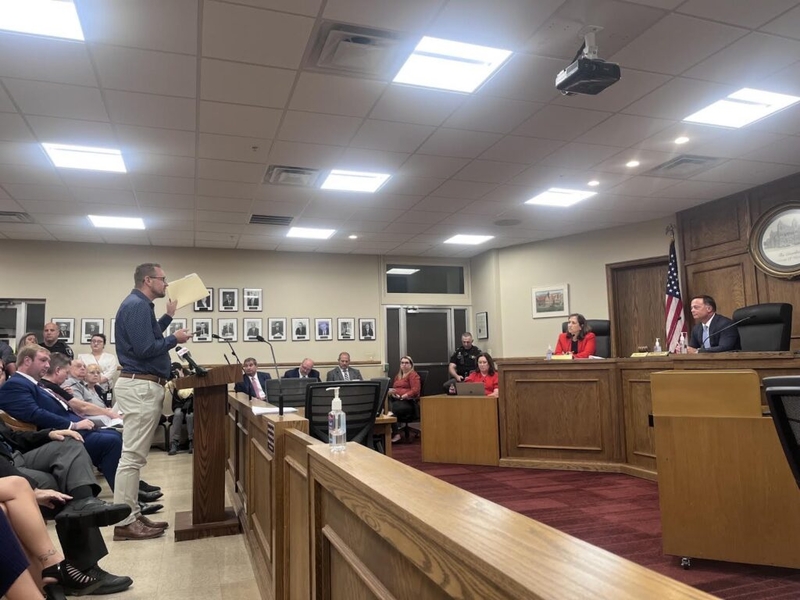
Eric Caruthers, a Belle resident who is concerned about the proposed Clean Seas project, speaks at the Kanawha County Commission meeting on July 23, 2026. Caruthers — along with several of his neighbors — delivered a petition signed by nearly 1,000 residents opposing the pyrolysis plant to commissioners Ben Salango and Natalie Tennant. (Photo by Caity Coyne | West Virgina Watch)
Members of the Kanawha County Commission sent a letter to the state Department of Environmental Protection this week urging it to refrain from issuing an air quality permit for a proposed “advanced recycling” plant until the company behind the project can provide more details to confront concerns raised by residents.
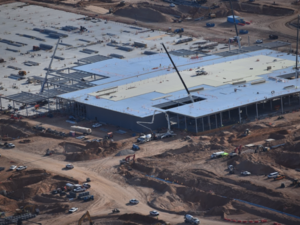
A public comment period for the project — which, as proposed by company Clean-Seas West Virginia, would build a plastics pyrolysis facility at the old 84 Lumber building near Belle, in eastern Kanawha County — was closed on Monday. The DEP has already granted a draft permit for the facility, which would operate by burning plastic feedstock to create pyrolysis oil, synthetic gas and solid residue to be used and sold for petrochemical manufacturing purposes.
Residents in the region have been sounding the alarm on the project — and the company proposing it — for nearly a year. They worry about potential emissions particularly as the proposed location sits only a few hundred feet from Riverside High School, Midland Trail Elementary School, residential neighborhoods and a new offroad trail system meant to increase tourism opportunities in the region.
Last week, several residents appeared at the Kanawha County Commission meeting. Armed with a petition signed by nearly 1,000 residents, they asked commissioners Ben Salango and Natalie Tennant to hear their concerns and let Clean Seas know residents are not happy with the way they’ve operated and are deeply concerned about the potential health and community impacts, especially for vulnerable populations.
“My son is a combat veteran who suffers from COPD from his time in Iraq, and he lives right behind me. This is going to hurt him. It’s going to hurt me as an older person. It’s going to hurt little children,” said Laura Wellstead, who lives a few miles down the road from the proposed plant in London. “What we’re asking you is to stand up for those of us who do not have access to people who wield the levers of power and authority in this state. To stand up for us in Kanawha County, to stand up for the elderly and the children and the disenfranchised, so that we can be proud of our state and say, ‘Come here! It’s beautiful. The air is fresh, and we welcome you, as West Virginians, to our community.’”
Several residents made similar requests at that meeting. They spoke about how difficult it’s been to get answers from the company about the proposed project. They cited Clean Sea’s previous, mostly failed, attempts at building similar facilities in other places. They raised alarms about the company’s questionable financials and what impact such a project could have on a community that’s attempting to rebrand itself as part of the tourism “gateway” to the New River Gorge National Park.
Salango, president of the Kanawha County Commission, told members that while he shared their concerns, the powers of the commission were limited. He cited a policy implemented about 40 years ago that stops the county from enforcing zoning in unincorporated areas, which includes most of eastern Kanawha County.
“So we can’t zone. We can’t. Commissioner Tennant and I couldn’t come up with an ordinance right now that says no plastic emissions or no recycling plants in that zone if we wanted to,” Salango said. “They took that away from us. That was the voters.”
In the letter to the DEP, Salango and Tennant — the third position on the Kanawha County Commission is currently vacant — pushed the DEP to evaluate several factors before moving forward with permitting, including:
- Whether the air dispersion modeling provided by Clean Seas reflects potential worst-case operating conditions
- If emissions estimates included in the air quality permit application are based on reliable data that is comparable to other, similar facilities
- Whether the pollution control measures touted by Clean Seas are sufficient enough to protect children at the nearby schools and those who live in neighboring communities
- What enforcement measures exist to verify actual emissions after the plant begins operations
Eric Caruthers, a Belle resident who has taken the helm of organizing his community to seek these answers and more about the proposed plant, said it’s critical not only for those who live nearby but the region as a whole to ensure that Clean Seas would bring a net positive to the area.
Based on what they know so far, though, that doesn’t seem to be the case.
“We all want economic development. We want jobs, we want new industries and opportunities. We just aren’t convinced that this kind of development will be good for us — or anyone,” Caruthers said. “We’ve done our research and we have a lot of concerns. This isn’t the first time this company has tried to open something like this, and they don’t really have a track record with projects that we can trust. On top of that, what they’re proposing to bring here — it really could harm us. We don’t need more polluters in a place already known as ‘Chemical Valley’.”
A report published this week by the Ohio River Valley Institute lays out several of the concerns shared by Caruthers and his neighbors about previous ventures taken on by Clean Vision Corporation, which is Clean Seas’ parent company.
Per the report, Clean Vision has proposed opening at least 14 plastics pyrolysis facilities worldwide since 2020. As of December 2025, only two of those operations were functional. Filings indicate that the ones that were operational have also scaled back services due to infrastructure needs and a lack of interested funders.
In those projects and in West Virginia, Clean Vision has repeatedly realigned projects, walking back previously promised timelines, changing the proposed scopes of projects and, in many cases, abandoning them altogether, per the report.
Caruthers said this doesn’t inspire hope for how they would operate in Kanawha County if they’re given approval to move forward.
“We want stable jobs. If we’re going to bring new industries, new companies here, we want to make sure that they’re stable and coming from (a company) that has experience and knows what it’s doing and can handle its financials,” Caruthers said. “No one that I know has seen that kind of evidence or assurance come from Clean Seas.”
Clean Seas initially came to West Virginia in 2023, when then-Gov. Jim Justice entered the state into a memorandum of understanding with the company, which promised to invest $50 million to build up the pyrolysis plant. Around that time, the company was making similar agreements with governments in Massachusetts, Arizona, Michigan and Puerto Rico.
None of those other projects appear to have advanced, per the ORVI report.
In 2023, the company asserted that operations at the Belle facility would be running by 2024, where it would process 100 tons of plastic per a day with plans to eventually scale up to 500 tons per a day.
By 2024, the plant was not yet operating. The company had yet to start the permitting process necessary to begin operations. That July, however, the West Virginia Economic Development Authority granted a $15 million bridge loan to Clean Seas to get the facility off the ground.
Throughout 2025 and into 2026, the project saw delay after delay announcement come from the company. The proposed scale of the project — as well as its predicted start date — changed almost quarterly.
Financially, the ORVI report paints an overall concerning picture for Clean Vision. The company currently has two operational pyrolysis facilities: one in India and another in Morocco. Since operations began at those locations in 2023, filings with the federal Securities and Exchange Commission show the company has generated less than $614,000 in revenue from pyrolysis activities, with the income shrinking year over year. Meanwhile, it’s accumulated nearly $58 million in deficits due to operational losses and other growing expenses.
Morgan King, the climate manager for West Virginia Citizen Action Group, said the company’s financials and the fact that taxpayer dollars have gone to this project raise grave concerns for residents in eastern Kanawha County.
“People don’t want their tax dollars going to a company that can’t even really prove it knows what it’s doing,” King said. “They’re really frustrated, and they do want to see new things come to the area but not like this, and not as some kind of experiment.”
And on top of being concerned over the financials, King said there are residents who — because of broken promises from numerous would-be developers in the past — don’t believe the pyrolysis plant will really happen.
“They’ve seen this before, so many times. Someone comes in promising jobs and a new industry, whatever that industry is, and it just never happens,” King said. “There are a lot of residents who don’t really believe this is real, but don’t want to see any more taxpayer dollars going toward it either way.”
For Caruthers, it’s difficult to ignore the history of Kanawha County’s “Chemical Valley.” The region was once thriving — nearly a metropolis in West Virginia terms. Chemical manufacturers like DuPont dominated the region, giving hundreds of locals good-paying jobs and contributing to building up the community through investing in local schools, roads and other amenities.
But over the years, Caruthers said, operations shrunk. Job opportunities dwindled. When the economic boons slowed, residents were left in communities with little else to show for that boom period other than poor air quality and manufacturing and chemical “eye sores.”
Now, he said, residents want to ensure they’re not watching history repeat itself. For the past few years, investments have come to the communities off the Midland Trail that gave residents hope.
The new Appalachian Outlaw Trails are paving the way for a new tourism-based economy. There are discussions occurring about how to capitalize on the region’s proximity to the New River Gorge and other tourist attractions.
A pyrolysis plant, Caruthers said, puts the potential benefits of these investments at risk.
“No one wants to see something like that right off the road, next to two schools, when they come to enjoy outdoor tourism,” Caruthers said. “The company is not cleaning the area up, they’re just coming inside and adding equipment, so it’s going to be an eyesore. It’s going to be a smell sore. It’s going to be a chemically-induced emissions sore. You’re going to have people coming to the trails, getting exposed to this, and then not wanting to come back.”
And further, Caruthers doesn’t feel that his community should be used as an economic experiment for alleged recycling technology brought by a company that has a questionable background in successfully running such endeavors.
“That’s not the kind of economy or investment that we’re asking for down here, and we deserve better than being guinea pigs for this company that hasn’t made any real effort to talk to us about our concerns or provide information that we can trust,” Caruthers, 45, said. “Since as long as I can remember, it’s felt like it’s just one bad thing after another for this portion of the county and we’re tired of it. We don’t want to live with the fallout of something we don’t support, so we need people to hear us and join this fight.”
Charleston, WV