Maine solar companies ask Sen. Collins to protect federal clean energy tax credits
Jun 03, 2025 | 1:30 pm ET
Description
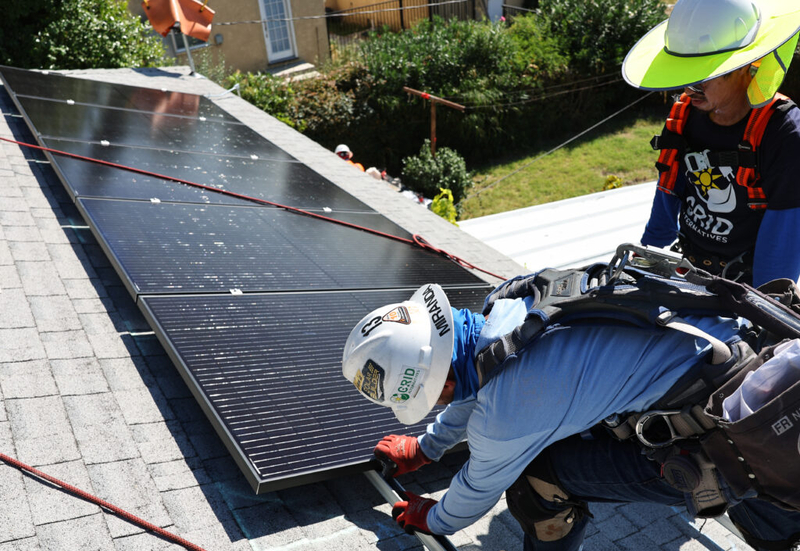
Sal Miranda (C) and Tony Chang of the nonprofit GRID Alternatives install no-cost solar panels on the rooftop of a low-income household on October 19, 2023, in Pomona, California. (Photo by Mario Tama/Getty Images).
Members of Maine’s solar and energy storage industry are asking U.S. Sen. Susan Collins to protect the clean energy tax credits that could be scaled back in the congressional spending bill.
“We realize that Congress has an important obligation to cut spending to balance the budget and reduce taxes,” wrote nearly 70 industry representatives in a letter Collins, who serves as Republican chair of the Senate Appropriations Committee. “However, cutting solar tax credits would be counterproductive.”
The spending bill that narrowly passed the U.S. House of Representatives late last month seeks to roll back the clean energy tax credits created in the Biden administration’s 2022 Inflation Reduction Act. The bill has been sent to the Senate, where it will likely face changes. President Donald Trump, who late last week released a more detailed version of his spending proposal, has said he backs the House version of the “big, beautiful bill.”
The letter from Maine’s solar industry cites three credits in particular they would like Collins to protect. The incentives specifically support manufacturing and the deployment of solar panels. Manufacturing credits attract investment, the letter argues, so removing those would “pull the rug out from under” solar companies in the U.S, such as the 62 currently operating in Maine.
Additionally, industry leaders pointed to recent studies that found clean energy tax credits could lower electricity bills, while repealing them could increase energy costs for ratepayers.
A spokesperson for Collins told the Morning Star that the senator supports Maine’s energy producers, pointing to investments into domestic battery manufacturing included in the Bipartisan Infrastructure Act, as well as legislation she co-authored to support grid-scale energy storage research and development. However, she said Collins “is not a member of the Senate Finance Committee, which has jurisdiction over these tax credits.”
“This issue is one of many the Senate is going to have to consider as it puts together its reconciliation bill,” she added.
Electricity prices in Maine have increased in recent years, in part due to the state’s reliance on natural gas, which has seen price swings from global events like Russia’s invasion of Ukraine.
South Portland-based ReVision Energy often sees customers who install solar panels with hopes of lowering their energy bills, said Lindsay Bourgoine, director of policy and government affairs.
In recent years, those customers have been able to take advantage of the Residential Clean Energy Credit, which covers 30% of the costs of qualified new clean energy equipment installed on a residential property. While that credit was designed to run through 2032, and then gradually decrease after, the House budget plan would move up that expiration date to 2026.
Though interested homeowners are cautioned about the potential loss of those credits, Bourgoine said solar is still a wise investment — even if initial costs go up.
With electricity demand expected to double in Maine by 2050, industry leaders outlined for Collins why solar is the fastest and least expensive way to add energy to the grid. A 2024 report from the Federal Energy Regulatory Commission shows that solar accounted for more than 80% of the new capacity installed nationwide that year.
“If the solar and storage tax credits are reduced or eliminated, it would be devastating to the solar industry, which would cause a ripple effect of negative consequences for Maine and our country,” the industry representatives wrote in the letter.
This story was updated to include a comment from U.S. Sen. Susan Collins.

Augusta, ME